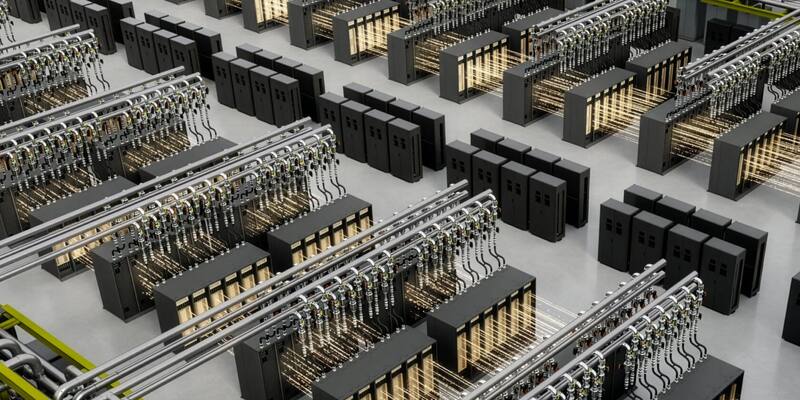
Rows of liquid-cooled AI server racks in an Nvidia illustration released for the OCP Global Summit, October 2026 (illustrative). Image: Nvidia
When a fault hits the power grid, a giant AI data centre can vanish from it in an instant, and that sudden loss of demand can push the whole grid off balance. Google, Meta, Microsoft and Nvidia now say their AI computers will stay on the line. The four companies published a grid specification through the Open Compute Project (OCP), the industry group for open data centre designs, as Nvidia opened up its next-generation Vera Rubin rack designs at the OCP Global Summit in San Jose on October 12.
Why AI data centres worry grid operators
The specification, written by engineers from the four companies, is blunt about the problem. AI has produced data centres that often use “hundreds of MW” of power, it says, and in 2024 a single event in North America saw 1,500 megawatts of load drop off the grid at once. A “similar event of even larger magnitude” followed in the US Eastern Interconnection on July 22, 2026, according to the document.
When that much demand disappears in a moment, frequency and voltage on the grid jump. The specification warns that if “massive blocks of demand disconnect unexpectedly during a grid fault”, the imbalance “can cause frequency excursions and possibly lead to cascading grid failures”. Utilities and regulators have been drafting tougher rules for large loads in response, and the companies say their spec follows proposals from the grid operators MISO and ERCOT, which runs most of Texas’s grid.
What Google, Meta, Microsoft and Nvidia are promising
The core commitment covers the computing part of a data centre, which the document puts at about 70% to 90% of its total load. During a voltage dip, the servers must keep drawing power from the grid for a set time rather than switching straight to backup. Once voltage recovers, they must climb back to 90% of their previous load within two seconds, so the grid doesn’t suffer a second shock.
There are gaps. Cooling systems are left out, because the companies say making them ride through faults is “impractical” without new hardware or extra energy storage, and they decline to give a timeline. For existing servers, the fix may come from firmware updates to rack power supplies, which they say each manufacturer still has to investigate. A follow-up specification will deal with how fast AI loads can swing up and down.
A second document, the Open Data Center Specification v0.7, from AMD, Google, Meta and Nvidia, sets out a shared blueprint for how AI data centres are laid out, powered and cooled.
Nvidia opens its Vera Rubin racks
Nvidia also gave its Vera Rubin rack and compute tray designs to OCP through its open MGX architecture, so other manufacturers can build compatible systems. The updated MGX 1.2 specification supports racks drawing up to 250 kilowatts, with liquid cooling throughout and a liquid-cooled 5,000-amp busbar to carry the power.
It includes a rack built around Nvidia’s Vera CPU, which the company says is designed for AI agents: running tool calls, orchestration and sandboxed code while the GPU racks handle training and inference. Nvidia also released open source software for running these “AI factories”, including a tool that stress-tests GPU clusters before a training run starts, and said Meta will build its next Vera Rubin clusters on Nvidia’s Spectrum-6 network switches.
A new plug for faster AI networks
Separately, Nvidia and Cisco announced USFP, a new size of plug-in optical module that carries 400 gigabits per second on each lane. The companies say it offers four times the bandwidth density and about 1.3 times the power efficiency of today’s 200Gb/s-per-lane modules, and they plan an open industry specification with TE Connectivity and Amphenol. Gilad Shainer, a senior vice president at Nvidia, summed up the pitch:
Building the world’s largest AI factories starts with rethinking the smallest of connections.
Gilad Shainer, senior vice president, Nvidia
The announcements land on the same day Microsoft unveiled its Maia 300 chip, which it says will run most of its own AI from 2027, and a day after a Senate investigation found that Amazon, Google, Meta and Microsoft aren’t paying the full cost of their AI data centres.
Why it matters
AI data centres are now big enough to shake the grids that everyone else depends on, and the companies building them have put in writing how their computers should behave when the grid stumbles. The commitments are voluntary, leave cooling out and will take time to reach existing sites, so utilities and regulators are likely to keep writing their own, stricter rules.
Sources: OCP, Interface Specification Between Hyperscalers and Utility Grid for Disturbance Performance; OCP, Open Data Center Specification v0.7; Nvidia blog; Nvidia and Cisco press release.
Latest Chips news