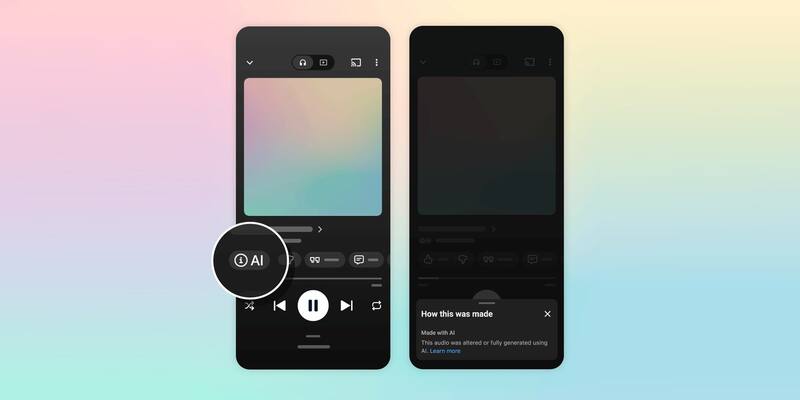
YouTube’s artwork showing the new AI label on the YouTube Music player and the “How this was made” panel it opens. Image: YouTube
YouTube Music will now tell you when the song you are listening to was made by AI. The company said on Wednesday that it is rolling out labels on the player for tracks "created primarily using generative AI", such as a song whose composition and vocals both came from a generative model.
The move puts a visible flag on AI music at a time when streaming services are being swamped by it, and when the worst abuses are ending up in court.
What the AI label looks like
The label sits directly on the player page, under the song title. In artwork YouTube released with the announcement, it is a small "AI" badge with an info icon. Tapping it opens a panel headed "How this was made", which reads "Made with AI" and says the audio "was altered or fully generated using AI", with a link to learn more.
YouTube says the labels will also come to the main YouTube app, though it did not give a date. Its post says the rollout starts "today" and does not list countries or say whether every listener gets it at once, so it may take a while to reach everyone.
How YouTube decides a song is AI
The company says it is "teaming up with music partners and using our own detection tools" to find AI-generated tracks, applying the same labelling principles it already uses for videos across YouTube.
Those principles are set out on its Help Center page on "How this content was made" disclosures. A "Made with AI" label means content has been "meaningfully altered or synthetically generated" with generative AI tools. It can appear when a creator ticks the AI disclosure in YouTube Studio, when the content was made with YouTube's own AI tools, or when it carries Content Credentials (C2PA version 2.1 or later) showing the whole thing was made with AI. Where nothing is disclosed, YouTube says it "may" add a label itself "to reduce the risk of harm to viewers". Music partners have a separate set of disclosure guidelines.
The threshold matters. YouTube is labelling songs where AI "played a significant role", not every track that touched an AI tool, so a song with an AI-assisted mix or a few generated sounds may not be flagged. YouTube has not said what share of AI involvement tips a track over the line.
A flood of AI tracks
The scale of the problem is clearest at Deezer, one of the few services that publishes figures. In July, it said nearly 90,000 fully AI-generated tracks were arriving every day, more than half of all new uploads at their June peak. Listening is a different story: Deezer says those tracks make up between 1 and 3% of total streams, and that up to 85% of the streams they drew in 2025 were fraudulent.
That fraud is now a criminal matter. Earlier this month a North Carolina man who used bots to play his AI-generated songs billions of times was sentenced to 18 months in prison in the first US criminal case over streaming fraud. Meanwhile, the tools keep getting easier: Suno can now read your words aloud and set them to music in one take.
What the labels don't do
A label tells you what you are hearing; it does not keep it out of your queue. YouTube's announcement says nothing about a setting to hide or skip AI-generated tracks, or about changes to how they are recommended or paid. It also leaves open how well its detection catches songs that are not disclosed, which are exactly the ones a bad actor would upload.
YouTube frames the change as giving listeners what they asked for. "Our listeners have told us they want transparency when they're hearing an AI-generated track," the company wrote.
Why it matters
With AI songs at times outnumbering human ones among new uploads on at least one major service, a label on the player is the first time many YouTube Music listeners will be told what they are hearing. How useful it is will depend on how many undisclosed AI tracks YouTube's detection actually catches, and whether listeners get a way to act on the label, not just read it.
Sources: YouTube Blog, YouTube Help Center, Deezer.
Latest Google news