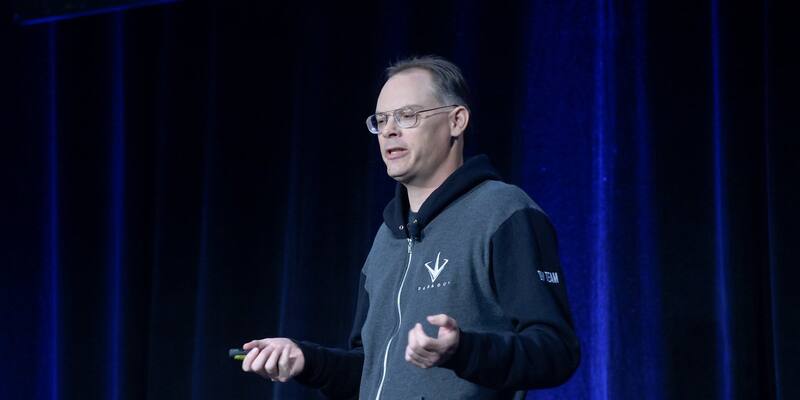
Epic Games chief executive Tim Sweeney speaking at the Game Developers Conference in San Francisco in March 2016. Image: Official GDC / Wikimedia Commons, CC BY 2.0, cropped
.jpg)
The company behind Fortnite has told the team making its Disney game to stop writing code by hand. Epic Games has delayed the unannounced shooter, which features Marvel and Star Wars characters, and moved it to an “AI-first” production model built on Anthropic’s Claude, Bloomberg reported on Monday. Hours later, chief executive Tim Sweeney confirmed a “huge pivot” across the company.
According to Bloomberg, one of the game’s directors told staff in an internal message that there would be “no more handwritten code” and that all of its art would be “generated with full AI workflows”. People would manage and guide the work rather than produce it. The game had been due in March 2027; Bloomberg says no new date has been set.
“Maximum AI acceleration”
Sweeney did not dispute the report. In a post on X on Monday evening, he described the change as company-wide rather than a fix for one late game:
We have a huge pivot underway here at Epic, moving developers around to retool for maximum AI acceleration.
— Tim Sweeney (@TimSweeneyEpic) October 12, 2026
The aim isn't to do the same stuff with fewer people, but to enable everyone here to build MORE and BETTER stuff, and to bring the benefits to all teams using Unreal.
Jake Jones, Epic’s communications director, told Bloomberg the company is “embracing AI-accelerated development, led by Epic developers who are the visionaries and creative drivers for everything we do”. Neither Epic nor Disney has commented on the game’s new timing, and Anthropic hasn’t commented on its role.
Why the Disney game slipped
The shooter is part of the deal Disney struck in February 2024, when it agreed to take a $1.5 billion stake in Epic and build a games and entertainment universe connected to Fortnite. Bloomberg says progress on the shooter was slower than planned, partly because Epic underestimated how many people it would need.
That shortfall follows a hard year for the company. In March, Epic laid off more than 1,000 people, about a fifth of its staff, after Fortnite engagement fell. Sweeney said then that Epic was “spending significantly more than we’re making”, and the company said the cuts were not related to AI.
Shock inside Epic
The change landed badly with some of the team. Bloomberg says the announcement left developers stunned on a video call last week, and that some joked about whether they should ask Claude to fix its own mistakes. It is not clear how Epic will check AI-generated code and art before it reaches players, or how much of the existing work will be redone.
It is the most direct move yet by a major games publisher to hand a big-budget game to AI tools. Smaller creators have already shown how far the tools can go: a sports creator vibe-coded a trivia game in 12 hours that drew a million players, and Claude Opus 5.5 rebuilt Pokémon Red from a single prompt. Google, meanwhile, launched Playground, which turns a sentence into a shareable game, last week.
What it means for Unreal
Sweeney’s post points beyond Epic’s own games. Unreal Engine powers a large share of the industry’s big releases, and his promise to “bring the benefits to all teams using Unreal” suggests the tools Epic builds for itself will reach outside studios too. At its State of Unreal keynote in June, Epic said Unreal Engine 6 will build Claude and Gemini into the editor, with early access aimed at the end of 2027.
That puts Epic on both sides of the shift: a studio betting its own Disney blockbuster on AI, and the company selling the engine that thousands of other studios will use to do the same.
Why it matters
Epic is not a small studio testing a tool: it makes Fortnite, runs a major PC store and sells the engine much of the industry builds on. If its Disney game ships with AI writing the code and making the art, other publishers will feel pressure to follow, and players and developers will get their first real test of whether an AI-first blockbuster holds up.
Sources: Bloomberg, Tim Sweeney on X, The Walt Disney Company, AP via PBS NewsHour.
Latest Anthropic news