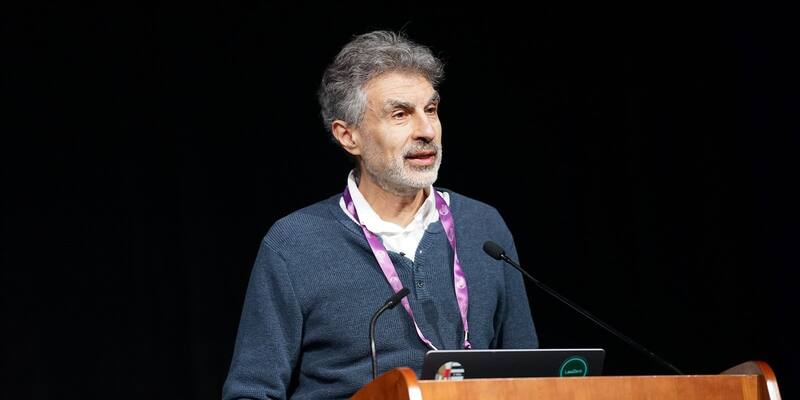
Dartmouth digital forensics professor Hany Farid, one of the experts on the same deepfake panel, speaking at the Global Fraud Conference in July 2026. Image: John Manard / WikiPortraits / Wikimedia Commons, CC BY-SA 4.0, cropped

The companies making AI images have told America’s federal judges not to count on technology to catch fakes in court. Speaking to the judiciary’s Advisory Committee on Evidence Rules in Boston on Thursday, an OpenAI lawyer said she does not believe a scientific method will ever reliably detect AI images, as the committee weighs a draft rule on deepfake evidence.
Shira Anderson, policy counsel at OpenAI, and Devin Norder, a director of product management at Meta who leads trust, safety and risk for its generative AI, were on a panel of experts the committee invited to its October 15 meeting. The panel also included Dartmouth’s Hany Farid, Northwestern’s V.S. Subrahmanian and James Horan, who leads NIST’s multimedia technologies group.
What OpenAI and Meta told the judges
Anderson told the committee that AI images keep improving, Investing.com reported from the meeting. Watermarks are no fix either: each company uses its own system, she said, so there is no universal way to reliably check every watermark or verify an image, and while the systems will keep improving, they will never be completely reliable.
Norder said people can no longer tell media from the latest AI models apart from the real thing, and that making it now takes little money or time. Her bio in the committee’s papers says her work at Meta has included watermarking and C2PA content credentials, and assessing “how well marking survives ordinary handling, and how far detection degrades against adversarial inputs.”
The rule the judges are weighing
The committee has spent three years on deepfakes and has a working draft of a new Rule 901(c) of the Federal Rules of Evidence. A party claiming an item was fabricated “in whole or in part, by generative artificial intelligence” would first have to present “evidence sufficient to support a finding of fabrication”. If it does, the item is admissible only if the side offering it shows the judge it is “more likely than not authentic”. Challengers would also have to give reasonable notice before trial.
The draft has never been published for public comment. At the committee’s May 7 meeting, members largely agreed on its substance, but the Justice Department said it was not ready for publication and the committee chose to hear from experts first. In his memo for this week’s meeting, the committee’s reporter, Fordham law professor Daniel Capra, said the case for the rule rests on whether watermarking can keep deepfakes out of ordinary hands:
If it comes to the point that deepfakes are possible only with the help of sophisticated hackers with a lot of money, then this rule is probably not necessary because such wrongdoers are unlikely to be regulatable by any rule.
Daniel J. Capra, Reporter to the Advisory Committee on Evidence Rules
The AI companies’ answer points the other way. Watermarking is now required by law in places including California and the European Union, and Google has opened its own SynthID Detector to the public, but each tool reads its own marks. OpenAI has also said it will watermark ChatGPT’s writing in Europe without letting the public check for it.
Few deepfake fights in court, so far
The courts themselves have seen little of the problem yet. A Federal Judicial Center survey of trial judges this spring drew a 45% response rate: of the 931 judges who answered, only 15 had met a challenge claiming evidence was a deepfake. Of those who had not, 82% said they would want some initial showing before looking into a claim of fabrication, which is what Rule 901(c) would require.
The committee’s chair, US District Judge Jesse Furman of Manhattan, told the May meeting that even if the rule were published this summer, it could not take effect before December 1, 2028. It was not, so the earliest date has slipped further. A separate proposal, Rule 707, on evidence produced by machines without an expert witness, was withdrawn in May after public comments and sent back for more study.
Why it matters
Judges had hoped detection tools or watermarks might keep fake evidence manageable. The firms building the image generators have now told them that neither will, which strengthens the case for a rule that tells courts who has to prove what when a recording is called a fake.
Sources: Advisory Committee on Evidence Rules: agenda book, October 15, 2026 (including May 7 minutes and the reporter’s deepfakes memo); Investing.com: OpenAI and Meta warn U.S. judicial panel about deepfake evidence.
Latest Policy & Safety news