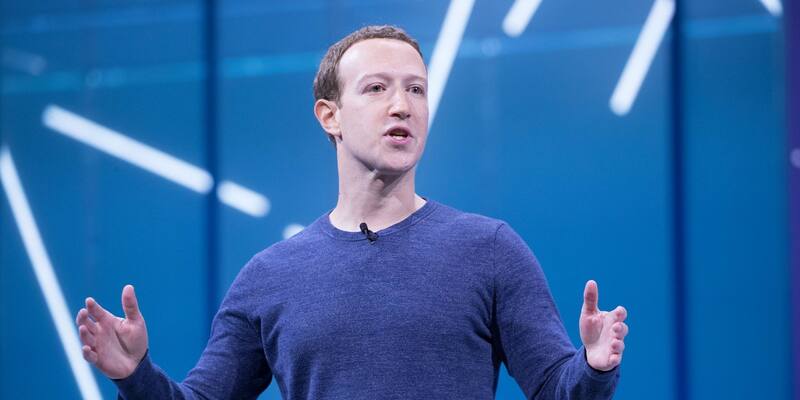
Meta CEO Mark Zuckerberg on stage at the company’s F8 developer conference in 2018. Image: Anthony Quintano / Wikimedia Commons, CC BY 2.0, cropped

Meta is spending so much on artificial intelligence that it is creating a whole new kind of share to help pay for it. Alongside third-quarter results that beat its own forecast, the company said on Wednesday it will create a publicly listed, non-voting Class C stock, giving it a new way to raise money, pay staff and fund deals while Mark Zuckerberg keeps control.
Revenue rose 26% to $64.60 billion, above the top of the $61 billion to $64 billion range Meta forecast three months ago. But a $9.89 billion legal charge cut operating income by more than a third, and heavy data centre spending pushed free cash flow below zero. Meta’s shares still rose about 3% in after-hours trading.
A new share class built for the AI race
Shareholders have already approved the stock by written consent, and Meta is blunt about why: “the scale of investment required to compete, sustain growth, expand infrastructure, and pursue new strategic initiatives amidst the AI transformation taking place in the industry is significant,” its release says, and the new class will give Meta “the ability to finance its growth.”
Once Meta’s new charter takes effect on January 19, 2027, every Class A and Class B shareholder will get one Class C share for each share they hold, as a one-time dividend. Meta expects Class A shares to trade as if after a two-for-one split, and says no one’s voting power changes. Zuckerberg controls most of the votes through Meta’s 10-vote Class B shares, so stock issued without votes can raise money or pay for deals without diluting his grip.
A Founder Alignment Agreement filed with the SEC stops Zuckerberg simply cashing in. Only 20% of the Class C shares he and his permitted transferees receive will be freely saleable. To sell the other 80%, they must sell or convert a matching Class A or Class B share, so he “generally cannot obtain liquidity in a significant majority” of the new stock without giving up votes.
“Our investments are paying off”
Zuckerberg credited Meta’s AI push, including the Muse AI agent and Muse Wonder, the model Meta says has caught OpenAI and Anthropic at the frontier:
We hit major milestones this quarter toward delivering personal superintelligence for everyone, including launching Muse and Muse Wonder, our first frontier model. Our investments are paying off, the core business is strong, and we’re seeing velocity across the board.
Mark Zuckerberg, Meta founder and CEO
Meta says AI is “already delivering substantial incremental advertising revenue through stronger engagement, better recommendations, and more efficient monetization.” Ad impressions rose 10% and the average price per ad 14%. The money going into Meta Superintelligence Labs, which builds Muse, is a slower bet: Meta admits it “will take longer to generate returns than those in our core business”.
The spending keeps climbing into 2027
Capital spending, including finance lease payments, was $34.91 billion in the quarter, more than the $32.79 billion of cash its operations brought in. Free cash flow was negative $2.12 billion, against positive $10.63 billion a year earlier.
For the full year, Meta now expects capital spending of $135 billion to $145 billion, narrowed from $130 billion to $145 billion by raising the floor. Much of it goes on sites such as Prometheus in Ohio, where it is wiring a million GPUs together. Meta gave no 2027 figure, saying it is still drawing up its budget but expects “to continue investing aggressively” in the core business and AI. Reality Labs, its headset and glasses unit, should lose around $15 billion next year, down from $18 billion to $19 billion this year, as money moves “primarily” to AI.
A $9.89 billion legal bill
Total costs rose 68% to $51.61 billion, including the $9.89 billion charge for Meta’s August agreement with 52 attorneys general over teen mental health and social media, which provides for payments of up to about $18.59 billion. Operating income fell 37% to $12.99 billion; without the charge it would have been $22.88 billion. Earnings were $3.83 a share, or $7.40 without the charge.
Meta raised its 2026 expense forecast to $175 billion to $179 billion to cover the charge and expects fourth-quarter revenue of $73 billion to $76 billion. It warned that more youth-related trials are scheduled in the US in the coming months.
Why it matters
Meta’s ads business is growing fast enough to beat its own forecast, but its AI building now costs more than its operations bring in, and it says the spending goes on into 2027. A non-voting share class gives it a new way to pay for that with stock, without loosening Zuckerberg’s control, and it lands squarely on several of the warning signs in our AI bubble guide.
Sources: Meta, “Meta Reports Third Quarter 2026 Results” (Form 8-K, Exhibit 99.1); Meta, Form 8-K on the Class C recapitalisation and Founder Alignment Agreement; Meta, second quarter 2026 results.
Latest Meta news