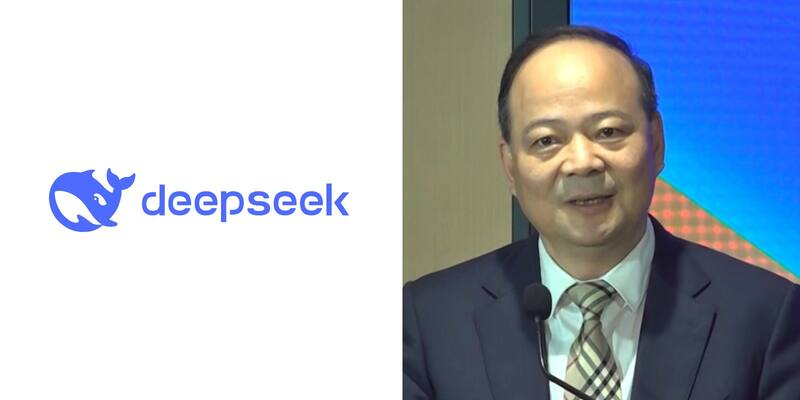
DeepSeek’s logo, and CATL founder and chairman Robin Zeng speaking in Hong Kong in December 2023. Image: DeepSeek (logo); China News Service, CC BY 4.0 (Robin Zeng, Hong Kong, December 2023)
DeepSeek has raised about 100 billion yuan, roughly $15 billion, in one of China’s largest ever private funding rounds, Bloomberg reported on Thursday, citing people familiar with the matter. Tencent and CATL, the world’s biggest maker of electric car batteries, founded and chaired by Robin Zeng, are among the largest investors. DeepSeek hasn’t confirmed the figure and hasn’t commented.
The money lands three days after the US government ordered every federal civilian agency to rip DeepSeek out of its computers, along with any product built on its AI.
The round kept growing
The Hangzhou lab raised its target at least twice as investors piled in, from 50 billion yuan (about $7.5 billion) to 80 billion yuan (about $12 billion), before settling on the final amount, according to Bloomberg. Earlier this month, CNBC reported that DeepSeek was seeking a valuation of about 500 billion yuan, or roughly $75 billion, and that carmaker Geely had also committed money.
It is DeepSeek’s second outside round in about four months. In June it raised about 51 billion yuan, roughly $7.4 billion, at a valuation of more than $52 billion. Founder Liang Wenfeng put in about 20 billion yuan of his own money, the largest single share, with Tencent adding about 10 billion yuan and CATL about 5 billion yuan, Chinese media reported. Both are back among the biggest backers this time.
Tencent, which owns WeChat, has been racing to secure computing power of its own: it is renting about 100,000 AI chips from Oracle for roughly $7 billion. CATL declined to comment when the round was first reported, and Tencent hasn’t commented.
What the money is for
DeepSeek has been spending more on data centres and open-source models as it prepares for a possible stock market listing, Bloomberg said. The company plans to restructure once the round closes and list in early 2027, people familiar with the plans have told Bloomberg, and Chinese media say it is talking to CITIC Securities about a listing on Shanghai’s STAR Market.
Much of that spending is about chips. Liang has told investors that switching to Huawei’s chips is one of DeepSeek’s biggest bets and that it “must succeed”, as part of a plan to train a model with 8 trillion parameters on Chinese hardware. Bloomberg has reported that DeepSeek is building a data centre in Inner Mongolia with at least 160,000 Huawei AI chips. Huawei’s chips are weaker than Nvidia’s, so DeepSeek needs far more of them, and far more money.
It has also been giving away the software that makes those chips usable, from TileLang support for Huawei’s Ascend chips to DeepInfer, the engine behind its own AI service, released on Tuesday.
Still a fraction of what US labs raise
For all its size in China, the round is small next to the money flowing to US rivals. OpenAI and Anthropic have each raised more than $100 billion, according to Bloomberg, which says DeepSeek still has considerably less financial firepower. Anthropic’s draft IPO filing showed it lost $80.7 billion in the first half of this year, more than five times DeepSeek’s entire new round.
DeepSeek has made a name for doing more with less. It rattled US tech stocks in early 2025 by showing a competitive model could be built for a fraction of what US labs spend, and this month it claimed its upgraded cheap model beats Claude Opus 5 at some coding tasks.
In the US, though, the doors are closing. Beyond the federal order, a growing list of states and countries ban DeepSeek on government devices.
Why it matters
A $15 billion round, backed by two of China’s biggest companies, means DeepSeek can now afford the data centres and Huawei chips its plans need. Washington is shutting it out of US government systems, but Chinese money is betting that DeepSeek can keep up with OpenAI and Anthropic on far smaller budgets and on Chinese chips.
Sources: Bloomberg (people familiar with the matter); CNBC; Meiri Shangbao via 10jqka (Chinese).
Latest More Labs news