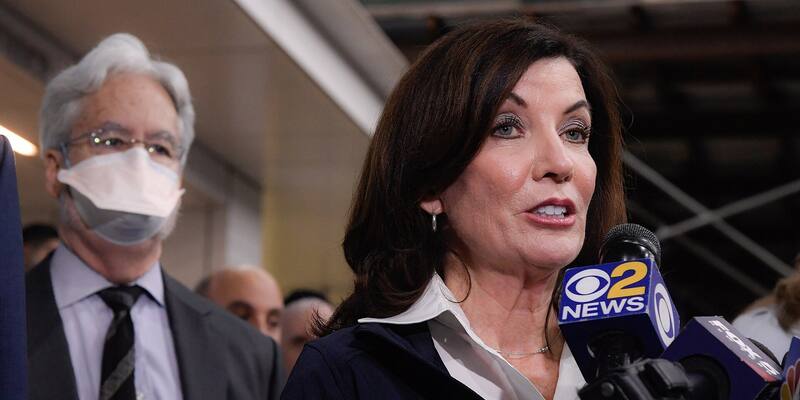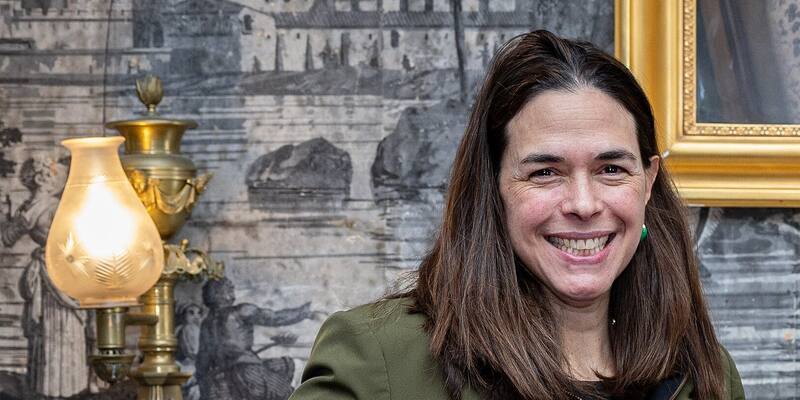
Dartmouth President Sian Beilock, who announced the provost’s resignation, pictured at Dartmouth in January 2024. Cropped. Image: US Department of Education / Wikimedia Commons, CC BY 2.0, cropped

Dartmouth College’s provost, Santiago Schnell, has resigned after a faculty review that read his Claude logs found he used AI to “meaningfully alter” his published writing without disclosing it, President Sian Beilock told the campus on Wednesday.
The panel’s eight-page report, dated October 27, found he broke at least one academic journal’s AI rules, clearly broke the Washington Post’s policy for an op-ed, “was not forthcoming about his AI use” and fell short of Dartmouth’s Code of Ethical Conduct and its Academic Honor Principle. Schnell, a mathematical biologist who left the deanship of Notre Dame’s College of Science to become Dartmouth’s chief academic officer in July 2025, is leaving the university altogether. “This was his decision,” Beilock wrote.
What the review found in his Claude logs
Beilock set up the five-member panel on September 25. It was chaired by computer scientist David Kotz, Schnell’s predecessor as provost, and said it did not use AI detectors, or AI of any kind, to reach or write its findings. Instead it inspected his Dartmouth laptop and his logs from Claude, the college’s enterprise AI tool.
Those logs, the report says, show he used Claude to “substantially edit” a chemistry paper, troubleshoot its code and generate figures after peer reviewers asked for major revisions. The paper, Reaction Acceleration: Reviving the second derivative in chemical kinetics, came out in the Wiley journal ChemSystemsChem on September 16 with no AI disclosure. One prompt asked Claude to imagine being a reviewer and write “your referee report for this paper”. Another said: “I asked ChatGPT to write a version of the response, which you will find enclosed. Please check it.”
For a forthcoming article on academic freedom at Catholic universities, he asked Claude: “Are there many signatures of AI writing in this article?” He then submitted a revised manuscript with the kinds of changes Claude suggested. When the editor asked, he said he had used AI “to help refine sentences, improve clarity”, which the panel said “understates” what the logs show.
A third paper, co-written with two junior academics including a graduate student, had its code run through “Claude Max Code and ChatGPT Pro Code”, but the panel couldn’t confirm a breach of that journal’s rules.
‘A disclosure would have been the best approach’
Schnell told Beilock on September 22 that he had followed Wiley’s pre-2025 author instructions and missed an update, which he said required disclosure only for AI-developed papers or substantive edits. Of his own use, he wrote:
This wasn’t the case, but a disclosure would have been the best approach.
Santiago Schnell, in an email to President Beilock quoted in the review
The panel found Wiley had required AI disclosure since at least 2023. When he finally wrote to the journal on October 6, he disclosed ChatGPT but not Claude. He also didn’t hand over logs from his personal AI accounts when asked, and didn’t make himself available to meet the panel, which said its findings might have been fuller with that information. It didn’t recommend any discipline, saying that wasn’t its role. Schnell declined to comment to The Dartmouth, the student newspaper.
An op-ed about AI cheating
The trouble began with an August 9 Washington Post op-ed under Schnell’s name, “Universities are fighting AI cheating. But there’s a deeper problem.” He told Semafor he had used ChatGPT “to refine a few arguments, check for grammatical errors”, though Post writers agree their work was “not created or manipulated with artificial intelligence or editing software”.
On September 21, The Dartmouth reported that Pangram, the detector at the centre of the row over a French prize-winning novel, flagged his op-eds and papers as AI-written. Beilock ordered the review four days later.
Matthew Delmont, a historian of the civil rights movement, will be interim provost through June 2028. Beilock’s letter ended on what Dartmouth expects of its leaders:
As leaders, it is so critical that we model the transparency and human judgment that we expect from our students and scholars.
Sian Leah Beilock, President of Dartmouth College
Why it matters
Schnell is one of the most senior university leaders yet to step down over undisclosed AI use, and the case rested on his own chat logs, not a detector score. With journals tightening disclosure rules and arXiv rationing papers under a flood of AI-written work, the lesson is that what gets leaders in trouble is hiding AI use, not using it. It lands as Dartmouth, where a 1956 summer workshop launched the field, hosts a conference this week called “AI at 70: What Must Remain Human?”
Sources: Dartmouth College, Office of the President, Advisory Committee report (PDF), ChemSystemsChem, Semafor, The Dartmouth
Latest Policy & Safety news