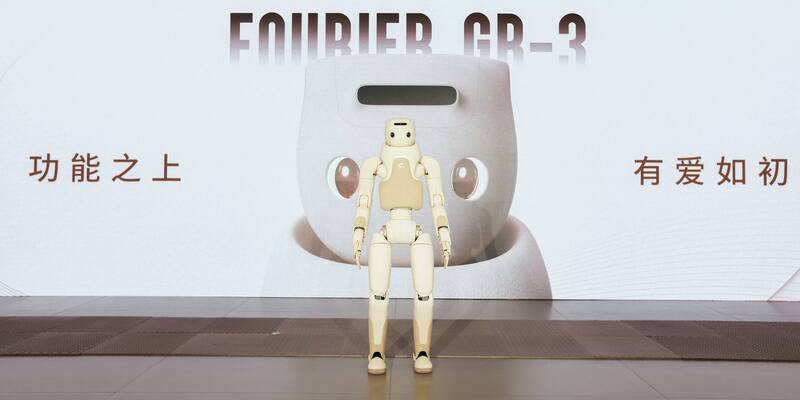
Fourier’s GR-3 humanoid at its launch in August 2025. Meta’s prototype, Max, has not been shown publicly. Image: Fourier
Meta has quietly built a working humanoid robot, and it had help from China. The company teamed up with Shanghai robot maker Fourier to build a prototype in about three months and is already working on a second version, The Information reported on Saturday, citing people familiar with the project.
Neither Meta nor Fourier has commented publicly on the report, and Reuters, which carried the news, said it could not immediately verify it.
A 106-pound robot called Max
According to The Information, the prototype weighs roughly 106 pounds (about 48kg) and is known inside Meta as Max. It is part of a push to build robots for people’s homes.
Max is not a product yet. One person told The Information the point of the project was to help Meta’s robotics group work towards a more polished robot that it could eventually sell, and that no launch date has been set. Meta hasn’t said what Max can do or which AI runs it.
Who Fourier is
Fourier was founded in Shanghai in 2015 by Alex Gu and spent its first years making rehabilitation robots and exoskeletons for hospitals. It started work on humanoids in 2019 and has since released the GR-1, GR-2 and GR-3, and it used to call itself Fourier Intelligence.
Its latest model, the GR-3, is pitched as a “care-bot” for homes, hospitals and eldercare rather than factories. Fourier launched it in August 2025 as a 165cm, 71kg robot with soft, upholstered panels, 31 touch sensors and a battery that can be swapped without switching it off. That focus on robots that live alongside people matches the home robots Meta is said to be after.
Meta goes to the country that makes the robots
The choice of partner is not a surprise on the numbers. Research firm IDC said last month that Chinese companies built more than 95% of the world’s humanoid robots in the first half of 2026, helped by local government support and a supply chain that covers everything from motors to finished machines.
It is a more awkward choice politically. Meta is one of America’s leading AI labs, and Washington and Beijing are fighting over who controls advanced AI technology. Building the body of a future Meta home robot with a Chinese firm puts the company’s robotics plans in the middle of that fight, even at the prototype stage.
“Will only accrue value to Meta AI”
Meta first set out its humanoid plans in February 2025, when it formed a robotics group inside Reality Labs led by Marc Whitten, the former chief executive of self-driving company Cruise. In a memo seen by Reuters, Meta’s chief technology officer said the group would focus on “consumer humanoid robots” and explained the bet:
We believe expanding our portfolio to invest in this field will only accrue value to Meta AI and our mixed and augmented reality programs.
Andrew Bosworth, Meta chief technology officer, in a February 2025 memo
Since then Meta’s AI has moved on. Its flagship assistant is now the Muse agent, built on models such as Muse Wonder, which Meta says has caught OpenAI and Anthropic. A robot in the home would give that agent hands, though Meta hasn’t said whether Max runs Muse.
Meta is far from alone. Tesla is building Optimus, Figure is backed by Nvidia, and Nvidia’s Jensen Huang said this month that the “ChatGPT moment” for robots is almost here.
Why it matters
Meta’s humanoid plans have gone from a memo to a walking prototype, and the fastest route it found ran through a Chinese supplier. If Max leads to a product, one of America’s biggest AI companies would be selling a home robot developed with a Chinese partner, while the two countries compete hard over AI.
Sources: The Information (Jyoti Mann); Reuters; Reuters, February 2025; Fourier GR-3 announcement.
Latest Meta news