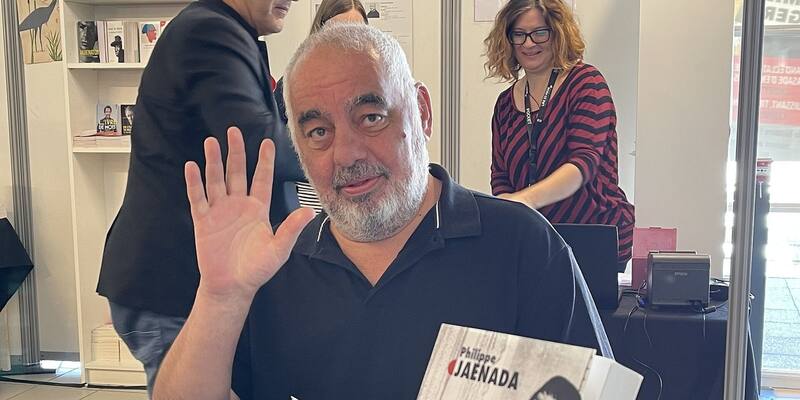
Philippe Jaenada at a book signing at the Lire en Poche festival in October 2021. Image: ActuaLitté / Wikimedia Commons, CC BY-SA 2.0, cropped

The winner of France’s most prestigious literary prize says his novel contains a sentence written by ChatGPT, and that only the jury knows which one. Philippe Jaenada, who won the 2026 Prix Goncourt on Tuesday for L’Inconnue du quai de Javel, said on France Inter’s morning show on Wednesday that he used AI “three times” in the book.
It lands at the end of a prize season dominated by AI. In September the Académie Goncourt dropped one of the year’s most talked-about novels, Thélyson Orélien’s C’était ça ou mourir, after an anonymous account accused it of being AI-written. A day before his radio interview, as the prize was announced at the Drouant restaurant in Paris, a journalist asked Jaenada whether he had used AI. He joked, Livres Hebdo reported: “Prod me all you like, I’m 98% human. You can check!”
‘Three times’: what he said
Asked about the Orélien case, the 62-year-old listed three uses, speaking in French:
- A hidden sentence: “Once, to play with readers, I hid a ChatGPT sentence in the book.” He revealed which one only to the Goncourt jurors on Tuesday. “If it gets out, I’ll know who it came from,” he joked.
- A joke at ChatGPT’s expense: another time, he said, was “to make fun of ChatGPT, which gives us completely absurd answers” about a technical detail.
- Research: and once, he said, “it really helped me” with research.
None of this was hidden. As 20 Minutes pointed out, the novel, published by Flammarion in August, describes on pages 237 to 240 how Jaenada asked ChatGPT and Claude which dries faster, cobblestones or hair, as he investigated the 1949 death of a young woman, Louise Cansot. He quotes their answers, some of them off the mark, and pokes fun at them. The book also says he kept one AI-generated sentence in his manuscript and challenges readers to find it.
‘We can’t pretend it doesn’t exist’
Jaenada used the interview to argue that writers should use AI openly rather than fight it:
You can’t push AI back, you can’t act as if it doesn’t exist. You have to use it, but first you have to acknowledge it, and above all you have to tame it, which means not letting yourself be replaced. It has to be useful to us.
Philippe Jaenada, on France Inter
He went further in an interview with 20 Minutes last month, predicting that “in the future, AI will be the most prolific author on the planet, by far” and asking: “Would a film director hide that he uses special effects?” He suggested a novel could one day announce that a chapter was written with AI.
Claudel has asked for something similar from the other side, calling on publishers to give readers a kind of “moral certificate” that a book was written by a human. (For what the big chatbots can do and the rules on selling an AI-assisted book, see our guide to writing a novel with AI.)
A prize that says ‘the machine’ has no place
The Académie Goncourt has spent weeks insisting its prize is for human writing. Its president, Philippe Claudel, told France Inter on October 6 that he wanted to change the rules to ban the use of AI. The academy ran the 16 titles it had as PDFs, Jaenada’s among them, through the Pangram 4 detector. Orélien’s scored “very high”, Claudel said on October 27, while “for the others the machine said they were absolutely human”. A single sentence in a 528-page novel was never likely to change that score.
Claudel said then that the prize “crowns a book written by a man, a woman, a human being, and the machine has no place being considered in our prize”. But he admitted the academy has neither the means nor the technical capacity to screen the 250 or so books it receives, and said that job belongs to publishers. Juror Pierre Assouline said the same on Tuesday: the Goncourt “is not going to install software”.
Orélien’s case has only grown since September. His Montreal publisher, Boréal, dropped him after traces of AI tags were found in the metadata of some documents, Radio-Canada reported, and won’t reprint the book. Orélien has admitted plagiarism in work from the 2010s but still says he wrote the novel himself, using AI only for historical research. The Académie Goncourt hasn’t commented publicly on Jaenada’s remarks.
Why it matters
The Goncourt has now crowned a book that openly contains machine-written text, weeks after dropping another over suspected AI use. The difference between the two is disclosure: Jaenada wrote his use of AI into the novel itself. Whatever rule the academy writes next will have to say whether that line is the one that counts.
Sources: franceinfo (Philippe Jaenada on France Inter, November 4), Livres Hebdo, 20 Minutes, franceinfo (October 6), franceinfo (October 27), Radio-Canada, Euronews.
Latest Policy & Safety news