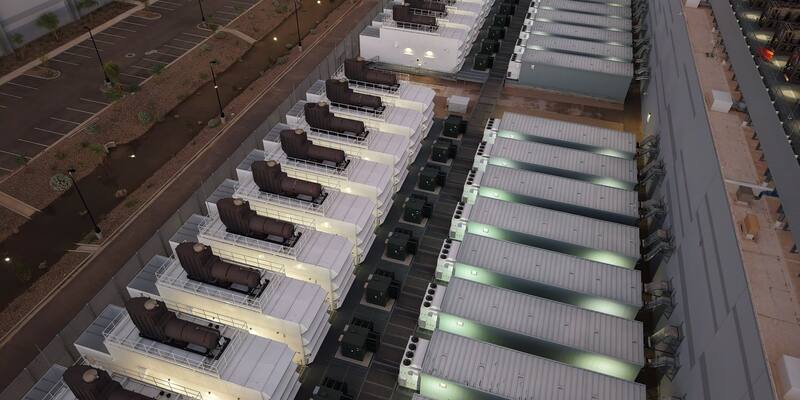
Rows of backup generators and power equipment at a data centre in Mesa, Arizona, in November 2025. Not an Anthropic site (illustrative). Image: Rsparks3 / Wikimedia Commons, CC0, cropped

Anthropic, the company behind Claude, has agreed to pay about $3.4 billion for gas-fired generators to power its data centres, the Financial Times reported on Sunday, citing a person familiar with the matter. The report does not say where the generators will be installed or which data centres they will serve.
According to the FT, Anthropic secured commitments in late September for 1.7 gigawatts of heavy-duty generators from OnePWR Solutions, a San Antonio, Texas, company that builds microgrids and on-site power plants. The deal also covers the engineering and construction work needed to install them. That works out at roughly $2 million for each megawatt of capacity. Anthropic, OnePWR and Caterpillar haven’t commented publicly on the report.
Generators someone else had already ordered
The machines are not fresh orders. OnePWR ordered them from Caterpillar, the US maker of engines and generator sets, about two years ago but needed financing to complete the purchase, the FT says. Anthropic first planned to become a OnePWR customer, then took over the orders itself. It has not bought OnePWR, and none of the supplier’s staff moved to Anthropic.
Stepping into someone else’s queue matters because power equipment has become one of the tightest bottlenecks in the AI build-out. Anthropic’s own IPO prospectus warns that generators and other equipment “must be ordered years in advance”, and that turbines, generators, substations and transmission parts have “been subject to extended delivery timelines, price increases, tariffs” and rationing as data centre operators compete for them.
Anthropic’s IPO filing already pointed to gas
The deal matches what Anthropic told investors when it filed publicly for its Nasdaq listing on October 26. In a passage repeated in its amended filing on November 2, it says “certain of our planned data center facilities rely on dedicated on-site natural gas-fired generation”, leaving it exposed to fuel price swings and supply disruptions “outside of our control”.
Its contracts generally pass fuel costs on to Anthropic “without cost caps”, the filing says, so it carries the risk if gas gets more expensive. It also expects data centre operators to compete for the same gas supply and pipeline capacity, and notes that on-site generation faces its own “permitting, environmental, air quality” and siting rules. That is the fight Elon Musk’s AI company is in over the gas turbines at its Southaven site, where a judge refused last month to throw out the NAACP’s Clean Air Act lawsuit.
A promise to bring its own power
In February Anthropic promised to cover electricity price rises caused by its data centres, saying “AI companies shouldn’t leave American ratepayers to pick up the tab.” It pledged to “bring net-new power generation online to match our data centers’ electricity needs” and to address environmental impacts, but did not say what kind of power that would be.
Generators of its own add new capacity without leaning on the local grid, which fits that promise. But they burn a fossil fuel, and the prospectus itself flags “shifting public and political views regarding climate change and the appropriate treatment of various power generation sources” as a risk to its plans.
A hard moment for data centres
The report lands days after US voters backed limits on AI data centres in 40 of 41 local ballot measures in the midterms, and Texas and Georgia elected governors who had promised a pause. OpenAI responded with a Community Compact saying its data centres will pay the full cost of their power.
Power is a growing part of Anthropic’s bill. Its amended prospectus puts its compute and infrastructure commitments at about $895 billion through 2045, and says capital spending will “increase significantly” as it builds more of its own infrastructure. The listing, under the ticker ANT, has yet to be priced.
Why it matters
Anthropic is moving from renting computing power to securing the electricity behind it, and its biggest known step so far runs on gas. With its IPO approaching and voters turning against data centres, where those 1.7 gigawatts end up, and what they mean for local air and power bills, will be closely watched.
Sources: Financial Times; Anthropic, Form S-1/A (SEC, November 2, 2026); Anthropic, Form S-1 (SEC, October 26, 2026); Anthropic, Covering electricity price increases from our data centers (February 11, 2026).
Latest Anthropic news