
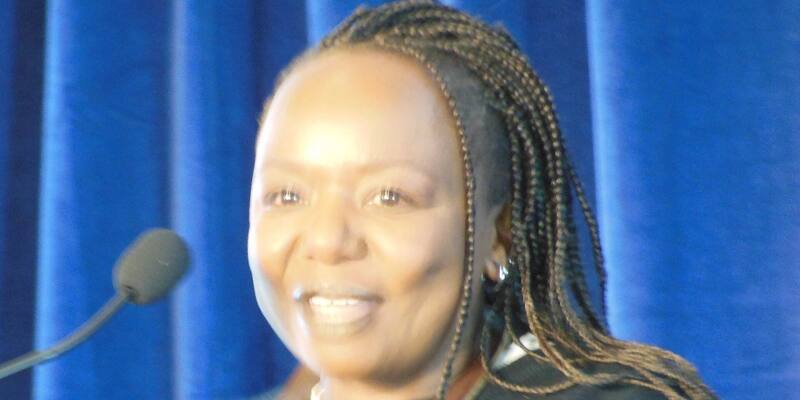
Ellah Wakatama, now chair of the Caine Prize, reading at Africa Imagines at Georgetown University, Washington, D.C., in March 2019. Image: Slowking4 / Wikimedia Commons, CC BY-SA 3.0, cropped

The Caine Prize for African Writing says its 2026 winner did not use AI. A month after an AI detector flagged almost all of Simbarashe Steyn Kundizeza’s story ‘The Blue Fighter’, the prize’s trustees said a forensic review of his drafts found “no evidence” of generative AI, and that detection tools alone “are not a reliable basis for determining authorship”.
Four drafts and 27 hours of editing
Kundizeza, from Zimbabwe, won the £10,000 (about $13,000) prize in October for ‘The Blue Fighter’, the story of Tinashe, a boy whose family slides into hardship after his father gives up his profession to build fish tanks. Days later The Atlantic ran a piece by Vauhini Vara titled ‘Yet Another Literary Prizewinner Seems To Be AI’. According to the Associated Press, the detector Pangram had indicated that the entire story was AI-generated, apart from an excerpt from another author’s poem.
The prize opened a review on October 11. Led by its interim director, Susi Owusu, it included interviews with Kundizeza, this year’s judges and The Shallow Tales Review, which first published the story. An independent cyber security and digital forensic investigator analysed the metadata of his drafts.
The statement says the story went through four separate Word documents before it was submitted, adding up to as much as 27 hours of writing and editing. Kundizeza began work in April 2025 and finished in June 2025, after “considerable communication” with the poet who inspired the piece. The board says Kundizeza remains the winner and it “considers the matter closed.” Ellah Wakatama, the prize’s chair, said:
From our detailed investigation, which was guided by a risk management framework that considered the people involved as well as data analysis, we feel the evidence is clear and have made the decision that Simbarashe’s award stands.
Ellah Wakatama, chair of the Caine Prize
‘I am happy to put all this behind me’
Kundizeza had denied the claim from the start, saying the story drew on his own family’s life during Zimbabwe’s years of economic turmoil, “a deeply personal story about economic collapse and familial relationships.” On Thursday he told the AP he felt “relieved”:
It was not necessary in the first place, I am happy to put all this behind me and continue with my writing journey.
Simbarashe Steyn Kundizeza, 2026 Caine Prize winner, to the AP
The AP says the row sparked a wider argument on social media, with some asking whether Black authors are being unfairly targeted by AI accusations. The prize says it hopes to present the award to him in Zimbabwe before the end of the year.
New rules: declarations, and permission before any detector
The prize is also bringing in new measures for 2027, when submissions open on November 23: an AI declaration from publishers for every story they submit, another from every shortlisted writer, guidance for judges on raising concerns, and a published process for handling them. Its new AI Use Policy sets out the detail:
- No AI stories: content generated by AI is not eligible “even where it has subsequently been edited, rewritten or incorporated into a larger work.”
- Helpers allowed: tools for accessibility, transcription, spelling, grammar or formatting are fine if they don’t generate the story, but any material use of AI must be disclosed.
- Detectors as a first hint only: they “may be used only as an initial indicator and not as conclusive evidence,” and the prize must ask the writer and publisher for permission before running a story through one.
- A right of appeal: a writer can ask the board of trustees to review any decision.
Detectors keep putting prizes on the spot
It is the second time this year a big short-story prize has had to answer a Pangram result: in May, Vara’s tests of past Commonwealth Short Story Prize winners set off a similar row. In France, a celebrated debut novel was accused of being “100% AI” and different detectors gave conflicting verdicts. Pangram also flagged the writing of Dartmouth’s provost, though it took his Claude logs to settle that case.
The Caine Prize has gone the other way: a detector score can start a review, but only drafts, version history and interviews can end one. AI labs are trying a third route, with Anthropic now hiding a watermark in Claude’s text, though that only works for text from its own models.
Why it matters
AI detectors are now driving public accusations against named writers, and this is one of the first big prizes to publish both a finding and a rulebook saying a detector score is not proof. Asking writers’ permission before testing their work, and keeping drafts that show the work, may become the standard other prizes and publishers copy.
Sources: Caine Prize: Caine Prize confirms 2026 winner following suggestion of AI use; Africa’95: AI Use Policy (PDF); Caine Prize: 2026 winner; Associated Press (via WFTV): Caine Prize clears Zimbabwean author of AI writing allegations and adds new rules.
Latest Policy & Safety news