
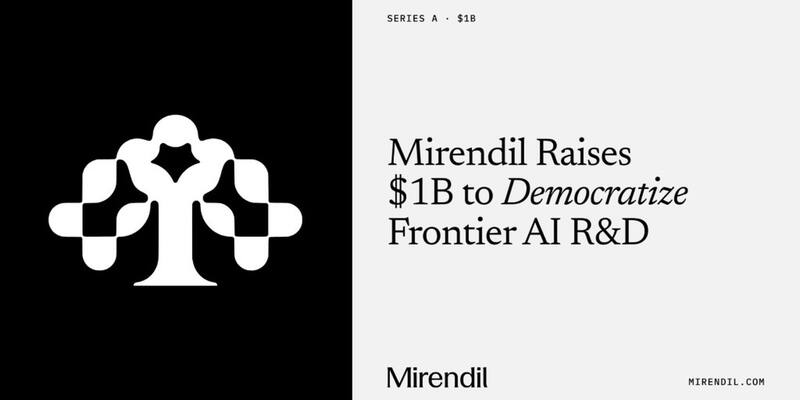
Mirendil’s announcement art for its $1 billion Series A. Image: Mirendil
Mirendil, the start-up two former Anthropic researchers founded to build AI that does AI research, has raised $1 billion in a Series A led by Kleiner Perkins and Clearlake Capital. That is five times its $200 million seed from June, and it lands days before Anthropic, the lab the founders left, is expected to start trading on Nasdaq.
Who is backing Mirendil
The announcement, dated November 12, also names Battery Ventures, Doerr Capital, Gil & Co, Google, M13, Pear VC and S32, “among other new and existing investors”. It gives no valuation. Bloomberg reported in September that Kleiner Perkins was in talks to lead a round of up to $1 billion at a $5 billion valuation, five times what the company was worth at its seed.
That $200 million seed was led by Andreessen Horowitz and Kleiner Perkins, with Nvidia investing afterwards, and valued the company at about $1 billion. Andreessen Horowitz isn’t named in the new announcement. Google is, three months after Mirendil signed a multi-year deal to run its training and research on Google Cloud’s TPUs and Nvidia hardware.
Who founded it
Mirendil is run by chief executive Behnam Neyshabur and chief technology officer Harsh Mehta. Neyshabur previously co-led Google DeepMind’s Blueshift team, which worked on reasoning and maths for Gemini, and Mehta built the first version of Anthropic’s internal AI research platform, according to Tech Funding News. The pair joined Anthropic in late 2024 and left about a year later to start Mirendil.
The company says its founding team of 20 researchers and engineers came from Anthropic, xAI, Google DeepMind and OpenAI. Its About page calls “self-accelerating AI R&D” the most direct way for AI to solve big problems, and says the lab that automates AI research “will build the thing that is capable of continually improving itself toward any goal”.
‘Call it vibe research’
Mirendil’s pitch is that a biology, chemistry or robotics lab shouldn’t have to become a frontier AI lab to build the models it needs. Its product, Lor, went into private beta on October 28: it runs hundreds of agents at once that write code, bring up their own GPUs and run experiments for days, using models such as Claude Opus, Claude Fable, GPT-6 Sol and GPT-6 Astra as well as open models from Kimi, DeepSeek and GLM.
When Andreessen Horowitz backed the seed, its partners summed up the idea:
Call it vibe research. If it works, it could change the way the AI ecosystem is structured, and support experts across many fields.
Matt Bornstein and Malika Aubakirova, Andreessen Horowitz
One researcher, one model, under $10 million
The new money follows three weeks of results the company has posted itself. It says one researcher, working with agents, pretrained Mirendil-Base, a coding model, from scratch in three and a half months with less than $10 million in compute. It then turned that into Fern, which it says holds up to 10 million tokens of context, “enough for days of an agent’s work”. None of those figures has been checked independently.
Mirendil isn’t alone in claiming big results from small teams. Ricursive Intelligence says it built America’s best open coding model for $32 million, and Anthropic itself says its Mythos model got Claude running on AMD chips in three days, a job that took months.
The same idea alarms critics. Four groups suing the biggest AI labs this week want a court to stop the labs pursuing recursive self-improvement, one of five practices their lawsuit targets.
Why it matters
Investors are now paying for the idea that AI can speed up its own development, something the big labs have kept in-house. Mirendil wants to sell it to everyone else, as its founders’ old employer prepares an IPO that could value it at about $1 trillion. With Lor still in private beta and its results self-reported, $1 billion is a large bet on a promise.
Sources: Mirendil (Series A, November 12, 2026), Mirendil (seed, June 24, 2026), Mirendil (Lor), Mirendil (Google Cloud), Andreessen Horowitz, Bloomberg, Tech Funding News
Latest More Labs news