
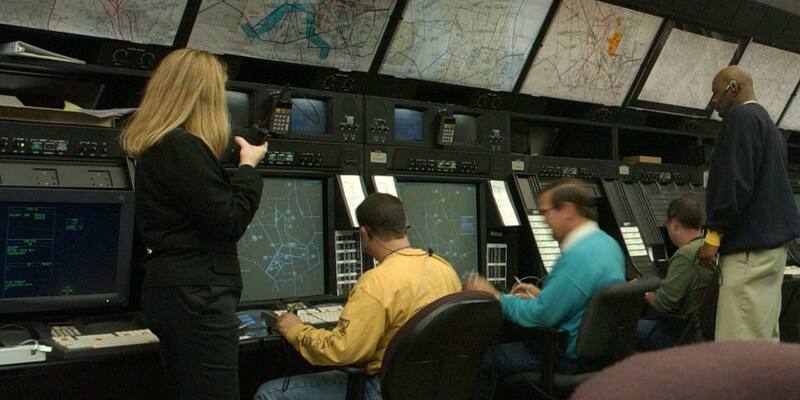
Air traffic controllers at work at the FAA’s Washington Air Route Traffic Control Center, one of the 22 en route centres where SMART is now used. Undated FAA photo. Image: Federal Aviation Administration / Wikimedia Commons, Public domain (US government work), cropped

Every departing flight in the US was held on the ground for more than four hours on Friday, three days after the FAA switched on its AI traffic planning tool across the whole country. The FAA blamed “communication issues” at its en route centres, and Transportation Secretary Sean Duffy told a White House briefing the AI “isn’t plugged in” to the systems that failed.
What happened on Friday
Duffy said radar and radio links at the FAA’s en route centres and TRACONs (the facilities that handle planes approaching and leaving airports) became unstable at 3:36pm Eastern (20:36 UTC). The FAA ordered a nationwide ground stop for all US airports soon afterwards, and Duffy said it lifted it at 8:15pm Eastern (01:15 UTC on Saturday).
More than 3,500 planes were in the air when the trouble began, Duffy said, and controllers brought them down while lifesaving medical and cargo flights and law enforcement kept moving. Thousands of flights were cancelled, and Duffy warned it would take time to unwind.
His explanation was old hardware. The FAA still runs what he called “TDM telecom, so this is analog telecom,” and he said: “Our switches, our routers actually got overloaded with data,” and began sending inconsistent data. The FAA later called it a “temporary telecommunications outage” on X. Duffy said the agency’s new IP switches did not go down, and used the briefing to ask Congress for $50 billion to rebuild the system.
“No possible way”
The timing invited questions. On November 10, the FAA said it would now use SMART, its AI-supported planning tool, in the airspace of all 22 of its en route centres. Asked whether the tool had anything to do with the ground stop, Duffy said it was completely disconnected from the systems that failed:
But that SMART system isn’t plugged in to STARS and ERAM… By the way, if it was, I would tell you that, but this is not even plugged in.
Sean Duffy, US Transportation Secretary
STARS and ERAM are the FAA’s core radar automation systems for airport approach and en route airspace. SMART, Duffy said, only gives a person a prompt, and “the human being will actually decide to accept or deny that prompt.” His conclusion: “there was no possible way SMART would have impacted what happened today.”
Air Space Intelligence, the startup that builds SMART for the FAA, put out its own denial on X at 5:34pm Eastern, while planes were still grounded:
The current ground stop is not based on or a result of the SMART system, any product of ASI or our integration with FAA and ATC.
— Air Space Intelligence (@AirSpaceIntel) November 13, 2026
What SMART does
SMART, short for Strategic Management of Airspace, Routes and Trajectories, was unveiled on September 21 around Washington, DC. It is a cloud-based system that pulls 200 data streams, including weather, flight paths, traffic flow and controller staffing, into one platform, and its “AI-supported engine” predicts where congestion and weather will cause trouble hours or days ahead.
FAA specialists at a SMART centre in Washington check its output and send scheduling suggestions to the agency’s command centre in Warrenton, Virginia, which passes them to local facilities to accept or ignore. The FAA says it cannot take control of an aircraft or replace controllers. By the agency’s own count, it has helped reroute 180 flights since September, saving an average of 10 minutes and almost 80 gallons (about 300 litres) of fuel each.
Air Space Intelligence won the FAA contract for SMART and the command centre’s new data backbone in June. The nationwide rollout went ahead after lawmakers had urged the FAA to pause and evaluate the tool, and the controllers’ union NATCA had complained it wasn’t involved, Flying reported.
What hasn’t been ruled out
The FAA hasn’t published a cause beyond its preliminary statement, and the officials at the briefing were careful about how much they knew. Asked whether a cyberattack or “a rogue AI” could be excluded with certainty, Homeland Security Secretary Markwayne Mullin said: “There’s nothing completely certain right now. It doesn’t appear that way.”
Mullin said there was “no connection between this and Microsoft,” whose outage a day earlier had prompted speculation, and that investigators had seen “zero evidence” of a cyberattack. But he also offered a cause that went further than Duffy’s: as the FAA put “new equipment and new technology” into the system, he said, it “was overwhelming the older system.” He didn’t say which equipment he meant, and neither official tied it to SMART.
Why it matters
SMART now feeds AI-backed suggestions into planning for every en route centre in the US, and its first week nationwide ended with the country’s airspace shut. Officials and the company say the AI played no part, but the FAA hasn’t yet published its own account of what overloaded its network, and that is the document that will settle it.
Sources: FAA statement on the nationwide ground stop; Transcript of the Mullin and Duffy briefing, Nov 13; FAA, “SMART Expanding Across the Nation”, Nov 10; FAA, SMART launch, Sep 21; FAA, Air Space Intelligence contract, Jun 22; Air Space Intelligence on X; Flying.
Latest Policy & Safety news