
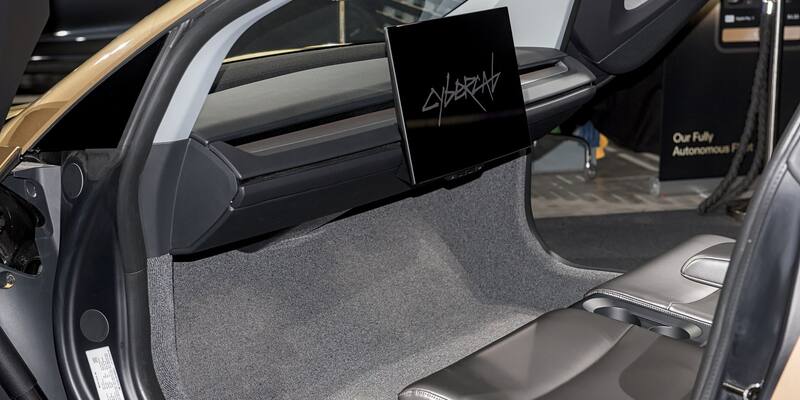
Inside a Tesla Cybercab at Auto Zürich in November 2026: a screen where the steering wheel would be, and no pedals. Image: Alexander Migl / Wikimedia Commons, CC BY-SA 4.0, cropped

Tesla will now sell you a car you can’t drive. Its Robotaxi account said on Friday that select customers are being invited to buy a Cybercab, the two-seater with no steering wheel or pedals, for personal use. It costs $29,990, needs a $299 monthly subscription to move at all, and only works where Tesla’s robotaxi service already runs.
What Tesla is charging
The order page in Tesla’s post lists an estimated purchase price of $29,990 before taxes and a $1,000 non-refundable deposit due on ordering. Below the price sits an “Autonomy Subscription” at $299 a month, ticked by default, with one month included. The small print reads: “Subscription and regular vehicle maintenance required to operate.” Estimated delivery is December 2026, in Austin, Texas.
Select customers are now being invited to purchase Cybercab for personal use
— Robotaxi (@robotaxi) November 13, 2026
Over five years, the subscription alone adds about $17,600 after the free month, before insurance, charging or taxes. That is about the same monthly price as the $300-a-month Grok Bot Tesla launched for its other cars in September. Tesla hasn’t said how many customers were invited or how they were chosen.
No subscription, no car
A copy of Tesla’s Autonomy Subscription Agreement shared on X spells it out: “Your Cybercab will not operate without an active Autonomy Subscription.” The fee covers autonomous driving, connectivity, remote support, roadside assistance and towing of up to about 50 miles, plus some routine servicing. Owners pay for registration, insurance, parking, charging and cleaning, and Tesla says it may change the terms “from time to time”.
The agreement also says features “depend on development and regulatory approval in your jurisdiction”. TeslaNorth, reading the rest of the terms, reports that owners can’t put the car to work on Tesla’s Robotaxi network, ride-hailing, delivery or rental apps without Tesla’s written permission.
Where it will drive
The Cybercab only drives itself inside Tesla’s supported service areas. Tesla’s Robotaxi page lists eight cities where rides run today: Austin, Dallas, Fort Worth, Houston and San Antonio in Texas, and Miami, Orlando and Tampa in Florida. Outside those zones, a car with no steering wheel has no obvious way home.
That means no sales yet anywhere else in the US, or in Canada, the UK, Europe, Australia or China. Tesla hasn’t given a date for other countries.
The regulators are still asking questions
The Cybercab has no exemption from US car safety rules. Instead, Tesla certified it as meeting every applicable Federal Motor Vehicle Safety Standard itself, and that is now under review. The National Highway Traffic Safety Administration opened an audit on September 3, the day Tesla began carrying paying passengers in a small number of Cybercabs in Austin.
NHTSA says the cars lack “a brake pedal, gas pedal, steering wheel, and mirrors”, and that it will look at “the extent to which Tesla’s certification depended on determinations that certain FMVSS are inapplicable to the Cybercab.” It estimated 1,000 vehicles were covered. The agency hasn’t published a finding.
Why it matters
This is the first time Tesla has offered to sell ordinary buyers a car in which AI is the only driver. Owners will pay for the hardware, but Tesla decides where it goes, what it can be used for and whether it runs at all, one month at a time.
Sources: Tesla Robotaxi on X; Tesla Robotaxi page; Autonomy Subscription Agreement, shared on X; TeslaNorth; NHTSA audit query AQ26002.
Latest SpaceXAI news