
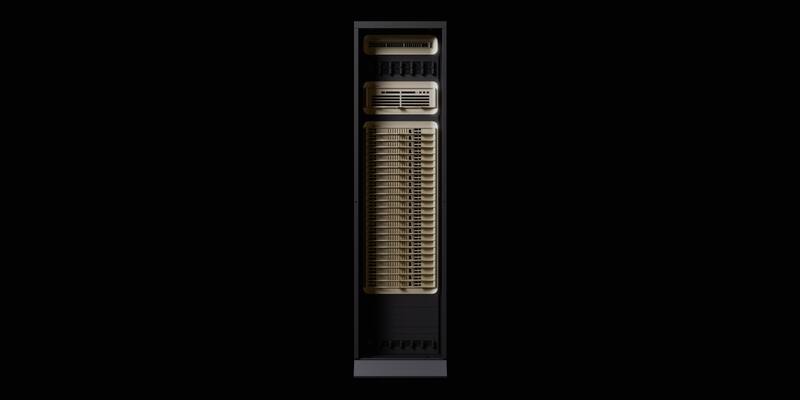
Nvidia’s Vera CPU rack in a company render released on November 16, 2026 (illustrative). Image: Nvidia
Nvidia has stopped shipping its AI chips to China. Interim chief executive Colette Kress told analysts on Tuesday that the company sold $2.4bn of licensed Hopper data centre chips there last quarter and has now halted those sales, as Nvidia reported record revenue of $115.8bn, up 103% on a year ago, in its first results since Jensen Huang resigned.
A record quarter, and a bigger one coming
The numbers for the quarter to October 25 were huge even by Nvidia’s standards. Revenue rose 20% from the previous quarter, and data centre sales, the chips and systems that train and run AI models, reached $107.6bn, up 110% on a year earlier. Net income was $65.3bn and gross margin stayed close to 75%. Edge computing, which covers PCs, gaming and robotics, brought in $8.2bn.
Nvidia said Vera Rubin NVL72, its newest rack-scale AI system, has shipped in what it calls the fastest product ramp in its history, with racks running at CoreWeave, Google Cloud, Microsoft Azure, Oracle and Nebius. It expects fourth-quarter revenue of $130bn, plus or minus 3%, a period that includes an extra week. Kress also raised the company’s forecast for next year’s growth to 75%, from 70%, CNN reported.
“Vera Rubin is off to an explosive start, our roadmap is on track and our ambition has never been greater,” Kress said in the release. Nvidia shares, down about 35% from their October 6 record, rose roughly 4% to 5% in after-hours trading.
No more chips for China
The China news came on the call. Kress said the outlook leaves out the H200-class Hopper chips Washington had licensed for sale to Chinese customers, and that those sales have stopped, Bloomberg reported:
Guidance does not have any licensed Hopper data center products included, and we are no longer shipping licensed Hopper data center products to China.
Colette Kress, interim CEO, Nvidia
She did not say why. The written outlook says Nvidia is not assuming any data centre compute revenue from China at all. Huang spent years lobbying for access to the Chinese market, and his exit followed reports about his relationship with Alice Huang, a former executive at Singapore cloud firm Megaspeed whom US officials suspect of links to Chinese intelligence.
Since then the pressure has only grown. The Commerce Department on Monday shut the loophole that let Chinese companies rent top US chips in data centres abroad, and on Tuesday Nvidia’s board set up a committee to oversee its export compliance. China was already small on paper: H200 shipments there made up less than 1% of data centre sales in the previous quarter, according to CNN.
‘We’ve got this’
The call opened with chairman Harvey Jones saying the board does not intend to reinstate Huang, hours after Huang said he would be “honored” to return, and that the search firm Heidrick & Struggles is looking for a permanent chief. Kress, finance chief for 13 years before she took over last week, took questions alongside Ian Buck, the Nvidia veteran who helped create its CUDA software.
She tried to show nothing has changed. “Our ambition will not change, our passion to innovate will not change, and our commitment to customers, partners, and shareholders will not change,” she told investors, ending with: “We’ve got this.” In her first interview since taking over, on CNBC’s Mad Money, she said customers and suppliers are “all 100% behind us”.
One thing is shifting: money. Nvidia has $118bn in guarantees for land, power and hardware financing, notably for an OpenAI project in Ohio, and Kress said it would be “rigorously evaluating future investments, commitments, and guarantees”, CNBC reported. She also said frontier labs such as OpenAI and Anthropic will make up about 15% of data centre sales this year, and put Anthropic’s annualised revenue at $81bn at the end of October. The planned purchase of Hugging Face is still going ahead.
Why it matters
Nvidia’s results are the closest thing the AI boom has to a health check, and this one says demand is still climbing even with Huang gone. But the first big decision of the post-Huang era is a retreat from China, the market he fought hardest to keep, and a more careful approach to the deals that have propped up its customers. Watchers of the AI bubble will notice both.
Latest Chips news