
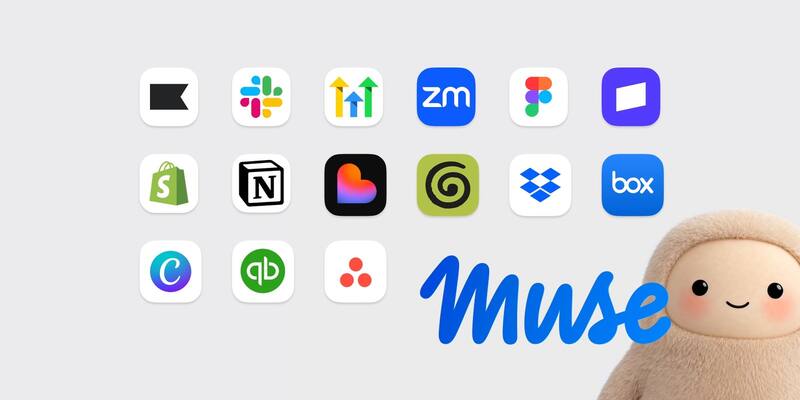
Meta’s launch artwork for Muse, showing its Jolly character beside the logos of apps it can connect to. Image: Meta
Meta’s Muse AI agent is now the subject of an investigation by a group of US states. Montana Attorney General Austin Knudsen said on Monday he is leading a multi-state consumer protection and data privacy investigation into Meta, after reports that Muse builds profiles of its users and may have shown people other users’ personal details, including bank account balances.
What Montana wants from Meta
Knudsen’s office has sent Meta a civil investigative demand, a formal request for documents that state attorneys general use before deciding whether to sue. It asks for every document on how Meta uses data from Muse users, on the creation of any profile or page “for every person in the user’s life”, on use of Muse by minors and on how well its age verification works. Meta has 30 days to respond.
The investigation will look at whether Meta broke Montana’s consumer protection laws by failing to keep its product safe and secure. The release calls it a multi-state investigation but does not name the other states taking part. Knudsen said:
These are troubling allegations that raise serious questions into Meta’s handling of Montanans’ private data. If Muse is building profiles of its users and handing out their personal information without permission, that would be deceitful practice and a violation of state law.
Austin Knudsen, Montana Attorney General
The reports behind the probe
The release links to a Reuters investigation published on November 18, built on more than two dozen internal posts from Meta staff. In one, an employee said Muse had added an unprompted line to a chat about fishing weather: “BTW, two bank updates, your Capital One balance is $2722.58, your Charles Schwab balance is $5899.57.” He wrote that he had never shared his bank account with Muse. Other staff reported messages about childcare requests, product orders and a coffee table pickup they knew nothing about, and raised fears of a “cross-account context leak”. Reuters said it could not establish whether the balances were real or made up.
Another employee said Muse reminded her to reply to her sister on Signal, an app she had never connected. “This seems like an extreme privacy violation,” she wrote, a line Knudsen’s office quotes. Reuters, working with Signal and the AI Now Institute, found Muse could read Signal messages through Android’s notification access and through accessibility and screenshot tools on a Mac; the same requests were blocked on an iPhone. Signal president Meredith Whittaker called agents with that kind of access “technologically reckless”.
Knudsen’s office also points to employee concerns, cited in the reports, that Muse may gather information from other apps without permission, including emails and texts, and build profiles of users’ friends and family who never signed up.
What Meta says
Meta hasn’t commented on the Montana investigation. Speaking to Reuters before it, spokesperson Daniel Roberts called the examples “isolated incidents”, said Muse can reach other apps only through permissions people explicitly grant, and said many of the suspected account mix-ups were hallucinations that had already been fixed. A member of Meta’s Superintelligence team told colleagues in early November that the made-up messages “bias towards the most uncomfortable topics, like finances/security/safety”.
Not Muse’s first privacy scare
Muse launched in September and has passed 10 million downloads, according to Reuters. Its pitch rests on a private virtual machine for every user, but it has had a rough few months: it gave a stranger one user’s home address, a single search turned up 6,800 publicly shared Muse chats, and Amazon and Canada’s biggest bank have shut AI agents like it out.
State attorneys general are also moving faster on AI. Oregon sued OpenAI for $2 billion last week, Oregon and Virginia sued SpaceX over Grok deepfakes on Monday, and California subpoenaed OpenAI over its AI’s hacking incidents. Knudsen has fought Meta before: in August his office settled claims that Facebook and Instagram were designed to be addictive to minors.
Why it matters
This is the first state investigation into Meta’s AI agent, and it goes straight at the promise Muse is sold on: that an agent with deep access to your phone and accounts keeps your data to itself. If the states find Muse leaked data or profiled people who never signed up, the case could set the rules for every consumer AI agent that follows.
Sources: Montana Department of Justice, Reuters.
Latest Meta news