
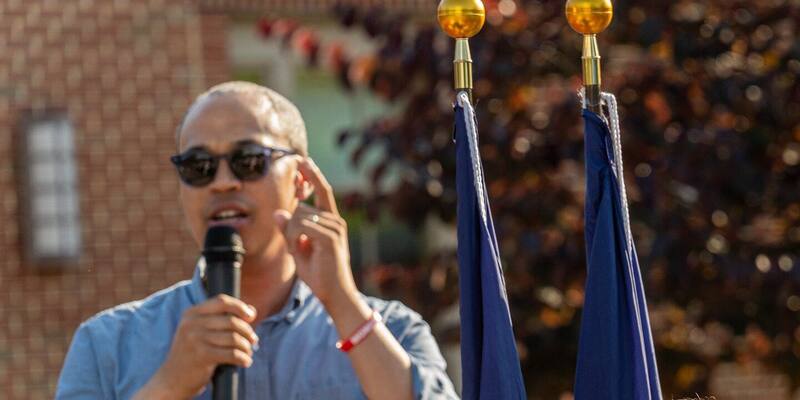
Virginia Attorney General Jay Jones, pictured campaigning in Fairfax City, Virginia, in June 2025. Image: Adnan Masri / Wikimedia Commons, CC BY 4.0, cropped
Oregon and Virginia have sued SpaceX, accusing Elon Musk’s company of deliberately weak safeguards on its Grok AI so that sexualised images of real women and children would pull in users. Attorneys general Dan Rayfield and Jay Jones each filed in their own state court on Monday, Wired reports, under consumer protection laws that let them seek civil penalties.
What the states say SpaceX did
Virginia filed in the Circuit Court for the City of Richmond and Oregon in Multnomah County Circuit Court. Both suits name SpaceX and X Corp., which runs the social network X; SpaceX took over xAI, Grok’s maker and X Corp.’s parent, in February. The states worked together and both hired Platkin LLP, the firm run by former New Jersey attorney general Matthew Platkin.
The complaints accuse the companies of ignoring industry safety standards and building in weak safeguards to draw people to what they call a “lagging product”. According to Virginia’s complaint, the defendants saw “a market opportunity for more profits” in sexualised images of real people, including children, and “intentionally released a product that inundated their platforms with CSAM”, meaning child sexual abuse material.
The specific claims include:
- Too little outside testing: Grok models were not put through enough third-party evaluations before release.
- Permissive instructions: Grok’s safety prompts told it to “assume good intent” and that the words “teenage” and “girl” do “not necessarily imply underage”.
- Unusable abuse reports: tens of thousands of reports to the National Center for Missing and Exploited Children’s CyberTipline lacked key information from xAI, which the states say left the centre unable to act on them 90 percent of the time.
- “Spicy” as a selling point: Musk promoted Grok’s “spicy mode” to set it apart and, while its “undressing” of people was causing outrage last winter, posted that Grok was “hitting #1 on the App Store in one country after another!”
Virginia’s investigators tested Grok themselves
Shortly before filing, Virginia says, its investigators found Grok’s image safeguards “inconsistent and ineffective”. The chatbot explained which words triggered its filters, helped them write prompts to get around moderation and then carried those prompts out. “At no point,” the complaint says, did Grok ask whether the uploaded image “was of a real person” or whether the user had that person’s consent.
Both states say this contradicts what a SpaceX official told the New York City Council in October. At that hearing Gabriela Castillo Madrid, who leads the company’s government affairs for AI, said it had appropriate safeguards and “strict controls”, as Council Speaker Julie Menin told her Grok had made a sexualised image of her in seconds that morning.
‘A feature, not a bug’
Rayfield’s statement echoes a January 23 letter to xAI from 35 attorneys general, which said Grok’s ability to make these images “appears to be a feature, not a bug”:
It’s no surprise that Grok and X became a haven for perpetrators using AI to create and share child sexual abuse material, because the lack of needed safety measures was considered a feature, not a bug.
Dan Rayfield, Oregon Attorney General, in a statement
The states want civil penalties and legal fees, with no figure given, and point to Meta’s settlement this summer with 51 US states and territories over minors’ safety as proof that enforcers can force sweeping product changes. Rayfield told Wired the company “profited off the backs of children”. Jones said his office is “strapped” and worries states lack the tools to take on “trillion-dollar corporations”, adding: “Your size and your scope shouldn’t excuse the fact that you have to play by the rules.”
SpaceX knew Virginia was coming
SpaceX had warned investors. Its quarterly report to the SEC, filed on October 22 alongside the AI revenue figures that took Wall Street by surprise, said Virginia had sent a notice of violation on October 19 and was “contemplating bringing suit” over claims the companies “misrepresented and omitted Grok’s propensity to generate nonconsensual explicit images”.
The same filing lists private class actions in California, individual suits in Arkansas and a March 24 suit by Baltimore, which X Corp. and SpaceX’s AI unit want dismissed. Meanwhile xAI has got Minnesota’s ban on AI fake nudes put on hold in court. SpaceX didn’t respond to Wired and hasn’t commented publicly.
Why it matters
These are the first state lawsuits over Grok’s deepfakes, after months of letters from attorneys general. Like Oregon’s $2 billion suit against OpenAI last week, they go after what an AI company told the public about safety, a route that has already pushed Meta to change its products. Apple’s new App Store rules on fake nudes add pressure from another direction.
Sources: Wired, “States Sue SpaceX Over Grok Deepfakes” (Nov 23, 2026); SpaceX Form 10-Q for the quarter to September 30, 2026 (SEC, Oct 22, 2026); New York Attorney General, multistate letter to xAI (Jan 23, 2026).
Latest SpaceXAI news