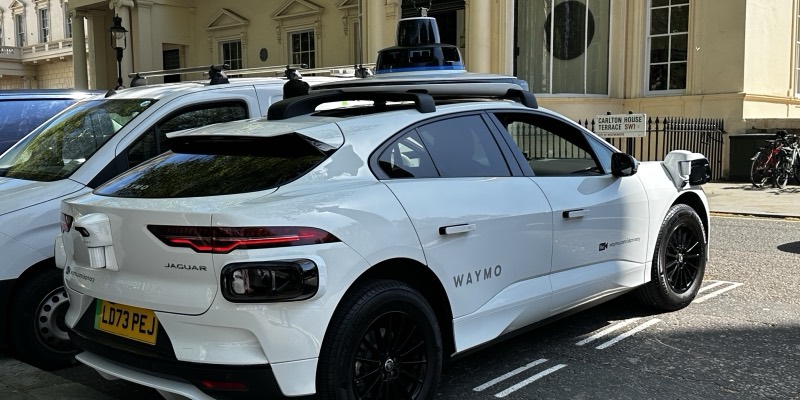
A Waymo Jaguar I-Pace test car on Carlton House Terrace in Westminster, London, in April 2026. Image: Matt Brown / Wikimedia Commons, CC BY 4.0, cropped
Waymo isn’t in London yet, and there’s no confirmed date for when it will be. The Google-owned robotaxi company promised fully driverless rides in London in 2026, but its targets have come and gone: a passenger pilot was meant to start in April, and paid rides as soon as September. Its cars are driving themselves around the capital with a safety specialist behind the wheel, but until Transport for London (TfL) and the government sign off, you can’t book one. Here’s where things stand, and why it keeps slipping.
Updated as of September 25, 2026. We’ll keep this page up to date as the rules and launch plans change.
When will Waymo launch in London?
Officially, “in 2026.” Waymo still says it aims to offer fully autonomous rides in London by the end of the year, but it hasn’t confirmed when paying passengers can use it. In reality, that depends on approvals that no company has yet received, from rules TfL hasn’t yet written. With TfL saying it is in no rush, a public launch before the end of 2026 now looks unlikely.
What you can do today is ride in a self-driving car with a safety driver: Uber and Wayve launched that service in London on September 3.
Waymo in London: the timeline so far
Swipe the table sideways to see every column →
| When | What happened |
|---|---|
| June 2025 | The government brings forward pilots of self-driving taxis and buses to spring 2026, a year earlier than planned. |
| October 15, 2025 | Waymo announces London, its first city outside the US, promising driverless rides in 2026 with fleet partner Moove. |
| Late 2025 | Waymo cars start driving in London with human drivers, mapping streets and learning local driving habits. |
| January 2026 | Waymo targets a passenger pilot in April and paid rides as soon as September, subject to approval. It sets up a base at Park Royal in west London. |
| April 14, 2026 | Waymo cars begin driving themselves in London, with a trained specialist behind the wheel. |
| April 23, 2026 | The government lays the regulations for automated passenger services permits. The April passenger pilot doesn’t happen. |
| July 2026 | TfL tells the London Assembly it is “not in a rush” to publish its guidelines. |
| August 5, 2026 | TfL approves Uber and Wayve for a supervised trial of up to 15 cars for a year. |
| September 3, 2026 | Uber and Wayve launch London’s first self-driving rides, with safety drivers. Waymo’s September target passes without a launch. |
Why is Waymo delayed in London?
The short answer is regulation. Under the Automated Vehicles Act 2024 and the pilot rules the government laid in April, a taxi-style service with no driver needs to clear three separate gates:
- Vehicle approval: the car must be authorised as able to drive itself safely.
- A DVSA permit: the operator needs an automated passenger services permit from the Driver and Vehicle Standards Agency.
- TfL consent: for any service that works like a taxi or minicab in London, TfL has to agree.
As of late August, no company had cleared any of them. No DVSA permits had been issued, no vehicles had been certified for driverless operation and TfL had not published the criteria it will use to decide, Tech Times reported. Without those criteria, operators like Waymo can’t realistically apply.
The government has promised that driverless services will be “independently assessed, monitored and enforced,” and full implementation of the Act isn’t due until the second half of 2027.
What TfL says
TfL is in no hurry. Christina Calderato, its director of strategy, told the London Assembly’s transport committee in July:
I do not think we are in a rush to get the guidelines out.
Christina Calderato, Director of Strategy, Transport for London
She added that TfL wouldn’t be able to accept applications “for some time.” TfL says safety is its top priority, and that any new vehicle licensed to carry passengers must help its Vision Zero goal of ending deaths and serious injuries on London’s roads by 2041. It says driverless vehicles “must be carefully managed.” For the current Wayve trial, a TfL spokesperson said: “A key requirement of any PHV journey is for a licensed PHV driver to be present in the vehicle and that they are responsible for the vehicle at all times.”
There’s also a political row over who is in charge. The government, not London, controls the permits, and London Assembly members think City Hall is being sidelined. Caroline Russell, who chairs the Assembly’s transport committee, said in August:
The regulation of all of this is being controlled by the government when TfL should have a licensing role in this.
Caroline Russell AM, Chair, London Assembly Transport Committee
TfL Commissioner Andy Lord has warned of a “risk” that the Department for Transport could undermine London’s devolved transport powers. The committee is still investigating, and says it has “many questions about the safeguarding of passengers.”
Mayor Sadiq Khan, who chairs TfL, has been wary of AI’s impact on jobs more broadly. In January he warned that AI could become “a weapon of mass destruction of jobs” in London if it isn’t managed, ITV News reported, as Uber drivers protested outside about driverless cars.
Wayve and Uber got there first
While Waymo waits, a British rival has taken the headlines. On September 3, Uber and London-based Wayve launched the UK’s first self-driving ride-hailing service, Bloomberg reported. It’s small and supervised: fewer than 20 Ford Mustang Mach-E cars, each with a TfL-licensed driver ready to take over.
- How to get one: order an UberX, Uber Electric or Uber Comfort, and you may be matched with a Wayve car at no extra cost. You can accept it or switch to a normal car before it arrives.
- Where: anywhere in London except airports.
“We’re proud to introduce the Wayve AI Driver to the public for the first time right here in London, our home city and one of the most complex driving environments in the world,” said Wayve CEO Alex Kendall. Uber and Wayve also want to go fully driverless, but that needs the same DVSA permit Waymo is waiting for. China’s Baidu is testing its robotaxis on both Uber and Lyft’s Freenow in London too.
Waymo, which raised $16 billion in February and runs driverless services in several US cities, isn’t short of money. In San Francisco, it became the city’s second-biggest ride-hailing service within 20 months of launching. London, with some 146 million taxi and minicab trips a year, is the prize.
What cabbies and drivers think
London’s taxi trade is not impressed. The city has around 15,000 black cabs and roughly 100,000 licensed private hire drivers, many of whom see robotaxis as a threat to their living. Steve McNamara, general secretary of the Licensed Taxi Drivers’ Association, has dismissed the idea:
A solution looking for a problem.
Steve McNamara, General Secretary, Licensed Taxi Drivers’ Association
He argues that London’s Roman-era street layout, heavy congestion and pedestrians who cross wherever they like make it far harder to automate than the grid streets of Phoenix or San Francisco, and he has described fully autonomous London taxis as “fantasy land,” Fast Company reports.
Minicab drivers are worried too. “Why would Uber employ a driver when they can employ a robot?” one Uber driver told LondonCentric. The App Drivers and Couriers Union has accused TfL of failing to answer questions about the rules, and in Brent, Green councillor Amandine Alexandre called the delay “a win” for those opposing robotaxis over “jobs, road safety, privacy,” Harrow Online reported.
Londoners themselves are unconvinced so far: 79% say they wouldn’t trust a driverless car or feel comfortable travelling in one, according to an HPI survey cited by the London Assembly.
What happens next
- TfL’s rules: the key step. Until TfL publishes its criteria for consenting to driverless taxis, no operator can realistically apply.
- The London Assembly report: the transport committee’s recommendations are due soon and could shape TfL’s approach.
- The first DVSA permits: whoever gets the first permit, Waymo, Wayve or Baidu, will run London’s first truly driverless taxi.
If you want to try Waymo as soon as it’s allowed, you can register your interest on Waymo’s UK website.
Frequently asked questions
When is Waymo launching in London?
There’s no confirmed date. Waymo says it plans fully driverless rides in London in 2026, but it missed its earlier targets of a passenger pilot in April and paid rides from September. As of late September 2026, none of the approvals it needs have been granted, and TfL says it is not in a rush to publish its rules, so a launch before the end of 2026 looks increasingly unlikely.
Is Waymo testing in London?
Yes. Waymo has a fleet of around 100 Jaguar I-Pace cars based at Park Royal in west London. Since April 2026 they have been driving themselves on London roads with a trained specialist behind the wheel, and Waymo cars have been spotted across central London, from Westminster to Shoreditch.
Can I ride in a driverless taxi in London now?
Sort of. Since September 3, 2026, Uber and Wayve have offered self-driving rides in London through the Uber app, but every car has a licensed safety driver behind the wheel. There is no fully driverless taxi service in London yet.
Why is Waymo delayed in London?
A driverless taxi needs three approvals: the vehicle must be authorised as self-driving, the operator needs an automated passenger services permit from the DVSA, and TfL must give its consent. None of those has been granted to any company yet, and TfL has not published the criteria it will use.
What does TfL say about driverless taxis?
TfL says safety is its top priority and that every new vehicle licensed to carry passengers must support its Vision Zero goal of eliminating deaths and serious injuries on London’s roads by 2041. Its director of strategy told the London Assembly in July that TfL is not in a rush to publish its guidelines.
How much will a Waymo cost in London?
Waymo hasn’t announced London prices. You can register your interest on Waymo’s UK website to hear when rides become available.
What do black cab drivers think of robotaxis?
They’re sceptical. Steve McNamara of the Licensed Taxi Drivers’ Association has called self-driving taxis “a solution looking for a problem,” arguing that London’s streets are far harder to automate than American cities.
Sources: Waymo, GOV.UK, Automated Vehicles Act 2024, Transport for London, London Assembly, Tech Times, Salamander News, Bloomberg, Tech Funding News, Fast Company, LondonCentric, Harrow Online, ITV News