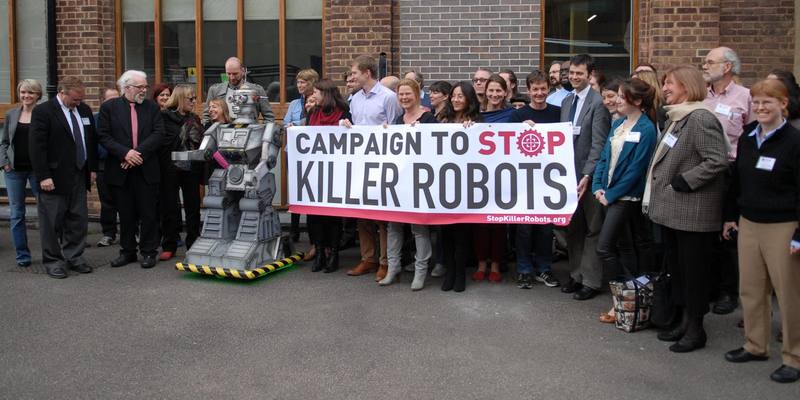
Campaigners at a Campaign to Stop Killer Robots meeting in April 2013. Image: Campaign to Stop Killer Robots / Wikimedia Commons, CC BY 2.0, cropped
The United States and Russia worked together to remove key safeguards from the first serious attempt at global rules for AI weapons, including a requirement that a human review targets chosen by AI before they are attacked, The Washington Post reports. The changes were made behind closed doors in the final hours of UN talks in Geneva this month.
“Death by a thousand paper cuts”
Hundreds of diplomats gathered in Geneva for the UN’s expert talks on lethal autonomous weapons, held under the Convention on Certain Conventional Weapons. The aim was a text that could become the first agreement on how weapons that pick and attack targets on their own may be used. On the last day, according to three people familiar with the negotiations and documents seen by the Post, US and Russian diplomats spent roughly 15 hours rewriting it.
They removed:
- Human review: the requirement that a person check military targets selected by AI before a strike.
- Reliability: language saying the systems must operate in a “predictable” and “reliable” way.
- Ethics: a clause saying ethical considerations must be taken into account when AI weapons are used.
Each country brought about 10 legal experts, nearly twice as many as other delegations, and the rewriting happened in a closed session with the conference room cameras switched off and civil society observers asked to leave. “It was death by a thousand paper cuts,” one person involved told the Post.
What critics say it means
Verity Coyle, deputy director for arms at Human Rights Watch, said the loss of the human review clause matters most:
It could mean machines can make life-and-death decisions without human control.
Verity Coyle, Human Rights Watch, to The Washington Post
Most countries want firmer rules. More than 70 have backed regulating autonomous weapons, and UN Secretary-General António Guterres and the International Committee of the Red Cross renewed calls for stricter limits in August, IBTimes reports. But the talks work by consensus, which lets a few powerful states hold them back:
They have the power to block any significant progress that is made by the vast majority of states who do want to move forward on a binding treaty.
Nicole van Rooijen, executive director, Stop Killer Robots
The US State Department, Russia’s foreign ministry and the UN did not respond to the Post’s requests for comment.
A familiar position from Washington
The move fits the Trump administration’s stance on international AI rules. At the UN General Assembly this month, Trump rejected any “globalist scheme to control” AI. It sits awkwardly with other recent moments, though: Xi Jinping told Trump last week that AI must stay “under human control”, and the two agreed to start talks on AI, and the Pentagon’s fight with Anthropic started when the company refused to let Claude be used for lethal autonomous weapons.
AI weapons are no longer hypothetical. Ukraine’s former defence minister Mykhailo Fedorov said this week he wants a humanoid robot to kill a Russian soldier within six months.
What happens next
The weakened text goes to the convention’s review conference in Geneva on November 16 to 20, where countries will decide whether to start negotiating a legally binding treaty. Richard Lennane, a disarmament adviser for the ICRC, said rules still matter even without a way to punish those who break them: “It’s not about punishment, it’s about setting norms and influencing behavior.”
Why it matters
Whether a human has to sign off before an AI-picked target is attacked is the central question of military AI. If the world’s two biggest nuclear powers can remove that requirement from the first global text, the rules that follow will start from a much weaker place.
Sources: The Washington Post (via The Spokesman-Review), IBTimes UK.