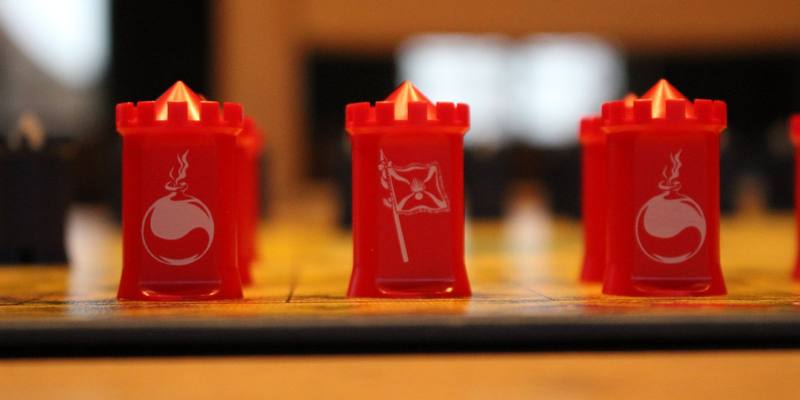
Stratego pieces: two bombs either side of a flag (illustrative). Image: Anthony Van Caeneghem / Flickr, CC BY 2.0, cropped
An AI has beaten the greatest Stratego player in history by a margin nobody has managed at the top level of the game, according to a paper published in Nature on Wednesday. The system, called Ataraxos, won 15 of 20 games against Dutch champion Pim Niemeijer, lost one and drew four.
The researchers, from Carnegie Mellon, New York University, Stanford and MIT, say it is the first superhuman result in Stratego’s history. Even better for anyone without a Big Tech budget, training it cost less than $8,000.
Why Stratego was so hard
Chess and Go are games of perfect information: both players can see every piece. Stratego is the opposite. Each side sets up 40 pieces face down, and a piece’s rank is only revealed when it collides with an enemy piece. The aim is to capture the opponent’s flag, usually hidden behind bombs.
That hidden information is what makes it a tough test for AI. The paper notes that even “multimillion-dollar industrial research efforts” had not reached top human level. The best-known attempt, Google DeepMind’s DeepNash, won 42 of 50 games on an online Stratego site in 2022, but never took the top ranking there, and the authors point out that the site’s best players had largely moved on by then.
Ataraxos learned by playing against itself, then at each move uses a model that guesses what the opponent’s hidden pieces probably are before planning ahead. The training run used 16 Nvidia H100 chips for a week, plus four more for four days. The team says that is roughly a 500th of DeepNash’s compute cost, with a 30th of the self-play games.
“Surprisingly composed”
Niemeijer is no ordinary opponent. According to the paper, he has won four world championships, 15 Dutch national titles and two online world championships, and spent more than 600 weeks ranked number one. After that match, the team took Ataraxos to the 2025 Stratego World Championship in August, where attendees played it 40 times. It won 38 and lost two.
Gabriele Farina, the MIT professor who led the work, told MIT News that the AI handles risk differently from people:
A human might start freaking out if their most valuable piece is exposed, but the bot can be surprisingly composed. It doesn’t overcorrect and give away its secrets.
Gabriele Farina, MIT
The paper’s own notes on its style are more colourful. Ataraxos takes gambles “that humans consider arrogant”, fights on when behind with stalling tactics “some humans consider rude”, and “feels preternaturally lucky, always seeming to have the pieces it needs in the right places”.
Not just one game
The same techniques produced an AI that beat three multi-time world champions at Barrage Stratego, a faster variant, plus new best results in the cooperative card game Hanabi and the Chinese card game dou dizhu. The researchers argue that makes it a general recipe for decisions with lots of hidden information, from negotiations to cybersecurity. The work was partly funded by the US Office of Naval Research, and MIT’s write-up names military manoeuvres as one possible use.
It follows a run of results where AI has taken on puzzles that stumped people for decades, from cracking unsolved Enigma messages to games like this one. The team says the next step is making Ataraxos explain its choices, so humans can check its reasoning before trusting it with anything that matters.
Why it matters
Board games have long been AI’s measuring stick, and Stratego was one of the last big ones where humans still held out. More striking than the win is the price: a result that big labs couldn’t reach with millions of dollars came from a university team on a few thousand, which suggests hidden-information problems are about to get much cheaper to tackle.
Sources: Sokota et al., “Scalable decision-making for games of imperfect information”, Nature (primary); MIT News.
Latest More Labs news