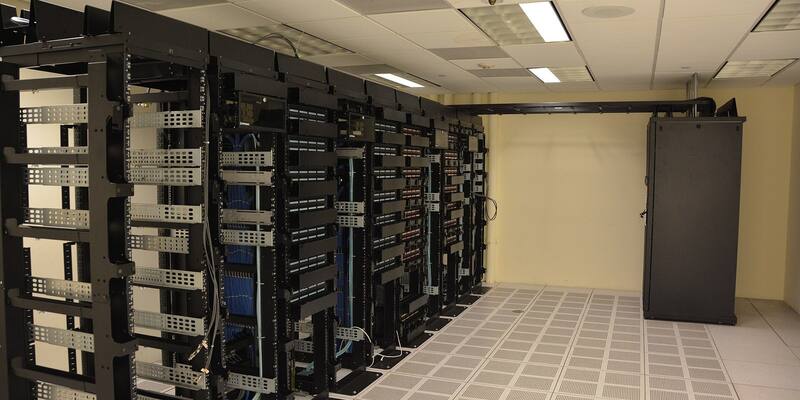

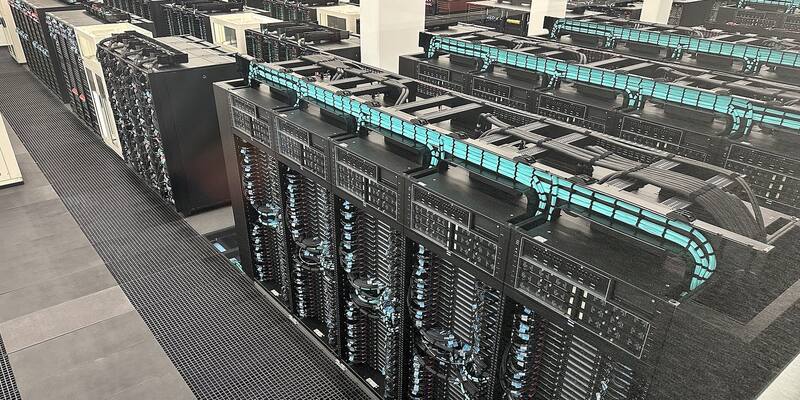
MareNostrum 5, the EU-funded supercomputer at the Barcelona Supercomputing Center, in July 2025. File photo, cropped. Image: Steve Jurvetson / Wikimedia Commons, CC BY 4.0, cropped
Sovereign AI is a country’s ability to build and run artificial intelligence on its own terms: on chips and data centres inside its borders, using its own data and engineers, under its own laws, rather than renting it all from American or Chinese tech giants. Governments from London to Riyadh are now spending billions on it, and the companies selling the kit have made it one of the industry’s favourite phrases.
What does sovereign AI mean?
There is no legal definition, but governments and vendors use the term for control over four things:
- Compute: the AI chips, supercomputers and data centres that train and run models, located in the country and ideally owned or run by local organisations.
- Models: AI models trained or adapted for the country’s languages, culture and laws, either from national labs or open models the country can host itself.
- Data: government, health and business data that stays in the country instead of going to a foreign provider.
- People and rules: local engineers who can build and fix the systems, and the legal power to decide who uses them and how.
The phrase took off in February 2024, when Nvidia’s Jensen Huang (who resigned as chief executive in November 2026) told the World Governments Summit in Dubai that every country needs to own the production of its own intelligence. Nvidia’s current guide to national AI says models should be “hosted and run on local infrastructure, subject only to local laws”, and calls the data centres that do it “AI factories”.
In practice, sovereignty is a sliding scale. A country that trains its own model from scratch on its own supercomputer sits at one end. A government that runs a US company’s model in a local data centre sits nearer the other. Both get called sovereign AI.
Why do countries want sovereign AI?
- Language and culture: the biggest models learn mostly from English text. Countries want AI that handles Hindi, Arabic, Japanese or German well and reflects local norms. India’s Sarvam, for example, builds models for the country’s 22 official languages.
- Law and security: data held by a US company can be demanded by US authorities under the CLOUD Act, even when it sits in a European data centre. Governments, armed forces and hospitals don’t want their most sensitive data exposed to that.
- Supply: the US decides who can buy Nvidia’s most advanced chips, and has used export controls against China. Other countries worry about being cut off, or priced out, in a crisis.
- Money: governments want the jobs, start-ups and tax revenue that come with AI, not just a bill paid to Silicon Valley.
Sovereign AI examples: which countries are building it
Almost every large economy now has a sovereign AI plan. These are the main ones, from official announcements:
| Country or bloc | Main programme | Models and compute |
|---|---|---|
| United States | Focuses on exporting: the American AI Exports Program, which took proposals until June 30, 2026, sells “full-stack” American AI packages to allies | OpenAI, Anthropic, Google and Meta models; Nvidia chips |
| United Kingdom | Sovereign AI, a government-funded venture fund launched in April 2026: £600 million-plus, cheques of £1 million to £10 million | Up to 1 million GPU hours per start-up on national supercomputers such as Isambard-AI |
| European Union | AI Factories, plus up to seven AI Gigafactories in at least seven member states; bids closed November 12, 2026 | EuroHPC supercomputers such as MareNostrum 5 in Barcelona; winners due early 2027 |
| France | Backs Mistral, Europe’s best-known AI lab | Mistral Compute, launched with Nvidia in June 2025 with 18,000 Grace Blackwell chips |
| Germany | Industrial AI deal with Nvidia (October 2026) | Aleph Alpha’s Kolibri; Deutsche Telekom’s AI cloud |
| India | IndiaAI Mission, worth more than ₹10,300 crore (about $1.2 billion) | 38,000-plus GPUs rented at ₹65 an hour, with 20,000 more announced in February 2026; Sarvam models |
| Japan | METI’s GENIAC programme, running since February 2024, pays for computing time for Japanese model builders | Japanese-language models from start-ups, labs and big companies |
| South Korea | National foundation model project and an Nvidia deal for 260,000 GPUs (October 2025) | Models from LG, SK Telecom, Naver and Upstage |
| Canada | Canadian Sovereign AI Compute Strategy, C$2 billion (2024) | Cohere, Canada’s biggest AI lab |
| United Arab Emirates | G42 and Stargate UAE, a 1GW cluster in Abu Dhabi with OpenAI, Oracle, Nvidia, Cisco and SoftBank | First 200MW due in 2026; Falcon and Jais Arabic models; OpenAI models run in the country |
| Saudi Arabia | Humain, a Public Investment Fund company chaired by Crown Prince Mohammed bin Salman | ALLaM Arabic models; up to 500MW of Nvidia AI factories, starting with 18,000 GB300 chips |
| China | Sovereign by necessity, after US chip export controls | DeepSeek, Qwen and Kimi models; Huawei Ascend chips |
Figures come from each government’s or company’s own announcements, and many are plans rather than finished projects.
Sovereign AI vs AI sovereignty vs private AI
The terms overlap and get used loosely:
- AI sovereignty is the goal: a state being able to make its own decisions about AI without depending on anyone else. Sovereign AI is the kit that is meant to deliver it.
- Private AI is the company version: a business running models on its own servers or a private cloud so its data never reaches OpenAI or Google. It is about one organisation’s data, not a country’s.
- Sovereign cloud is a cloud service run inside a country or region, often by local staff, with the customer holding the encryption keys. Microsoft, Amazon Web Services and Google all sell one in Europe.
Vendors increasingly blur the lines. Palantir calls its software a “Sovereign AI Operating System”, and Microsoft’s Sovereign Private Cloud lets governments run Azure, Microsoft 365 and large AI models on their own hardware with no internet connection at all.
Who sells sovereign AI?
Much of the sovereign AI being built around the world is American technology in a local building. The main sellers:
- Nvidia: chips for almost every national project, from Saudi Arabia’s Humain to India’s GPU pool. When Nvidia signed with Humain in May 2025, Huang said “AI, like electricity and internet, is essential infrastructure for every nation”.
- OpenAI: OpenAI for Countries, launched in May 2025, offers to build national data centres and customised versions of ChatGPT; Stargate UAE was the first.
- Microsoft, Amazon and Google: sovereign cloud regions and on-premises versions of their AI services.
- Palantir and Oracle: software and cloud for governments and defence.
- Mistral, Aleph Alpha and Cohere: non-American labs whose models governments can host themselves.
Washington encourages it. When the Commerce Department opened its AI exports programme, White House technology adviser Michael Kratsios described it as “sharing a trusted, sovereign AI stack with the world”. In the US government’s pitch, a country can be sovereign while running American technology from the chips up.
The catch: how sovereign is sovereign AI?
Most sovereign AI is less independent than the name suggests:
- The models: Counterpoint Research’s index of more than 170 national models found 56% were adapted from existing open models, most often Meta’s Llama (38%), Alibaba’s Qwen (20%) and Mistral (19%), as MadRobot reported in its look at what sovereign models are built on.
- The chips: nearly every project runs on Nvidia GPUs, made in Taiwan and sold under US export rules.
- The partners: OpenAI pulled out of Stargate UK and Stargate Norway in April 2026, according to Nscale’s IPO filing, and Microsoft reportedly walked away from Nscale’s planned supercomputer in Essex, a site not expected to get grid power until the 2030s.
- The cost: governments are buying in the middle of an AI spending boom that may not last; MadRobot’s AI bubble guide tracks the warning signs.
Counterpoint’s research director, Marc Einstein, put it plainly: control “is a continuum rather than a switch”.
What happens next
The EU picks its AI Gigafactory winners in early 2027 and expects them to be running within 18 months of selection. India has promised 20,000 more GPUs for its shared pool, the UK’s Sovereign AI fund is making its first investments, and Stargate UAE’s first 200MW was due to go live in 2026. Expect “sovereign” to keep appearing in every big chip and cloud deal with a government.
Frequently asked questions
What is sovereign AI in simple terms?
Sovereign AI is a country building and running its own artificial intelligence: on chips and data centres inside its borders, with its own data and engineers, under its own laws, instead of relying on foreign tech companies.
What is an example of sovereign AI?
India’s IndiaAI Mission is one: the government rents more than 38,000 GPUs to start-ups and researchers at ₹65 an hour and funds Indian-language models such as Sarvam’s. Others include the EU’s AI Gigafactories, the UK’s Sovereign AI fund, Saudi Arabia’s Humain and the UAE’s G42.
What is sovereign AI infrastructure?
The physical layer: AI chips, supercomputers, data centres, power and networks located in a country and run under its laws. Nvidia calls these data centres “AI factories”.
Is sovereign AI the same as AI sovereignty?
Not quite. AI sovereignty is the political goal of a state making its own decisions about AI. Sovereign AI is the infrastructure and models that are meant to deliver it. Many people use the two interchangeably.
What is the difference between sovereign AI and private AI?
Sovereign AI is about a country’s control over AI. Private AI is about one organisation running models on its own servers or private cloud so its data stays in-house. Vendors now sell private AI to governments under the sovereign label.
What is Palantir’s sovereign AI?
Palantir sells its AIP, Foundry and Apollo software as a “Sovereign AI Operating System” that governments and companies can run on their own infrastructure, including air-gapped and classified systems, and in 2026 added Nvidia’s Nemotron open models to it.
Is there a sovereign AI stock?
No single stock tracks sovereign AI. The companies selling into national projects include Nvidia, Microsoft, Oracle and Palantir, and private firms such as Mistral, G42 and Humain. MadRobot doesn’t give investment advice.
Does the UK have sovereign AI?
The UK has a government-funded Sovereign AI fund, launched in April 2026, that invests £1 million to £10 million in British AI start-ups and gives them up to 1 million GPU hours on national supercomputers such as Isambard-AI. It has no national flagship model.
Last checked: November 14, 2026, against the EuroHPC Joint Undertaking’s AI Gigafactories call, the UK Sovereign AI fund’s site, the US Commerce Department’s American AI Exports Program announcement, India’s Press Information Bureau, and Nvidia, Mistral and OpenAI announcements.
Sources: EuroHPC Joint Undertaking; UK Sovereign AI; US Department of Commerce; Press Information Bureau, India; Nvidia blog; Nvidia newsroom; Mistral AI; OpenAI.
Latest Policy & Safety news