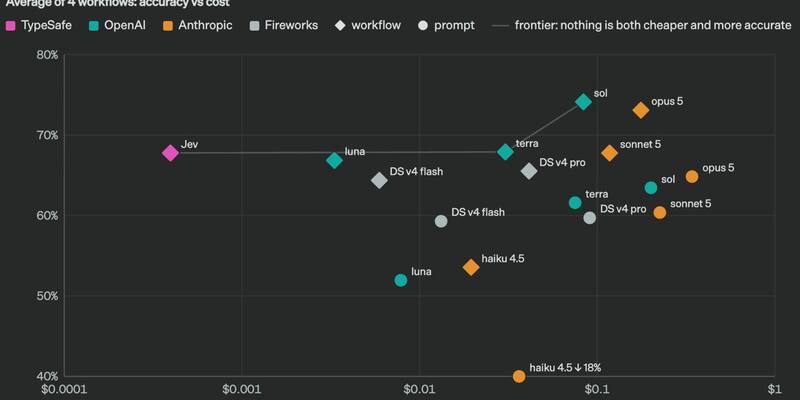
TypeSafe’s own chart comparing Jev’s accuracy and cost with OpenAI, Anthropic and other models across four workflows. Image: TypeSafe AI
Jev is an AI model from TypeSafe AI that makes decisions instead of writing text. You give it some text and a set of typed questions, such as “which team should handle this ticket?” with three options, and it returns an answer to each one with a probability and a confidence score, usually in well under a second. TypeSafe launched it in early access on September 15, 2026, and calls it the first “System One model”. Here’s what that means, what Jev is good and bad at, what it costs, and how it compares with ordinary LLMs and the rivals that have followed it.
What is Jev AI?
Jev is a model built for software to use, not people. A chatbot such as ChatGPT or Claude produces sentences that a person reads. Jev produces structured answers that a program can act on straight away, without having to pull an answer out of a paragraph of text.
TypeSafe is a San Francisco company founded in 2024 by Diogo Almeida, Erik Gafni and Sasha Sheng. Almeida, its chief executive, spent about four years at OpenAI working on the methods behind InstructGPT and ChatGPT. The company spent two years in stealth and announced Jev alongside a $40 million seed round led by DCVC.
The name “System One” comes from Daniel Kahneman’s Thinking, Fast and Slow, which describes fast, intuitive “System 1” thinking and slow, deliberate “System 2” reasoning. Jev is named after the economist William Stanley Jevons, whose paradox says that making something more efficient tends to increase how much of it gets used. TypeSafe’s bet is that much cheaper AI decisions will mean far more of them.
How does Jev work?
You send Jev two things: the state, which is the text it should look at (an email, a support ticket, a document, a JSON record), and one or more questions. Each question is one of three types:
- Choice: pick one option from a list you supply, such as billing, technical or sales. Jev returns the option, a probability for every option and a confidence score.
- Score: rate the text against ordered levels you describe, such as “calm”, “frustrated but civil” and “very angry”. It returns the level, the probabilities and a confidence score.
- Noul: TypeSafe’s name for a yes/no question. It returns a single probability between 0 and 1 that the answer is yes.
The key difference from an LLM is that Jev doesn’t generate its answer one word at a time. TypeSafe says it answers every question in a single parallel pass, and because the possible answers are fixed in advance, it can never return something outside them. That’s why the company says Jev “can’t hallucinate” and never makes type errors: it can still be wrong, but it can only be wrong by picking one of your options.
It was trained with a method TypeSafe calls Reinforcement Learning for Calibrated Decisions (RLCD), which rewards honest probabilities rather than answers human raters like. The aim is that when Jev says it’s 90% sure, it’s right about 90% of the time, so software can act on its own when confidence is high and send the rest to a person.
What is Jev used for?
TypeSafe describes Jev as a “smart if-statement”: the kind of fuzzy judgment a knowledgeable person could make in a second, slotted into ordinary code. Its documentation suggests a good question looks like “does this message convey urgency?”, not “analyse this message and decide what to do”. Typical uses include:
- Routing and triage: sending tickets, emails or requests to the right team, tool or model.
- Classification at scale: tagging documents, products or filings, where an LLM would be too slow or too expensive per item.
- Checking LLMs: screening prompts and replies for hazards, catching citations that don’t support a claim, or scoring retrieved passages before they reach a chatbot.
- Agent decisions: picking which tool or skill an agent should use next. One of TypeSafe’s worked examples chooses one skill from a catalogue of 182.
- Real-time features: TypeSafe quotes response times of 70 to 500 milliseconds, against several seconds or more for a frontier LLM.
Its docs also include recipes for re-ranking legal search results, extracting dates, and classifying company annual reports into 75 industry groups.
Jev pricing and how to get access
| Jev 1.13 | |
|---|---|
| Input price | $0.042 per million tokens ($42 per billion) |
| Output price | Free |
| Speed | 70 to 500 milliseconds per call (TypeSafe’s figure) |
| Context | 64,000 tokens per request; 32,000 for the text plus the longest question |
| Rate limits | 100,000 tokens and 40 requests per second, adjusting while demand is high |
| Input types | Text only (string, JSON or a list of text values) |
| Open weights | No |
Source: TypeSafe’s models page for jev-1.13.0.
TypeSafe’s homepage puts its input price at 238 times lower than Anthropic’s Claude Fable 5.1. In its own demo, one Jev call cost $0.000081 and took 0.114 seconds, against $0.013880 and 8.6 seconds for an LLM doing the same job. Those are the company’s figures, and it admits it can’t prove its prices aren’t subsidised, though it says it expects them to fall.
To get in, you join the early access waitlist on typesafe.ai; TypeSafe says it is letting developers in “as quickly as we can”. Once you’re in, you can try questions in the Playground without writing code, create API keys in the console, and call the API directly or through the Python SDK (pip install typesafe-sdk, Python 3.10 or later) or the JavaScript and TypeScript SDK. There’s also an agent skill that teaches Claude Code and Codex how to write code that uses Jev.
TypeSafe doesn’t publish a list of supported countries. Its service currently runs from the US West Coast, so calls from Europe, India or Australia will take a little longer, and English is where Jev is most accurate: the company says other languages, including Chinese, Japanese and Korean, work but not as well. It says Jev isn’t trained on customer requests, and offers zero data retention to enterprise customers.
What Jev can’t do
Unusually, TypeSafe publishes a list of Jev’s weak spots, which it calls “jaggedness”. For version 1.13 it says Jev:
- Reads literally. It answers the question you wrote, not the one you meant, so instructions need to spell out exact conditions.
- Is bad at maths and counting. It doesn’t reliably count words or items, or compare numbers, colour codes or dates; TypeSafe says to do that in code.
- Struggles with indirection. Questions that need several steps of reasoning, or large inputs full of irrelevant detail, are less accurate.
- Can’t generate anything. No summaries, replies or code. For that you still need an LLM.
It also has no chain-of-thought reasoning, and a Choice question can have at most 255 options. TypeSafe says it gets around that in its own demos by scoring options separately first.
Jev vs LLMs, OpenAI’s Decisions API and Strands Decider
Jev isn’t a smarter LLM. It gives up writing text in exchange for speed, price and predictable answers. TypeSafe’s own workflow tests, which compare models against the average answers of OpenAI’s GPT-6 Astra and Anthropic’s Fable, put Jev at roughly the same accuracy as OpenAI’s Terra and Luna models for a tiny fraction of the cost, but below the most capable models such as OpenAI’s Sol and Anthropic’s Opus 5 (the chart at the top of this page). These are TypeSafe’s own tests, and no independent benchmarks have been published yet.
Barely two weeks after Jev’s launch, two big rivals arrived:
| Jev (TypeSafe) | Decisions API (OpenAI) | Strands Decider 2B (AWS) | |
|---|---|---|---|
| Launched | Sep 15, 2026 | Sep 29, 2026 | Oct 1, 2026 |
| Built on | TypeSafe’s own model | A specialised version of GPT-6 Luna | Qwen3.5-2B with a small scoring head |
| Runs | TypeSafe’s API | OpenAI’s API | Your own CPU or GPU |
| Open source | No | No | Yes (Apache 2.0) |
| Images | No | Yes | No |
| Access | Early access waitlist | Limited preview at launch | Free download |
OpenAI announced its Decisions API at DevDay: you supply context as text or images and a set of predefined answers, and get back answers you can use to classify content, route requests or pick an agent’s next action. Amazon’s Strands team released Strands Decider 2B as open source two days later, saying the class of model had been “gaining a lot of attention since TypeSafe AI’s launch of Jev”. It runs locally and answers in tens of milliseconds, but AWS is clear it’s far worse than reasoning models at complex problems.
For anyone deciding between them: if you need text, code or conversation, stick with an LLM. If your software makes the same kind of judgment thousands of times a day, a decision model is worth testing, with Jev for price and speed, OpenAI if you need images or want to stay with one provider, and Strands Decider if the data can’t leave your own machines. Cheap, fast decisions like these are also part of why a single great model is no longer much of a moat for the big labs.
Frequently asked questions
What is Jev AI?
Jev is an AI model from TypeSafe AI, a San Francisco start-up. Instead of writing text, it answers typed questions about a piece of text: it picks an option from a list, scores something on a scale or gives the probability that a statement is true, with a confidence figure attached to each answer.
What is Jev used for?
Decisions inside software: routing support tickets, classifying documents, scoring content against a rubric, checking whether an LLM’s output is safe or supported by a source, and choosing an agent’s next step. TypeSafe’s docs include worked examples for moderation, re-ranking search results, extracting dates and checking citations.
Is Jev an LLM?
Not in the usual sense. TypeSafe calls it a System One model: it reads text like an LLM but can’t generate text. It returns all its answers in one parallel pass, constrained to the options you define, rather than writing a reply word by word.
Is Jev free?
No, but output is free. TypeSafe charges $0.042 per million input tokens ($42 per billion) and nothing for output tokens. Access is through early access, with a waitlist, and there’s a Playground for trying it once you have an account.
Is Jev open source?
No. Jev is proprietary and only available through TypeSafe’s API, so its weights can’t be downloaded. TypeSafe hasn’t published a technical paper on its architecture.
Can I run Jev locally?
No, Jev only runs on TypeSafe’s servers. If you need a decision model that runs on your own hardware, Amazon’s open-source Strands Decider 2B works in a similar way and runs on a local CPU or GPU.
Is Jev multimodal?
No. Jev 1.13 accepts text only: a string, a JSON object or an array of text values. Images, audio and video have to be turned into text first. OpenAI’s rival Decisions API does accept images.
Can Jev write code or replace Claude in a coding agent?
No. TypeSafe says Jev is not a drop-in replacement for the model behind Claude Code, Cursor, Copilot or similar tools, because it can’t write text or code. You can use a coding agent to write software that calls Jev.
How do I get a Jev API key?
Sign up for early access on typesafe.ai. Once you’re let in, you create keys in the TypeSafe console and call the API at api.typesafe.ai, or use the Python or JavaScript SDK.
Sources: TypeSafe, Introducing System One Models & Jev; TypeSafe homepage; TypeSafe docs: models, quick start, primitives, Jev 1.13 jaggedness, Jev with coding agents; TypeSafe funding announcement; OpenAI DevDay 2026 recap; Strands Agents, Introducing Strands Decider 2B.
Latest More Labs news