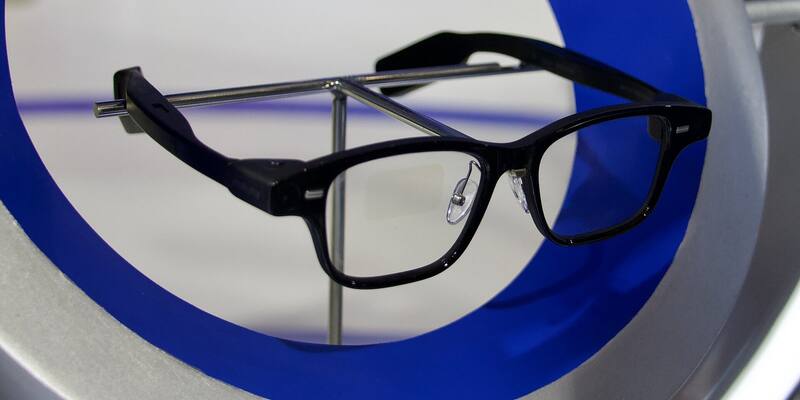
Alibaba’s earlier Quark AI glasses on display at the World Artificial Intelligence Conference in Shanghai in July 2025. The new Qwen Glasses N1 went on sale on October 13, 2026. Image: Xuthoria / Wikimedia Commons, CC BY-SA 4.0, cropped

Alibaba wants you to pay for things by looking at them. Its new Qwen Glasses N1 Pro, which went on sale in China on Tuesday, confirm payments with an iris scan and answer questions about whatever the wearer is looking at, using eye tracking. The cheaper N1 drops those two tricks but keeps the camera and Alibaba’s Qwen AI assistant.
Both pairs were launched at an event in Hangzhou on October 13 and went on sale the same day on Taobao, Tmall, JD.com and Douyin. Alibaba hasn’t announced a launch outside China.
What the Qwen N1 glasses do
Neither model has a display. Instead, they are camera glasses built around a voice assistant: a 50-megapixel sensor that records 4K video, bone-conduction microphones for voice commands and what Alibaba calls a three-chip computing platform, according to IT Home’s report from the launch.
The Qwen assistant can translate, take meeting notes, set travel reminders, keep memos and help with shopping and payments. Alibaba pitches the glasses as a “personal agent” that offers help before it is asked, rather than waiting for a command. Song Gang, the general manager of Qwen’s AI hardware business, has described wearables as a core part of that personal agent, because they can see what the user sees.
The batteries sit in the arms and can be swapped without switching the glasses off. Alibaba quotes nine hours of mixed use for the N1 and eight hours for the N1 Pro.
Iris payments and health tracking on the Pro
The N1 Pro adds three features the standard model lacks:
- Eye tracking: look at an object, then ask the assistant about it.
- Iris-verified payments: a scan of the wearer’s iris confirms a purchase, which Alibaba describes as financial-grade security. Chinese reports say the system was built with Ant Group, Alibaba’s payments affiliate.
- Health monitoring: heart rate, blood oxygen and skin temperature, with AI summaries of the readings.
Alibaba first teased an iris-recognition pair, without a display, at the Bund Summit in Shanghai on September 10, then showed the N1 series at its Apsara conference later that month and opened pre-orders.
How much the Qwen Glasses N1 cost
These are the list prices reported by IT Home, with conversions at Bloomberg’s rate. Bloomberg put the N1’s starting price slightly higher, at 2,999 yuan ($450).
| Model | List price | After China’s subsidy and launch offers |
|---|---|---|
| N1, standard | 2,899 yuan (about $435) | 2,218 yuan (about $333) |
| N1, long-battery set | 3,297 yuan (about $495) | 2,446 yuan (about $367) |
| N1 Pro, standard | 3,399 yuan (about $510) | 2,600 yuan (about $390) |
| N1 Pro, long-battery set | 3,797 yuan (about $570) | 2,829 yuan (about $425) |
The discounted prices rely on China’s national subsidy for consumer electronics and apply only to buyers in China.
Alibaba also launched the Qwen Clip, its first AI earbuds, tuned with Bose. They clip onto the ear, translate between 89 languages and transcribe speech, and cost 1,299 yuan (about $195), or 1,099 yuan at launch.
For buyers in the US, UK, Canada, Germany, Australia and elsewhere, there is no official way to get them yet: Alibaba gave no international pricing or release date.
Alibaba’s growing gadget push
The N1 follows Alibaba’s earlier Quark AI glasses, first shown in 2025, and the Qwen-branded G1 and S1 launched this year. The new range moves into the space led by Meta’s Ray-Ban glasses, which, as Bloomberg notes, cost about the same. Both companies want glasses to become the way people reach their AI assistants.
The same Qwen models power a lot more than glasses. Microsoft built its new Decision-1 model on Qwen, and Alibaba is designing its own hardware further down the stack, including the Zhenwu chip it unveiled last month.
Camera glasses are also drawing pushback. China issued a voluntary code in September asking makers to show a light while recording, and Norway wants to ban AI glasses from parks, schools and gyms because people can be filmed without knowing it.
Why it matters
Iris payments turn AI glasses from a camera and assistant into a wallet, tying Alibaba’s hardware directly to shopping and payments in a way Meta’s glasses don’t yet match. For now the N1 is a China-only product, but it shows how quickly Chinese rivals are catching up with Meta at a similar price.
Sources: IT Home (launch, prices and specs); Bloomberg; IT Home (Apsara preview); TechNode.
Latest More Labs news