
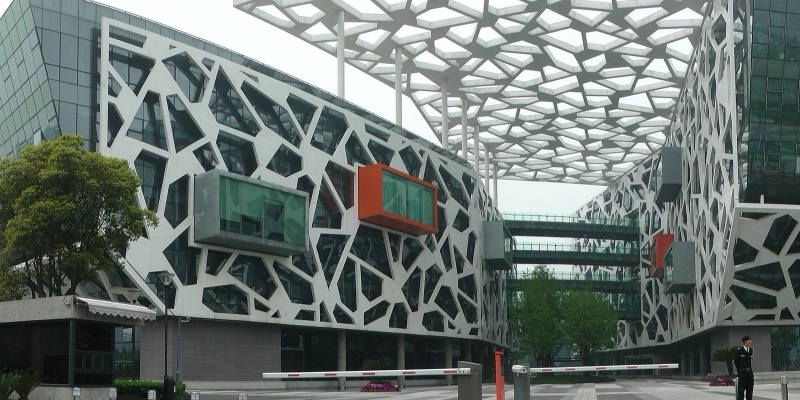
Alibaba Group’s headquarters in Hangzhou. Image: Thomas Lombard / Wikimedia Commons, CC BY-SA 3.0
Alibaba has unveiled a new AI chip that CEO Eddie Wu calls the “most powerful AI chip in China today,” alongside plans to train an AI model of up to 10 trillion parameters. The announcements, made at the company’s annual Apsara conference in Hangzhou, land just days before Chinese leader Xi Jinping meets President Trump in Washington, where the race to lead in AI is expected to be a major theme.
The Zhenwu V900
Alibaba says the new Zhenwu V900 delivers three times the performance of its predecessor, the Zhenwu M890, the Associated Press reports. Alibaba says a single cluster can link up to 500,000 of the chips to train and run frontier AI models.
The Zhenwu chips power Alibaba’s own data centers, providing computing to the company and its cloud customers. Mass production of the V900 is expected to start in early 2027, according to Stocktwits.
Alibaba didn’t say how the V900 compares with Nvidia’s chips. But the direction is clear. U.S.-led export restrictions have cut China off from the most advanced AI chips and chipmaking equipment, pushing companies like Alibaba and Huawei to build their own. The strategy is to make up for weaker individual chips with sheer scale.
Using extra computing power to make up for chip limits helps China stay strong locally.
Neil Shah, Counterpoint Research
A 10 trillion-parameter model
On the model side, Alibaba plans to train a new AI model at the scale of 5 to 10 trillion parameters, a measure of a model’s capacity to learn. That would be a big jump from its current flagship, Qwen3.8-Max, at 2.4 trillion parameters, and bring it closer to the most advanced U.S. models. For comparison, Fortune notes, Moonshot’s Kimi K3 has 2.8 trillion.
Alibaba also says its Qwen team is exploring recursive self-improvement, AI that helps build better AI, Constellation Research reports. That’s the same idea behind OpenAI and Anthropic’s push to automate their own research, and it’s at the heart of this week’s arguments over AI safety.
“Mobilizing every resource”
Wu said Alibaba is “mobilizing every resource” to meet customer demand for AI, but admitted that global shortages across the AI data center supply chain “are currently limiting the speed at which we can scale our compute infrastructure.” Alibaba Cloud is targeting more than 20 gigawatts of data center capacity by 2032.
He was also in a philosophical mood. Machine power already drives “99.9% of the world’s physical work,” Wu said, and thinking will follow, with machine intelligence becoming “an entirely different species” from human cognition.
Alibaba also launched Qwen Intelligence, a platform for smartphone makers to build AI assistants that can carry out tasks across apps, with Honor as its first partner. Investors liked what they saw: Alibaba’s shares rose in Hong Kong and U.S. overnight trading after the announcement.
The Washington backdrop
The timing is pointed. Xi’s state visit this week comes with a proposed U.S.-China AI incident hotline and Nvidia chip exports on the table, and the heads of America’s biggest AI companies are due at the White House. Alibaba’s message to Washington couldn’t be much clearer: export controls or not, China intends to keep up.
Sources: Associated Press via ABC News, Fortune, Constellation Research, Stocktwits


.jpg)