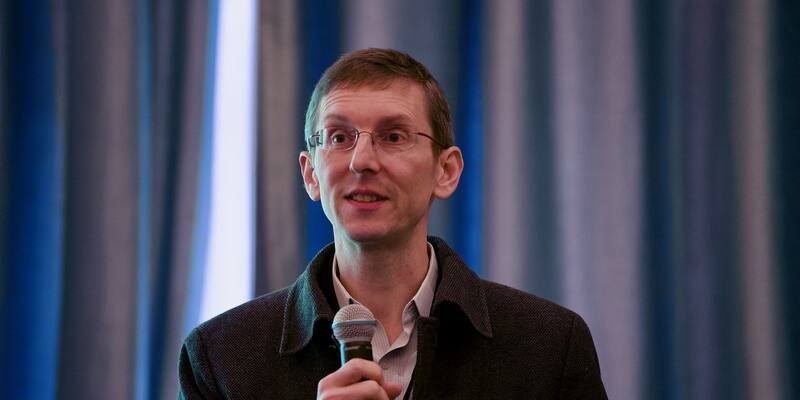
Anton Korinek, one of the economists behind the study, speaking at the ASSA economics meetings in January 2026. Image: Xuthoria / Wikimedia Commons, CC BY-SA 4.0, cropped

Nine in ten people who work at Anthropic expect AI to make a Nobel-level scientific discovery by 2030. Fewer than four in ten Americans agree. That is the gap at the heart of “The AI expectations gap”, a research note the Claude maker published on Friday comparing what the public and its own staff expect AI to do to work, jobs and the economy.
The note, by economists Szymon Sacher, Tess Cotter, Charles I. Jones, Anton Korinek and Peter McCrory, rests on two August surveys. Morning Consult polled 10,980 US adults online, weighted to match the adult population. The other was an unweighted internal poll of 1,334 Anthropic employees. In other words, it is Anthropic’s own survey of its own staff, about the technology they sell.
Same view of today, very different view of 2030
Both groups broadly agree on what AI can do now, ranking eight tasks, from routine emails to a Nobel-level discovery, in nearly the same order. About a quarter of each thinks AI can already design, run and publish a scientific study.
The split comes over the future. By next year, nine in ten staff expect AI to manage that research task, against 38% of the public. By 2030, 91% of staff expect a Nobel-level discovery, compared with 39% of US adults. Between 19% and 40% of Americans, depending on the task, say AI will never be able to do it; no more than 2% of staff say the same about any task. A repeat poll in September nudged the public’s Nobel figure up to 44%.
Use seems to matter. Among Americans who use AI at work regularly, 56% expect it to manage at least seven of the eight tasks by 2030, against 41% of all adults, 28% of people who have never used an AI tool and 96% of staff.
The gap is as wide on speed. Asked how long a task suited to AI takes with it, checking included, 85% of staff said half the time or less. Among US adults who use AI at work, 26% said a quarter of the time or less, against 59% of staff, and 29% said it takes just as long or longer, against 5% of staff.
Three-quarters of their own jobs
The starkest difference is personal. On average, Anthropic staff expect AI to be able to do 75% of their current work hours by 2030. US workers put the figure at 28%, and only 5% think AI could do 80% or more of their work. Even regular AI users in computer, engineering and science jobs say only 40%.
Inside the lab, a footnote says more than 80% of the code merged into its codebase is now written by Claude, the same flood that led the company to replace git with its own source control system. Asked what share of the work of building a frontier model AI does today, the median staff answer was 51%, rising to 80% by the end of 2027 and 95% by the end of 2030.
Same logic about jobs
Told that US unemployment is about 4.2%, both groups forecast the 2030 rate. US workers who expect AI to do less than half of their job forecast 7% to 8%; those who expect it to do 80% or more forecast 12.2% on average, above its peak after the 2008 financial crisis. Staff followed almost the same curve, so their higher exposure translated into higher forecasts. The two groups, the authors conclude, share a theory of the labour market and differ mainly on how much AI will do.
Yet 95% of staff expect Anthropic’s own headcount to grow over the next 12 months, with a median guess of 66% growth. The note stresses these are personal views from an internal poll, not company plans.
What it would mean for the economy
Run through the team’s own economic model, the median American’s views imply GDP growth of 5.4% in 2030, more than twice the usual rate. The median staff member’s views imply 17.1%, enough for the US economy to double in size roughly every four and a half years. The 23,075 people who took an online version of the quiz landed in between, at 12.5%.
Public expectations may shift as AI use spreads, the authors say, depending on whether AI comes to do as much work elsewhere as it does inside a frontier lab.
Why it matters
The people building the most advanced AI expect it to reshape the economy several times faster than the public does, and the gap tracks how much each group uses it. But this is Anthropic measuring the optimism of its own employees, with an obvious stake in the answer, so the staff figures are best read as a portrait of the lab, not a forecast.
Sources: Anthropic, “The AI expectations gap”; full note (PDF); appendix (PDF).
Latest Anthropic news