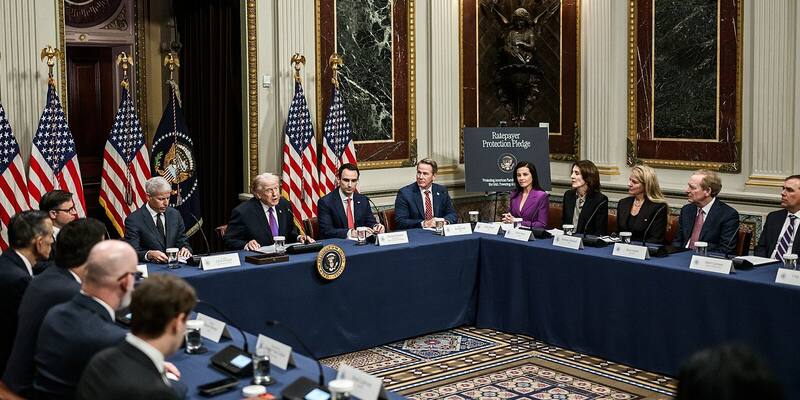
President Trump at the White House Ratepayer Protection Pledge roundtable with tech executives on March 4, 2026. Image: The White House / Wikimedia Commons, Public domain, cropped

President Donald Trump says America’s biggest new data centres now have to make their own electricity, and should pay the towns that host them to win them over. In a Truth Social post at 1:37am Eastern time on Wednesday, he wrote that new and large data centres, “in some cases gigantic”, are “mandated by me to make their own electricity, and give or sell any excess back to the local community, or grid”.
He added that this could bring a “substantial decrease” in power prices, and told companies how to make their projects popular:
If companies want to make their Data Centers popular, pay the community, and/or individuals within the community, a “dividend.”
Donald Trump, on Truth Social
He said he had been “watching Data Centers very closely” as president, and that projects that were “highly unpopular in a certain area, have become extremely popular when a financial deal is struck”. The post ended: “MAKE DEALS, and get them built!!! GREAT FOR THE U.S.A.”
Which order?
The post doesn’t name an executive order, rule or law, and it doesn’t say how the requirement would be enforced, how big a data centre has to be for it to apply, or how a “dividend” would be paid or to whom.
The closest thing on the books is the Ratepayer Protection Pledge, which the White House published on March 4. Under it, the big cloud and AI companies agree to “build, bring, or buy” all the new power their data centres need and pay the full cost of it, pay for grid upgrades, and pay for the power they reserve “whether they use the electricity or not”. Amazon, Google, Meta, Microsoft, OpenAI, Oracle and xAI signed it that day, and in July the White House said more than 200 utilities, developers and states had joined.
The pledge is voluntary: the White House describes it as a “call” on companies, which “agree” to its terms and will “voluntarily negotiate” new rates with utilities. It also lets companies buy power from new plants rather than generate it themselves. Wednesday’s post goes further, saying the power must be made by the data centres and any surplus shared. The “dividend” is new too: the pledge asks companies to invest in local jobs and training, not to pay residents.
We covered the pledge, and the gap between Trump’s AI rhetoric and his own government’s policy, in our analysis last month.
A post on the day of a bad poll
The post went up hours before a new ABC News/Washington Post/Ipsos poll found that 66% of Americans oppose building new data centres, rising to 72% when the data centre would be in their own community. Only 30% approve of how Trump is handling AI.
Opposition has been growing for months. The backlash reached Trump’s home county in Florida in September, and a report by Senator Elizabeth Warren and two colleagues found that Amazon, Google, Meta and Microsoft won’t pay the full grid costs of their AI data centres. A bill introduced in Congress this month would make data centres, not households, pay for the power they need.
Trenton, Ohio, votes on a ban in two weeks
Trump’s idea of paying communities is already being tested in a small Ohio city. On November 3, voters in Trenton, in Butler County, will decide Issue 17, a charter amendment that would ban data centres with a peak load of more than 25 megawatts. It would block a proposed Amazon data centre on about 600 acres just south of the city.
The city council has put forward measures that only take effect if the ban is voted down: waiving the city’s general fund property tax for 2026, ruling out some new tax levies until at least 2035, and a 30% discount on YMCA memberships once construction begins. Mayor Ryan Perry said the aim was to lay out the consequences of the vote, “laying them on the table so the voters can know this will happen.” Some residents called them “five dangling political carrots”.
Amazon has offered $1 billion to win over towns that host its data centres, and its AWS staff met Trenton residents last week ahead of the vote.
Why it matters
Trump is now telling the AI industry to win over angry towns by sharing power and cash with them, and he says it is mandatory. But until the White House names the order behind it, the only policy in place is a voluntary pledge, and towns like Trenton are setting their own terms at the ballot box.
Sources: Donald Trump on Truth Social (archived copy); White House, Ratepayer Protection Pledge; White House, July update; FOX19; WCPO.
Latest Policy & Safety news