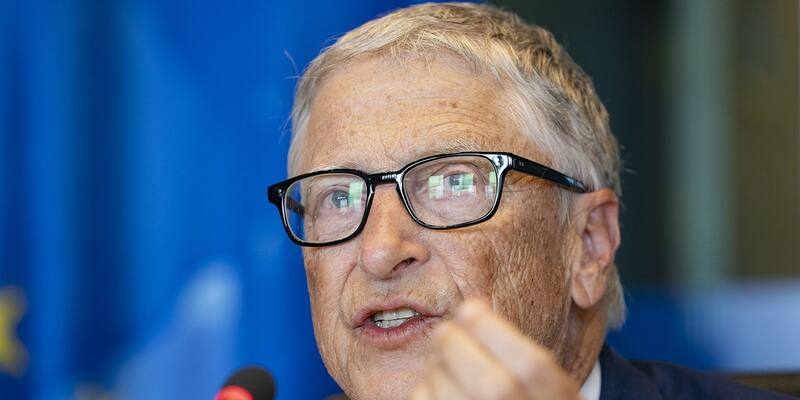
Bill Gates speaking to the European Parliament’s development committee in Brussels in June 2025. Image: Philippe Buissin / © European Union / Wikimedia Commons, Attribution, cropped

Bill Gates says the world should brace for about two decades of upheaval as AI takes over more of the work people do, and that some people may respond by opting out. “Even in the very best case of how we manage AI, this is going to be as tumultuous a period as there’s been in human history,” the Microsoft cofounder told Nilay Patel on The Verge’s Decoder podcast, published on Thursday, October 22.
Gates has been sounding the alarm since his late-August essay, “The turbulent AI era is here”, including on Meet the Press, where he said AI could cause “a billion deaths”. This time he put a timeline on the disruption and suggested society could split over how much AI to accept.
A 20-year transition
Gates sees an eventual era of abundance, with robots that “build houses, grow food, do surgery”, unless the world chooses “to massively slow down or stop”. Getting there is what worries him. He called 20 years “a reasonably safe number”, depending partly on how soon humanoid robots arrive:
My big concern is this 20-year transition period, where they’ll have winners and losers and a lot of disruption, and we have to get through that in order to get to that period of abundance.
Bill Gates, on Decoder
The damage starts much sooner, he said. Within two to three years, “you’ll see significant negative effects” from AI-driven cyberattacks and in the job market. White-collar work like telesales and accounting goes first, because “there isn’t some mountaintop of cognition that the AI does not achieve.”
‘Let’s be like the Amish’
Asked what young people should hold on to, Gates pointed to the Amish as a group that does not live at the technology frontier, and said “a lot of humanity may choose not to live at the technological frontier because of things we get from helping each other or coming up with unique ideas.”
Societies could also keep some jobs for people even where AI would do them better. Gates said he had proposed in his memo that professions such as childcare, food preparation, art and sports “might get chosen to be human-reserved”. “You could literally say, ‘Let’s be like the Amish, and let’s only use AI for certain things,’” he said.
He has tried the idea out on Anthropic’s Claude, aiming to reserve about 40% of the labour market for people, alongside early retirement and shorter working weeks. Claude kept pushing back, he said, telling him: “You’re artificially restricting the AI from doing these things.” “I couldn’t get to a very high percentage without doing that,” Gates added.
‘The most dangerous weapon of all time’
“No, I’m not a doomer,” Gates said, and the problem is not that AI bosses ignore the risks. Sam Altman, Dario Amodei, Satya Nadella and Sundar Pichai all understand “there are some grave challenges here,” he said, but once several companies compete at the frontier, “the responsibility becomes the government’s responsibility.” He would back a globally enforceable slowdown, but said one is very hard to induce, with people asking whether China would agree and whether compliance could be audited as nuclear weapons production is: “there is no credible proposal that makes that work.” Instead, he said:
Today’s debate is literally whether the government should even pay attention to the dangers here. You don’t even have to show what you’re doing and so it’s a “voluntarily call me if you’d like” type of thing, which is clearly inadequate for the most dangerous weapon of all time.
Bill Gates, on Decoder
When Patel described the Trump administration’s approach as “let it rip” and noted that Trump has called AI risk a hoax, Gates was diplomatic: “The more the administration learns about these dangers, the more they’ll move to a more nuanced position about protecting Americans from the downsides here.” A climate-style split where one party doesn’t care “would be a failure of democracy,” he added. Asked whether it will take a disaster to force action, he said: “Probably yes.”
Lock the safeguards in
His fix: models above a certain capability should run only on platforms that certify to the government that users can’t strip out the safeguards and monitoring, with rules applied to platforms and distribution, “not at the chip level”. Releasing open weights that let anyone remove all safeguards is “irresponsible” given the cyber and bio risks, he said, a similar worry to the one behind Geoffrey Hinton and Yoshua Bengio’s letter on hacking-capable models. Relying on liability laws instead “will be looked back on as absurd,” he added.
Why it matters
Gates has moved from general warnings to a timeline and a specific fix: lock safeguards into the most powerful models wherever they run. His view that change will probably need a disaster first is a bleak read on how ready governments are to act before one.
Latest Policy & Safety news