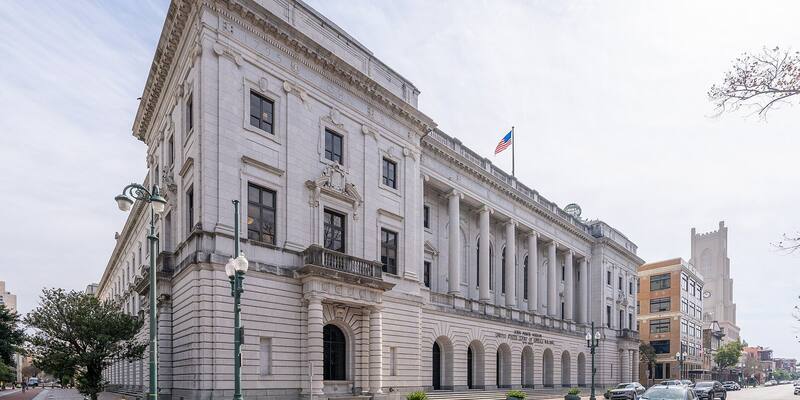
The John Minor Wisdom US Court of Appeals Building in New Orleans, home of the Fifth Circuit, photographed in February 2026. Image: Ajay Suresh / Wikimedia Commons, CC BY 4.0, cropped

A federal appeals court has taken a case away from a judge whose AI-drafted order named plaintiffs who weren’t in the lawsuit and quoted words that aren’t in the law. In a published opinion on Thursday, a Fifth Circuit panel vacated US District Judge Henry Wingate’s preliminary injunction against Mississippi’s ban on diversity, equity and inclusion (DEI) programmes in public schools and colleges, and ordered the case handed to a different judge.
Judge Jerry Smith, joined by Judge Kurt Engelhardt, wrote that the proceedings below “were a botch job, to say the least.”
What the AI-drafted order got wrong
Wingate’s temporary restraining order of July 20, 2025, paused House Bill 1193, passed that April. According to the appeals court, it:
- named as plaintiffs eleven people and organisations who had never been party to the case;
- named as defendants two officials who had not been sued;
- claimed, without evidence, that three colleges had already cancelled DEI programmes because of the law;
- quoted the law as covering “critical race theory”, “race or sex scapegoating” and “institutional bias”, terms that appear nowhere in its text;
- cited declarations from four people who “do not appear in the record at all and may not even exist.”
When the state pointed out the errors two days later, Wingate removed the order from the docket and replaced it, without explanation, with a corrected version backdated to July 20. He refused to restore the original and called the mistakes “clerical.” The panel says it was “lucky” the state had filed a copy, “given that Judge Wingate kept it from public view.”
Senator Chuck Grassley, chairman of the Senate Judiciary Committee, then wrote to Wingate asking whether AI had been used. In reply, Wingate admitted a law clerk had used AI to help draft an earlier version that was docketed by mistake, and said the errors didn’t touch the “core legal reasoning or the ultimate judgment on the merits.” Grassley’s letter set out the standard he expected:
No less than the attorneys who appear before them, judges must be held to the highest standards of integrity, candor, and factual accuracy.
Senator Chuck Grassley, chairman, Senate Judiciary Committee
A court case that doesn’t exist
The fix didn’t catch everything. At oral argument before the Fifth Circuit, it emerged that the corrected order still cited “Cousins v. School Bd. of City of Norfolk”, a supposed 1974 Fourth Circuit ruling. The panel calls it “an apparent AI hallucination.” Its citation lands in the middle of an unrelated Sixth Circuit case. Because the later injunction “generally incorporates by reference” the restraining order, the fake case is “arguably part of the shoddy reasoning of the preliminary injunction, too,” the panel writes.
The panel was scathing:
This district judge carelessly exercised his Article III power by issuing sloppy edicts based on falsehoods and fabrications.
Judge Jerry Smith, Fifth Circuit opinion
Upon discovering the falsehoods, the opinion says, Wingate “dug in his heels” and never explained why the order should stand without them. It accuses the lower court, “or perhaps, being charitable, its AI agent”, of manipulating the law, “apparently to satisfy a policy agenda,” and lists legal errors that had nothing to do with AI.
‘Extraordinary’ but necessary
The opinion calls reassignment an “extraordinary” and “rarely invoked” power, but says “This case easily calls for reassignment.” Given “the embarrassment of the AI hallucinations,” Wingate could “reasonably be expected to have substantial difficulty in setting aside previous views,” and an objective observer “might question the impartiality of the proceedings.”
The court told the chief judge of the Southern District of Mississippi to assign the case to someone else, and set out how the new judge must apply the Supreme Court’s test for First Amendment challenges, saying most of the law “rests squarely within the heartland” of the state’s power over its schools. The plaintiffs, including a teachers’ union, students, professors and parents, can still pursue the case.
The third judge, Catharina Haynes, joined only the final paragraph ordering the new judge, not the reasoning. In a short concurrence she wrote that it is “very important to make sure that teachers at school are in no way limited or forbidden from teaching the students not to discriminate.” Wingate hasn’t commented.
Courts elsewhere are grappling with AI’s mistakes too: a UK judge set out rules after a man filed a ChatGPT-written argument, and German courts have held Google liable for false claims in its AI answers. This time the errors came from the bench.
Why it matters
Lawyers have been fined for years over AI-invented citations; now a judge has lost a case over them. The ruling makes clear that an AI slip in a court order isn’t “clerical”, and that a judge who won’t own it can be taken off the case.
Sources: Fifth Circuit opinion, Jackson Federation of Teachers v. Fitch, No. 25-60496; Senate Judiciary Committee.
Latest Policy & Safety news