
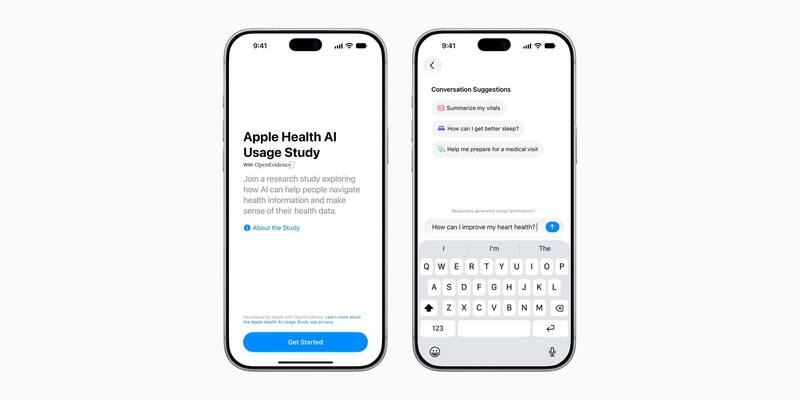
The Apple Health AI Usage Study app on two iPhones, in a press image from Apple. Image: Apple
Apple wants up to 200,000 iPhone owners to ask an AI app about their symptoms, sleep and lab results, so it can learn how much people trust the answers. The company launched the Apple Health AI Usage Study in the US on Sunday, with a free study app built on technology from OpenEvidence, a clinical AI tool used by doctors.
What the study app does
Participants download the Apple Health AI Study App, enrol, and then use it like a health chatbot. Apple says answers draw on medical sources such as The New England Journal of Medicine, the Journal of the American Medical Association and Nature, are written in plain language and come with links to the peer-reviewed research behind each response.
The App Store listing suggests four uses: understanding symptoms or conditions, putting your Health data in context, preparing for a medical visit, and building a personal exercise or meal plan. Users can choose to share HealthKit data such as resting heart rate, activity, sleep or lab results, which Apple says will help it test whether personal data makes answers more relevant and easier to understand. One screen in Apple’s press images shows a “visit prep summary” to take to a doctor.
Apple says the study will measure what drives trust, the quality of responses, how well people understand them and what they do next. Participants rate answers for accuracy, detail and relevance, and Apple told TechCrunch the study will run for more than 12 months with monthly surveys.
Who can join, and where
For now the study is open only in the United States. Apple says participants must be 21 or older and have an iPhone 15 Pro or later that supports Apple Intelligence, running iOS 26 or later. The app is free, English only and rated 18+ on the App Store.
There is no version for the UK, Canada, Germany, Australia, the EU or anywhere else, and Apple hasn’t said whether the study will expand.
What happens to your data
Apple says study data will not be used to train AI models, that sharing HealthKit data and survey answers is optional, and that it has security measures to protect what it holds. Apple told TechCrunch the data is anonymised before it goes to a secure third-party cloud provider, and that OpenEvidence deletes question and answer data after 24 hours. The study falls under Apple’s health study apps privacy policy.
The app also has guardrails meant to spot certain worrying questions and point people to a doctor or other help. Apple says the app is not meant to diagnose or treat any condition or replace medical advice. That matters: chatbots have already given risky health advice, including a ChatGPT case in which a lawsuit says it coached a woman off her seizure drug. People still turn to them, sometimes with striking results, as when ChatGPT named a toddler’s ultra-rare condition before tests confirmed it.
‘Patients and clinicians are both turning to AI’
Apple brought in Robert Wachter, chair of the Department of Medicine at UCSF, to make the case for tools shared by patients and their doctors:
Patients and clinicians are both turning to AI, but the tools they use are being built and tested in separate worlds. When patients and doctors draw on versions of the same trustworthy tools, patients arrive prepared, conversations improve, and next steps happen seamlessly.
Robert M. Wachter, M.D., UCSF
Sumbul Desai, Apple’s vice president of Health and Fitness, said “conducting a dedicated research study is the most thoughtful way to understand how people engage with, comprehend, and evaluate health AI in everyday life”.
The App Store pitch is more direct: “Help Apple build better health AI products.” Apple says the findings will inform “the responsible design of health AI experiences for Apple and the industry”, but it hasn’t said whether chatbot answers like these will come to the Health app or Siri. The Verge notes the study app doesn’t run on Apple Intelligence itself, even though it needs an iPhone that supports it.
The study arrives as rivals push harder into medicine. Microsoft’s diagnostic AI solved 83% of hard cases in a Science study, and OpenAI and Anthropic both offer health features in their chatbots, while Apple has been accused of falling behind in AI.
Why it matters
Millions of people already ask chatbots about their health, but there is little hard evidence on whether they understand or act on the answers. Apple is choosing to gather that evidence at scale, with real Health data, before shipping anything of its own, and the results could shape how careful the whole industry has to be.
Sources: Apple Newsroom; App Store (Apple Health AI Study App); Apple Health Study Apps Privacy Policy; TechCrunch; The Verge.
Latest Apple news