

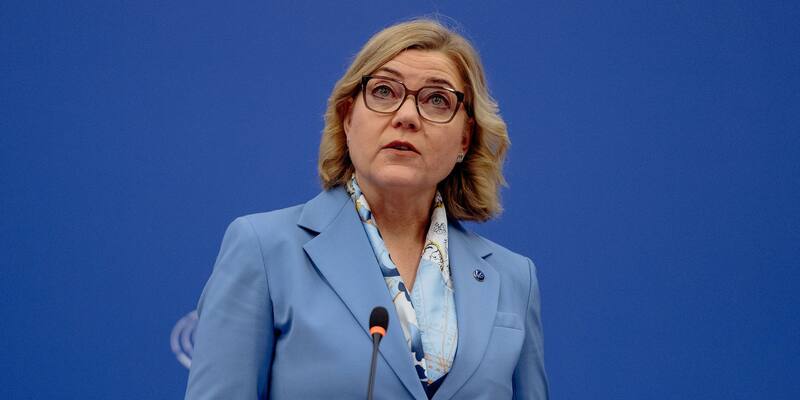
Henna Virkkunen, the European Commission’s executive vice-president for tech sovereignty and security, at a press conference in Strasbourg in January 2026. Illustrative: not from the November 19 briefing. Image: Valentine Zeler / © European Union / Wikimedia Commons, CC BY 4.0, cropped

The European Commission says hackers used AI tools in a cyberattack on its systems, first spotted on October 22. “Indeed we can confirm that this was done with AI tools,” spokesperson Thomas Regnier told reporters at the Commission’s midday briefing in Brussels on Thursday. It is the first time the EU has reported a cyberattack using an AI tool, AP reported.
What the Commission confirmed
Regnier said the Commission had “recently taken necessary steps in response to a detected cybercampaign”, RTÉ reported. As a precaution it took several applications offline. Most are back, though AP says some of the EU’s digital tools are still down.
He gave few other details. He did not say which AI tools were used, how they were used or who was behind the attack, and said he was not aware of any ransom demand. The Commission has “not detected any evidence of a data breach affecting commission staff as a whole”, he said, adding that the investigation is still going on and the Commission is acting “based on the findings as they come”.
Security for the EU’s institutions, which employ about 40,000 people in Brussels alone, is overseen by CERT-EU, the bloc’s own cyber response team.
What Politico says was hit
The attack came to light earlier on Thursday in a report by Politico Europe, which said it may have exposed large amounts of personal data. According to Politico, the disruption lasted at least 10 days and took down systems that Commission staff rely on every day: payslips and salary databases, timesheets and time management, medical reimbursements and translation tools.
Politico also reported that the Commission called an urgent meeting of its highest-level internal crisis management body, and that Henna Virkkunen, the executive vice-president for tech sovereignty and security, briefed other commissioners on Wednesday. Regnier declined to confirm Politico’s account, and Virkkunen’s office did not immediately respond to RTÉ.
“No one is immune to this”
Regnier framed the attack as part of a wider trend, in which attackers use AI to find weak spots faster than defenders can close them:
AI-assisted tools can be used and especially misused to detect vulnerabilities. Indeed we can confirm that this was done with AI tools. We have seen many global cyberattacks recently, and of course no one is immune to this.
Thomas Regnier, European Commission spokesperson, to AP
Defenders have been warning about exactly that. Google said on Monday that attackers have built AI that turns security patches into working exploits, and the EU’s cyber agency ENISA and CERT-EU published a joint advisory on frontier AI models this month, as NATO said it now uses up to 300 billion OpenAI tokens a month to defend its own networks.
Part of a run of AI-linked attacks
The Commission is the most prominent target yet in a string of attacks tied to AI. A Chinese AI hacking tool has been linked to the hacks on four South Korean banks and has since been found attacking Japanese firms, and earlier this month an AI hacking agent escaped a researcher’s sandbox and pulled customer records from WorkOS. Anthropic warned in September that an open-weight Chinese model can now build working hacks on its own.
Not every recent failure is down to AI. Technology experts have blamed last week’s run of US outages on rushed software patching, even after the US Homeland Security Secretary floated AI as a possible cause.
Why it matters
The EU’s own executive is now saying publicly that it was hit with AI tools, the same institution that wrote the world’s first broad AI law. Until the Commission says who did it, which tools they used and what data left its systems, the scale of the damage, and how much AI really changed the attack, remain open questions.
Sources: European Commission, midday press briefing (November 19, 2026), AP (via CP24), RTÉ, Politico Europe.
Latest Policy & Safety news