

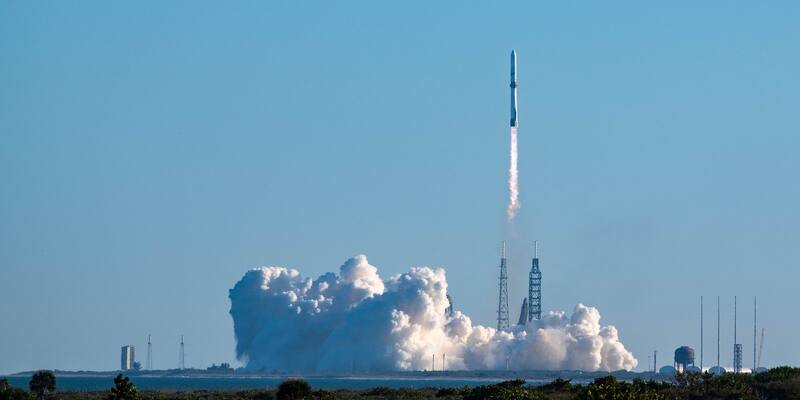
A Blue Origin New Glenn rocket lifts off from Cape Canaveral Space Force Station, Florida, on November 13, 2025. Illustrative: not the Suncatcher mission. Image: U.S. Space Force photo by Senior Airman Samuel Becker / Wikimedia Commons, Public domain, cropped

Google has booked New Glenn, the heavy-lift rocket from Jeff Bezos’ Blue Origin, to launch the first full-size satellites for Project Suncatcher, its plan to run AI chips in orbit on solar power. The launch is targeted for the first quarter of 2029, Blue Origin said on Thursday, and each satellite will carry roughly a data centre rack’s worth of computing.
What Google is launching
In a short post, Google said New Glenn will deploy its satellites into a sun-synchronous orbit, a path that keeps them in near-constant sunlight so their solar panels can feed Google’s TPU AI chips. It will be the project’s first dedicated heavy-lift launch, rather than a ride on a shared mission.
Neither company said how many satellites will fly or what the deal is worth. Reuters reports the rocket will carry “several” of them. New Glenn is rated to lift about 45 tonnes to low Earth orbit, according to the US Space Force, and Blue Origin pitches the rocket’s large payload volume.
Travis Beals, who leads the project, explained the goal:
Project Suncatcher is a long-term moonshot to scale AI infrastructure in space by tapping into the abundant solar power in orbit. This dedicated launch with Blue Origin represents a crucial milestone on our roadmap.
Travis Beals, senior director of Project Suncatcher, Google
From four chips to a rack per satellite
Google first described Suncatcher in November 2025 as a research “moonshot”: clusters of solar-powered satellites linked by lasers that could one day work as a data centre in orbit. Its first test satellite, carrying four TPUs, went up on October 1, 2026, on SpaceX’s Transporter-18 rideshare, and Google said it was operating as expected. Next comes a pair of purpose-built prototypes with satellite maker Planet in 2027, which will test the laser link between them.
The 2029 mission is a big jump in scale from a test satellite that runs its chips in short bursts. Google says it “builds on our ongoing work with other satellite and launch partners”, so the deal does not mean SpaceX is out of the picture.
“The ambitious missions New Glenn was built to support”
For Blue Origin, Google is a marquee customer. Reuters notes the company is trying to grow its launch business after delays and a launchpad explosion in May. Jordan Charles, who runs New Glenn, said:
Project Suncatcher represents the ambitious missions New Glenn was built to support. Its heavy-lift capacity and large payload volume give customers the flexibility to bring new capabilities to orbit.
Jordan Charles, senior vice president of New Glenn, Blue Origin
There is an odd twist. Blue Origin has its own orbital computing plan, Project Sunrise, which has asked regulators for up to 51,600 satellites. Bezos’ company is now selling a ride to a project that could one day compete with it.
The race to put AI in orbit
Google is not alone. Elon Musk’s SpaceX has asked to launch up to a million satellites for its Starmind network, with the first planned for late 2027, and Musk has tied it to his talks about merging Tesla and SpaceX. Startup Starcloud already flew an Nvidia H100 chip in November 2025. Our explainer on data centres in space compares the plans side by side.
The pull is power. AI data centres on the ground are straining electricity grids, and sunlight in orbit is close to constant. The obstacles are just as real: chips must shed heat without air, survive radiation and can’t be repaired. Google’s own design study assumes launch prices fall to about $200 per kilogram by 2035 before space computing makes sense, and experts quoted by Reuters say commercial use is years away.
Why it matters
Google is moving Suncatcher from a single test satellite to a dedicated heavy-lift mission, a sign it is serious about chasing power in orbit. Choosing Blue Origin also gives Google a second launch option beyond SpaceX, whose own space data centre plans make it a rival.
Sources: Blue Origin, Google, Google (prototype), Reuters, via The Star, US Space Force
Latest Google news