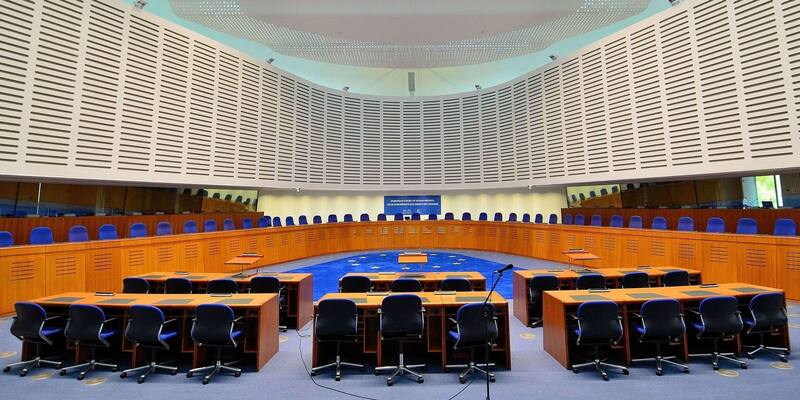

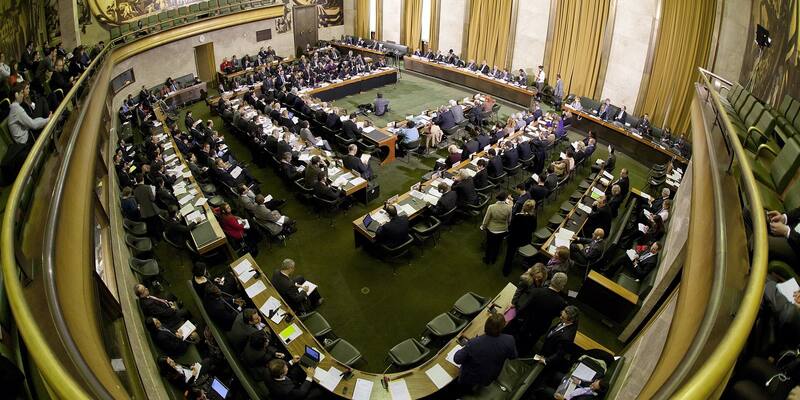
Diplomats at a Conference on Disarmament session in the Council Chamber of the Palais des Nations in Geneva, in an earlier year. Illustrative: not this week's CCW talks. Image: United States Mission Geneva / Wikimedia Commons, CC BY 2.0, cropped

After 13 years of talks, the 128 countries in the UN’s weapons convention agreed in Geneva early on Saturday to spend two more years drawing up rules on AI-powered autonomous weapons, the so-called killer robots, Reuters reports. But they agreed only to “elaborate” an instrument, not negotiate one, after Russia objected, and nobody has promised it will be legally binding.
What the 128 countries agreed
The Seventh Review Conference of the Convention on Certain Conventional Weapons (CCW) was due to end on Friday, but talks ran until after 4am on Saturday. The conference’s Swiss president, Julien Thoeni, told reporters that states had “agreed to launch the elaboration of an international instrument on lethal autonomous weapons systems, which should be conducted over the next two years”, according to AFP. He said the work would look at which weapons could be banned under international humanitarian law and which could be regulated.
The agreed text has not yet been posted. The conference’s draft final document, dated November 20, still left the autonomous weapons decision as a blank placeholder marked “[LAWS]”. The CCW works by consensus, so a single country can block any decision.
Izumi Nakamitsu, the UN’s disarmament chief, called it a “significant achievement” but admitted it was a “glass half full or half empty” result, the AP reports. UN Secretary-General António Guterres had set 2026 as the deadline to start negotiations.
How ‘negotiate’ became ‘elaborate’
The draft mandate on the table before the conference told an expert group to “negotiate a new Protocol to the Convention”, meeting 15 days a year and handing a draft protocol to the CCW’s 2028 meeting. Austria, Belgium, Brazil, Ireland, Mexico, New Zealand and Panama wanted faster talks: 25 negotiating days in 2027 and a draft protocol that year. The Red Cross also called for a one-year deadline.
Thoeni said some countries had objected to the word “negotiate”. Magnus Løvold of Lex International, a group campaigning for new laws of war, wrote that Russia was the country that refused it. By his account, a text to “negotiate, by consensus, an instrument, including prohibitions and restrictions” was on the screen at about 2am, Russia objected to both phrases, and by 3:30am the final wording was to “elaborate, by consensus, an instrument”. Russia had also stalled the conference on Monday by blocking the agenda.
What Washington wanted
The United States had argued against a new treaty from the start. Its working paper, dated November 4, proposed five more years of expert talks, 10 days a year, to write a non-binding instrument by consensus, with a “version 1.0” by 2029. It argued that “a LAWS is not a ‘certain’ conventional weapon” and that it “has not been established” that these systems need new prohibitions.
About 100 countries backed legally binding rules, but big arms makers including the US, Russia and Israel opposed them, Reuters said. It is the second time this autumn that the two powers have shaped the text: in September, US and Russian diplomats stripped human review of AI-picked targets from the expert group’s report. The Pentagon, meanwhile, is building a four-star command for autonomous warfare.
‘Puts civilians and humanity at risk’
Campaigners called it a “watered-down mandate”. Stop Killer Robots said more than 95 states had backed a treaty during the week:
Autonomous weapons technology, including AI in the targeting cycle, is being deployed on the battlefield. Delaying the creation of a legally binding instrument puts civilians and humanity at risk.
Nicole van Rooijen, executive director, Stop Killer Robots
Verity Coyle of Human Rights Watch said the mandate “introduces uncertainty when clarity is needed”. Max Tegmark, chair of the Future of Life Institute, went further:
States have agreed it is sufficient to just talk about the issue, for the 14th year, while these weapons enable atrocities.
Max Tegmark, Future of Life Institute
Thoeni saw it differently: “It shows that even in today’s deeply divided world, multilateral diplomacy can still deliver concrete results.” Some campaigners and former military officials now want countries to take the issue outside the CCW, where no single state has a veto. Recent tests of how AI picks targets are not reassuring: top models marked medics and surrendering soldiers as drone targets when the task was framed as a game.
Why it matters
AI weapons that pick their own targets are already being used, and the only global forum working on rules for them has bought two more years without promising binding law. Whether the 2028 instrument has any teeth now depends on the same consensus rule that let Russia and the US water it down.
Sources: CCW draft mandate on lethal autonomous weapons, US working paper (CCW/CONF.VII/WP.2), seven-country working paper (WP.7), ICRC working paper (WP.9), draft final document (Rev.2), Reuters (via TimesLIVE), AP (via Yahoo), AFP (via TRT World), Magnus Løvold, Spoiler Alert, Stop Killer Robots, Future of Life Institute on X.
Latest Policy & Safety news