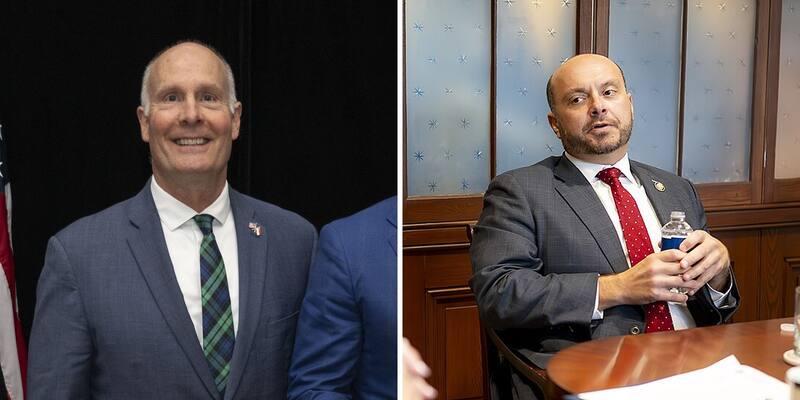

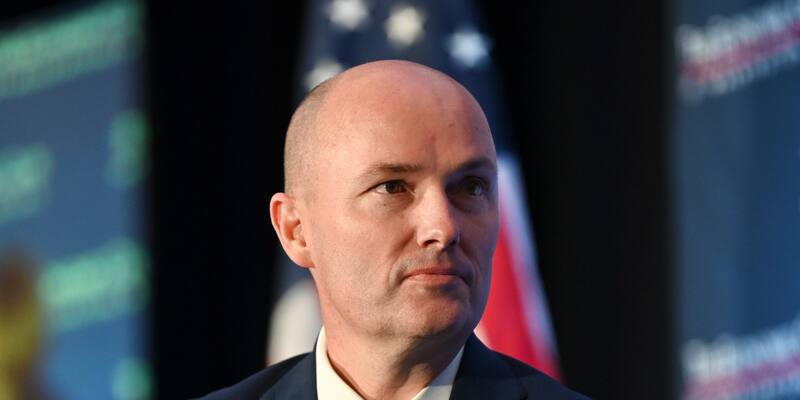
Utah Gov. Spencer Cox at an Economic Club of Washington fireside chat with Maryland Gov. Wes Moore in Washington, DC, in February 2024. Cropped. Image: Pat Siebert, Maryland GovPics / Wikimedia Commons, CC BY 2.0, cropped
America’s governors have drawn their own line in the fight over who regulates AI. The National Governors Association on Sunday published bipartisan principles asking Congress for national rules on the most powerful models, with independent audits and mandatory incident reports, while leaving states in charge of chatbots, jobs and discrimination. Any move to override state laws, they say, should be approached “cautiously”.
Who wrote it
The principles come from the association’s Governors Council to Secure American AI Dominance, led by two Democrats and two Republicans: Maryland’s Wes Moore, who chairs the association, Indiana’s Mike Braun, its vice chair, North Carolina’s Josh Stein and Utah’s Spencer Cox. Moore set the group up in October, saying governors could not “sit on our hands” while Washington stalled, days after Trump got AI’s biggest bosses to sign a voluntary “morally binding” pact with no new rules.
The four-page statement is aimed at the incoming Congress, which sits in January. It is a set of recommendations, not a bill, and names no sponsor on Capitol Hill.
What Washington would handle
The governors want Congress to pass a risk-based framework for frontier models, the most advanced general-purpose systems “whose risks and reach are national in scale”. Under it:
- Independent checks: frontier models should be “evaluated or audited by independent experts”.
- Incident reports: developers should have to report security breaches and significant safety incidents to federal authorities and to affected states.
- National security: federal standards for AI threats to critical infrastructure, including financial systems, chemical, biological and nuclear security, and cybersecurity.
- Diplomacy: Washington leads talks with other countries on AI standards, trade and global risks.
The framework should be updated as the technology changes, they add, and Congress should look at what states have already passed.
What states would keep
States, in the governors’ plan, stay “a primary accountability mechanism for AI harms affecting people”, including through lawsuits and civil liability. Their list of state jobs is long: protecting children from addictive design, chatbots and companion apps; tackling AI scams aimed at older people; requiring human oversight and a right to challenge when AI helps decide on housing, jobs, loans or insurance; and setting the rules for AI in state government, including collective bargaining duties.
They also want states to cut down the patchwork themselves, by agreeing common definitions and recognising each other’s rules. Moore summed up the shared ground: “humans must stay in control.”
“We don’t have to choose between innovation and safety”
Cox, a Republican, argued states have already shown how to do both:
We don’t have to choose between innovation and safety. Many states have already enacted thoughtful policies that foster AI adoption and advancement while protecting children and consumers.
Spencer Cox, Governor of Utah
Braun said the framework “strikes the right balance”, and Stein called AI’s risks and opportunities “too big to ignore”. The association’s chief executive, Brandon Tatum, put the message to Washington more bluntly:
It’s clearly time for a national AI approach, but no federal AI policy will be effective without governors’ input.
Brandon Tatum, CEO, National Governors Association
A warning on preemption
The sharpest line is the fifth federal principle, “Approach preemption carefully”. Any attempt to override state laws needs “meaningful input from a representative cross-section of states”, and governors will judge it against the association’s standing rules on federalism.
That puts them at odds with the White House. Trump signed an executive order in December 2025 setting up a Justice Department task force to challenge state AI laws, and he is backing a Republican push to write a ban on state AI rules into the annual defence bill before the new Congress arrives. Some Republican governors have criticised an outright ban, Bloomberg reported. Preemption has also split the AI industry: Anthropic’s own leaked draft bill would have overridden state laws, and Ted Cruz has blocked binding federal safety rules in the Senate.
Why it matters
Governors from both parties now have a written alternative to wiping out state AI laws, and it asks Washington for more frontier oversight, not less. Any preemption deal in the defence bill or the next Congress will have to get past them.
Sources: National Governors Association: Governors Call for AI Action; NGA: Federal and State Roles in AI Regulation (PDF); AP via WTOP; Bloomberg.
Latest Policy & Safety news