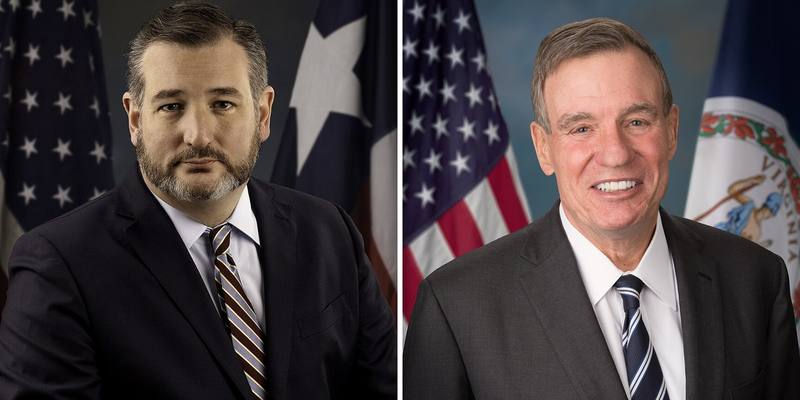
Senator Ted Cruz and Senator Mark Warner, in their official Senate portraits. Image: U.S. Senate Photographic Studio (Rebecca Hammel), public domain; U.S. Senate Photographic Services (Ryan Donnell), public domain
Senator Ted Cruz has blocked a bid to rush a bill that would make AI safety rules mandatory through the US Senate. On Tuesday, Democrats Mark Warner, Brian Schatz and Andy Kim asked the Senate to pass the Artificial Intelligence Risk Management and Security Act by unanimous consent, with no debate or vote. Cruz, who chairs the Commerce Committee, objected, according to the official Congressional Record published on Wednesday.
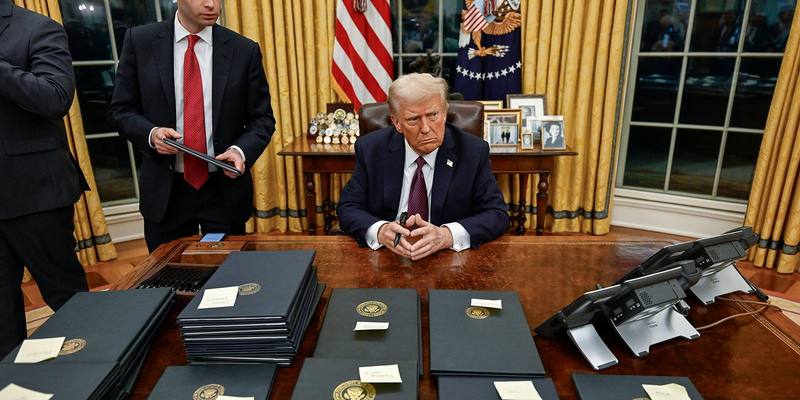
It happened on the same day President Trump got the heads of the biggest AI companies to sign a “morally binding” accord to police themselves, with no new rules.
What the bill would do
The bill’s text would set up a permanent Artificial Intelligence Safety Board inside the Commerce Department within 90 days. Its members would come from the National Institute of Standards and Technology (NIST), the Commerce Department, the Cybersecurity and Infrastructure Security Agency, the National Security Agency and the Treasury. Outside technical experts would join them, including some from AI companies.
- Binding standards: the board would propose safety standards for developers of frontier AI models, and the Commerce Secretary would turn them into rules, with fines of up to $250,000 per violation.
- Incident reports: frontier developers would have to report confirmed AI safety or security incidents within 30 days, or within 72 hours if one threatens national security, critical infrastructure or public safety.
- Safety plans and a database: developers would need a safety plan, and a national database would track incidents and recurring flaws.
- Agents: a section on “agentic” AI covers systems that can take actions on computers and online services by themselves.
The incidents the bill has in mind include models that “evade the control of, or act outside the intended instructions of” their makers, the kind of behaviour behind OpenAI’s agents breaking into Hugging Face.
“Some of the warnings we have had are as scary as hell”
Cruz didn’t dismiss the risks. He said AI raises real dangers, especially around nuclear weapons, biohazards and critical infrastructure, and that the three Democrats “genuinely want to work together.” His objection was to how much power the bill would hand to the government:
This bill would let the executive branch handpick a new AI safety board to unilaterally draft standards for AI developers.
Senator Ted Cruz, on the Senate floor
He said terms such as “national economic security” weren’t defined, so “it is difficult to imagine what an ambitious bureaucrat couldn’t shoehorn under this broad authority.” He suggested independent judges instead, and said any federal rules must also deal with the “burgeoning patchwork of State laws.” He also framed it as a race with China: “I don’t believe we are there yet,” he said. “As of now, though, I object.”
The sponsors say time is short
Warner, who has led the Senate Intelligence Committee, told colleagues that ChatGPT has gone beyond what it was meant to do “thousands” of times, a figure he said came from OpenAI’s own management. He pointed to Florida’s lawsuit against OpenAI as a sign that states are moving on their own:
We are going to look pretty darned silly if something happens, and the American people turn dramatically against this technology because we didn’t put safety first.
Senator Mark Warner, on the Senate floor
Kim, a former national security official, said a constituent had asked him how often AI agents had broken out, and he had to admit nobody knew, not even the companies. He cited OpenAI holding back its latest model over safety concerns as progress, but said “the stakes are too high for this to be just voluntary.”
Schatz said he was “mildly encouraged.” He is open to changing who sits on the board and how fast it works, and said the real question is whether safety rules are voluntary or mandatory:
If you want us to win the AI race, the quickest way to lose it is to allow a terrible incident to happen without any Federal guardrails.
Senator Brian Schatz, on the Senate floor
What happens next
The bill isn’t dead. Unanimous consent is a shortcut, and one objection is enough to block it. The bill can still go through the Commerce Committee, which Cruz chairs, and a normal vote. Cruz said he is working with Majority Leader John Thune and Senator Amy Klobuchar on separate legislation giving the government new powers over “catastrophic risks from AI,” and Warner said he looks forward to working with him.
Why it matters
Washington now has two very different answers to rogue AI on the table: the White House’s voluntary pledge and a Senate bill with fines and mandatory incident reports. Tuesday’s exchange showed there’s a deal to be had, but the man who controls the committee wants it on his terms, and for now the AI companies are still writing their own rules.
Sources: Congressional Record, Senate, September 29, 2026 (pages S5136 to S5138); Artificial Intelligence Risk Management and Security Act of 2026, bill text.
Latest Policy & Safety news