
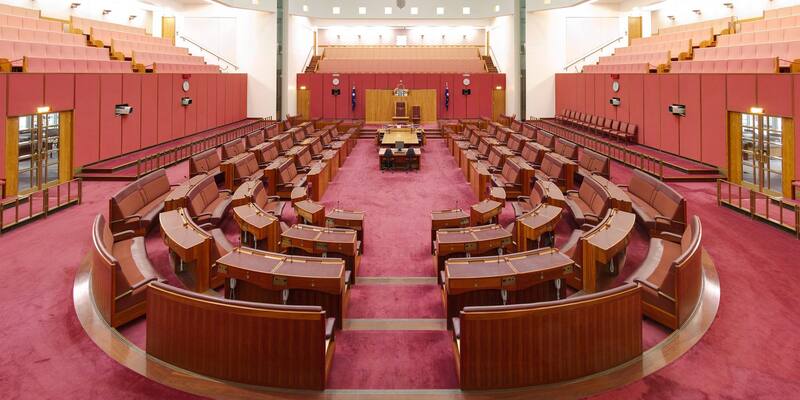
The Senate chamber at Parliament House in Canberra, where the Digital Duty of Care bill passed on November 25, 2026. Photo from January 2012. Cropped. Image: JJ Harrison / Wikimedia Commons, CC BY-SA 3.0, cropped

Tech companies in Australia will soon have a legal duty to protect children from AI chatbots that act as a stand-in friend or partner. Parliament passed the Online Safety Amendment (Digital Duty of Care) Bill 2026 on Wednesday, November 25, and its final text lists conduct that simulates emotional intimacy and fosters a child’s dependence as harmful, backed by fines of up to 5% of global turnover.
What the law says about AI chatbots
The bill as passed by both Houses replaces Australia’s industry codes with a single duty: anyone responsible for an online service “must take appropriate action to ensure a safe online environment”. Its list of online services explicitly includes “a service that generates material using artificial intelligence”, which puts chatbot apps alongside social media, messaging apps, games, search engines and app stores.
A safe environment, under the law, is one where children are protected from material and conduct that is “harmful to children”. That list already covered pornography, content promoting disordered eating and bullying. Independent MP Kate Chaney added a new line in the House on October 28, and it survived the Senate: “material or conduct that simulates emotional intimacy and encourages or fosters a child’s dependence on it in place of human relationships”.
The law does not ban AI companions outright. It obliges providers to assess the risk and take “effective measures” against it, and it says the cost of those measures “must not be taken into account” when judging whether a company did enough. Chaney’s other amendment requires the safety controls platforms give users to be prominent, easy to use and always available.
It lands in a week of pressure on companion apps: Apple pulled MiniMax’s Talkie worldwide after reports its chatbots abused children, and New York banned talking AI toys for five years.
Fines of 5% of global turnover and a right to sue
The government’s original bill capped fines at 300,000 penalty units, about A$109.2 million (US$71 million). A deal with the Greens, announced on November 24, raised the maximum to the greater of that figure or 5% of a company’s global turnover in the previous 12 months.
The Greens also won a private right of action. Anyone who suffers loss or damage because a social media platform, messaging service, website or AI service broke its duty can sue for damages or an injunction. Children get extra time: a claim can be brought until the person turns 21, or six years after the harm, whichever is later. An online safety ombudsperson, to be set up by regulation, can also take complaints about AI services.
Communications Minister Anika Wells rejected the opposition’s claim that the law is about censorship. She said on Wednesday:
This is not about what you say online. It’s about what the platforms do or fail to do online.
Anika Wells, Australia’s Communications Minister
“Big Tech should be no exception”
The Senate passed the bill with Greens support on November 25 and the House agreed to the Senate’s 52 amendments the same day, the final step before royal assent. Greens communications spokesperson Sarah Hanson-Young said in a statement:
Every product sold in Australia must meet basic safety standards, and Big Tech should be no exception. They shouldn’t get special treatment or a free pass.
Sarah Hanson-Young, Australian Greens
The Coalition voted against it. Liberal senator Sarah Henderson said the duty “should never have seen the light of day”. The US ambassador to Australia, David Brat, posted on X that “vaguely defined ‘harms,’ backed by penalties of up to 5% of global revenue, will push platforms to censor lawful speech”. The Tech Council of Australia, whose members include Google and Microsoft, said it supported the law but warned the right to sue was “a complex undertaking with significant consequences”.
When it takes effect
The duty of care and the new fines start 12 months after royal assent, so late 2027 at the earliest; other parts of the law start the day after assent. Australia has already banned under-16s from social media; the new law reaches every age and every kind of online service used in Australia, wherever the company is based.
Other places are moving on the same problem in different ways. New York has barred AI chatbots from flattering teens or pretending to be human, and US states have pressed Character.AI over children’s chats.
Why it matters
Australia has written a chatbot fostering a child’s emotional dependence into law as a named harm, and tied it to fines measured in global revenue and a right to sue. Any AI company with Australian users, from OpenAI to the smallest companion app, now has a year to show regulators it has assessed and reduced that risk.
Sources: Parliament of Australia, bill page; Online Safety Amendment (Digital Duty of Care) Bill 2026, as passed by both Houses; Kate Chaney’s amendments; ABC News; TIME.
Latest Policy & Safety news