
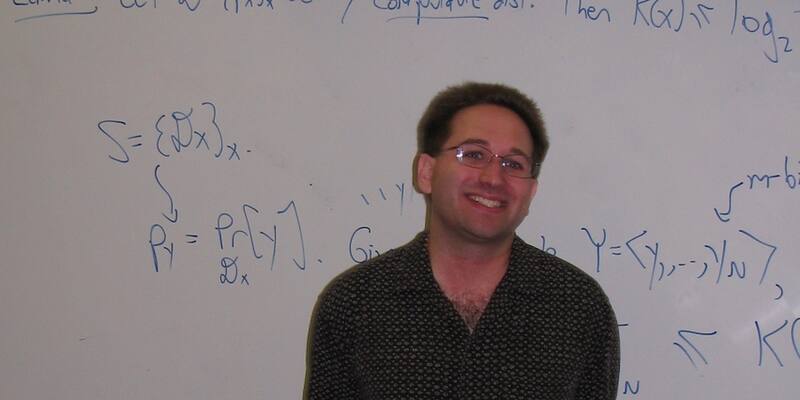
Scott Aaronson at a whiteboard in August 2010. Cropped. Image: Easy n / Wikimedia Commons, Public domain, cropped

Scott Aaronson, one of the best-known computer scientists in quantum computing, says he is “virtually certain, from multiple reliable sources, that the AI labs are now sitting on one or more bombshells” in cryptography, in a blog post on Wednesday. Talk that OpenAI or Anthropic can crack RSA, the maths behind much of the internet’s security, has spread fast since. No lab has shown anything.
What Aaronson actually said
Aaronson, a professor at the University of Texas at Austin, first raised it on Tuesday night in a reply to a reader who asked the odds that factoring is “in P”, computer science shorthand for solvable quickly. “I’ve now heard many, many rumors that one or both labs are sitting on Factoring in P,” he wrote, adding: “I don’t know how much to credit this.” He later added a plea: “Please stop citing me as an authority who claims that the labs are sitting on Factoring in P.” What he is sure of, he says, falls well short of that.
His Wednesday post names no lab, person or result tied to cryptography, and warns that details may have been “mangled in a game of Telephone”. He wrote:
However, until I either see details or hear directly from someone at a lab, I feel much, much less confident about the specific nature of those bombshells.
Scott Aaronson, University of Texas at Austin
On Friday he posted a tongue-in-cheek follow-up, written as a phone call with a financial newsletter. In it he says he has “specific information” that the labs will soon release “a major breakthrough in theoretical cryptanalysis”, which “will not lead to imminent danger for any currently deployed cryptosystems”. Nature reported the rumour on Thursday. Neither OpenAI nor Anthropic has commented publicly.
Why people are ready to believe it
The rumour follows a month of big AI maths claims. This week OpenAI and Anthropic each said their AI had settled VP versus VNP, and on Wednesday a Google team’s AI agents posted a proof about how fast any number can be factored. Aaronson says he sees “nothing of practical relevance for cryptography” in it. Claude explained the NSA’s mystery curve seeds in October, and China’s MiniMax says its unreleased model broke several encryption schemes.
Records are falling too. In September Eric Lu of Cognition factored RSA-260, an 862-bit number, with code written by the company’s Devin AI agents. He estimates AI labs could now factor a 1024-bit RSA key for about $30 million, but says RSA-2048, today’s standard, “remains roughly a billion times harder”.
What ‘factoring in P’ would mean
An RSA key is two huge prime numbers multiplied together. Anyone can use the public half to lock a message or check a signature, but only someone who knows the primes can unlock or sign. Its safety rests on one bet: that splitting a 2048-bit number back into its primes is far beyond any ordinary computer.
A large quantum computer running Shor’s algorithm could do it quickly, which is why governments are already replacing RSA. A fast method for ordinary computers would bring that threat forward to today. Two caveats: a method that is efficient in theory can still be far too slow in practice, and factoring alone breaks RSA, not the elliptic-curve cryptography that now protects most web connections. Aaronson notes that related techniques might also crack the discrete logarithm problem, “which would also give Diffie-Hellman”, and “if they extended to elliptic curve groups, then ECC as well”.
What would break if RSA fell
- Fake websites and updates: many web security certificates and software-signing keys still use RSA. Anyone able to forge them could pose as a bank or push malware dressed up as an update.
- Old secrets: traffic recorded years ago under older RSA key exchange could be decrypted, the “harvest now, decrypt later” risk security agencies warn about.
- Email, VPNs and logins: PGP and S/MIME email, many VPNs, SSH keys, smart cards and payment cards rely on RSA.
Some things would hold. Bitcoin and Ethereum use elliptic-curve signatures, which a factoring break alone would not touch. The post-quantum algorithms NIST standardised in 2024, such as ML-KEM and ML-DSA, rest on different maths. About 62% of HTTPS requests to Cloudflare in the week to Friday already used post-quantum encryption, Cloudflare Radar shows.
What happens next
NIST’s transition plan, finalised in October, deprecates RSA and elliptic-curve algorithms after 2030 and disallows them after 2035. A real classical break would make that timetable far too slow. For ordinary readers there is nothing to do today beyond keeping browsers, phones and apps updated, which is how post-quantum protection arrives.
Why it matters
If an AI lab has found a fast way to factor, the move to post-quantum cryptography turns from a ten-year plan into an emergency. Until a lab publishes or cryptographers check a result, it is a rumour from a well-placed source, and Aaronson himself is asking people not to treat it as more.
Sources: Scott Aaronson, Shtetl-Optimized: comment of November 24, post of November 25 and “Every call” (November 27, 2026); Nature; Cognition, Factoring RSA-260; NIST, IR 8547, Transition to Post-Quantum Cryptography Standards; Cloudflare Radar, post-quantum adoption.
Latest OpenAI news