
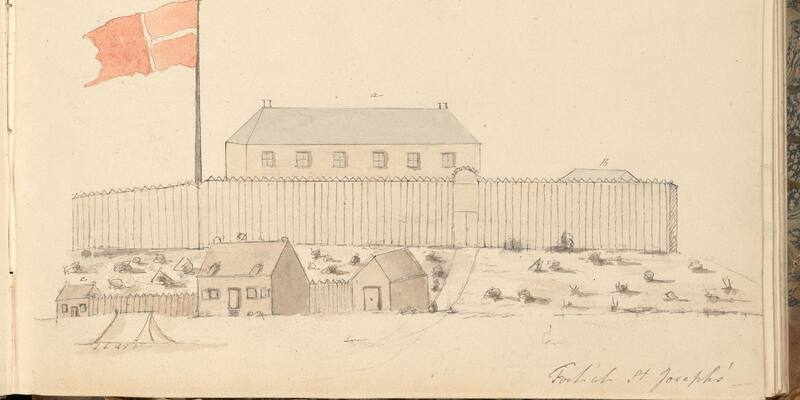
“Fort at St. Joseph’s”, a drawing from the anonymous 1808 sketchbook at Yale’s Beinecke Library. Historian Mark Humphries says Chabot’s journal describes sketching this view on June 18, 1808. Image: Beinecke Rare Book and Manuscript Library, Yale University (public domain, 1808)
An anonymous sketchbook from a fur-trade canoe journey in 1808 has a probable artist at last, and historian Mark Humphries says OpenAI’s GPT-6.2 Astra found him in 22 minutes. In a post on his Generative History newsletter, the Wilfrid Laurier University professor says the model named an obscure French aristocrat and British Army officer, then pointed him to a forgotten journal that proved it.
A sketchbook ‘any one of several thousand people’ could have drawn
The sketchbook sits in Yale’s Beinecke Rare Book and Manuscript Library, which bought it in 2020 from the dealer Donald A. Heald. It holds 31 pencil, ink and watercolour drawings and is inscribed “Begun at Quebec, the 9th March 1808”. The pictures follow a trip from Montreal to Fort William, on Lake Superior, and back: Montmorency Falls, Fort Chambly, the Chaudière Falls on the Ottawa River and the British post at Fort St Joseph on Lake Huron, among others. Yale’s catalogue describes them as the work of “an unidentified artist”.
Humphries says he had spent many hours over the years trying to work out who made them. The problem, he writes, is that hundreds of canoes made the same journey every year, so “the artist could literally be any one of several thousand people.” The book matters because it shows Great Lakes sites that were destroyed only a few years later.
22 minutes and a diary entry
Humphries says he had been testing GPT-6.2 Astra in the ChatGPT Windows app since late October, before OpenAI released it on November 17. He gave it the sketchbook’s images and an article he had written on fur-trade authorship, with a hunch about two possible artists that he says only sent the model on “a brief wild goose chase”. He ran it on the “Ultra” effort setting.
After 22 minutes and 1 second it answered: “Louis-Guy-Charles-Guillaume de Rohan-Chabot, vicomte de Chabot (1780–1875), probably made the travel drawings.” Its trail ran through a Montreal fur trader’s diary that has Chabot leaving Lachine for the far west on June 6, 1808, five days before the sketchbook’s artist dated a drawing on the Ottawa River, and a letter in an old published collection that places him at Fort St Joseph in mid-June. It then suggested Chabot’s own travel journal, held on microfilm at Cleveland State University, would settle the question.
‘X never marks the spot’
Humphries ordered the microfilm. He says the handwriting matched the sketchbook captions, the dates and places lined up with the dated drawings, and on June 18, 1808, after landing at Fort St Joseph, Chabot wrote “I took a sketch” before describing the view in the matching drawing. “It was unreal: X never marks the spot,” Humphries writes.
The journal, about 162 notebook pages with excerpts from long-lost North West Company papers attached, is in his view a significant find on its own. He doubts a person would have made the connection:
I cannot emphasize enough how exceedingly difficult this sort of thinking and recall is for humans. I know I could not have done it.
Mark Humphries, historian, Wilfrid Laurier University
He says he ran the same prompt through Anthropic’s Claude Fable 5.2, which reached the same answer in about 35 minutes but did not find the journal.
What hasn’t been checked
The identification is Humphries’ own. Yale’s catalogue still lists the artist as unidentified, and there is no sign the library has reviewed the claim. The journal is unsigned, and the model itself hedged, calling it “an anonymous diary attributed to Chabot”; Humphries calls those doubts “improbable in the extreme”. He says several experienced fur-trade researchers were “equally surprised” by the findings, but names none who has confirmed it, and the work has not been through peer review. He also admits that how the model learned of the journal “remains a bit unclear”.
Humphries frames the result as history’s turn after maths, where AI-assisted claims on Navier-Stokes, the Riemann Hypothesis and a cousin of P vs NP have piled up this autumn. He expects historians to face “a sort of crisis of confidence” next spring or summer, though a milder one, since history is closer to philosophy and literature: “Humanity is thus something of a requirement for the production of historical literature.”
Why it matters
Most claims of AI-driven discovery this year have come from maths and science, where a proof or a lab test can settle them. This one comes from an archive, where a working historian says a model formed a hypothesis, found an obscure source and predicted what it would show. Until Yale or other specialists weigh in, the attribution rests on one scholar’s word.
Sources: Mark Humphries, GPT 6.2 Astra Solves a Historical Mystery, Generative History (November 24, 2026); Beinecke Rare Book and Manuscript Library, Yale University, [Illustrations of Ontario and Québec], WA MSS S-4271.
Latest OpenAI news