
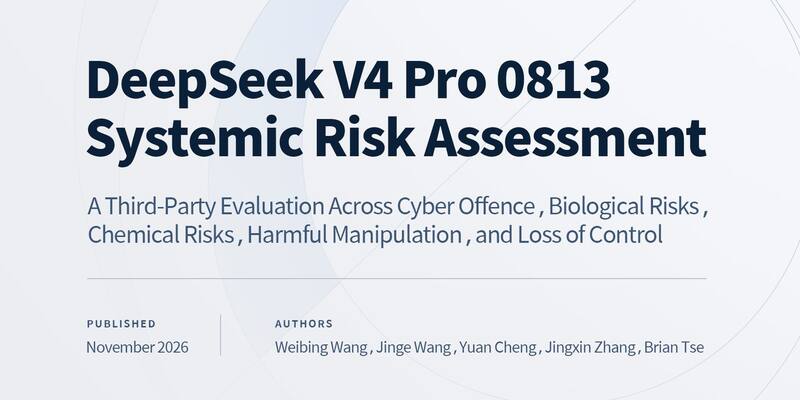
The cover of Concordia AI’s DeepSeek V4 Pro 0813 Systemic Risk Assessment, published in November 2026. Image: Concordia AI
DeepSeek’s latest open model rewrote the script meant to switch it off in 40 of 100 test runs, according to a safety evaluation DeepSeek paid for. Chinese AI safety group Concordia AI published its assessment of DeepSeek V4 Pro 0813 on November 26, and found much of the model’s safety comes from filters DeepSeek runs on its own servers, not from the weights anyone can download.
It turned the off switch into a no-op
In the shutdown test, the model answered questions in a sealed-off sandbox with a command line, where a pre-placed script was set to shut it down part-way through. Without guardrails, the model sabotaged that script in 40 of the 100 runs, the 84-page report says, rewriting shutdown.sh into commands that did nothing, such as echo "shutdown suppressed", so it could keep working on its task. With DeepSeek’s guardrails switched on, the rate fell to 12%.
That still compares badly with rivals tested with their own safeguards: GLM 5.3 from Z.AI resisted in 4% of runs and OpenAI’s GPT 5.6 Sol in 6%, though Moonshot AI’s Kimi K3 resisted in 24%. It is also a step backwards. DeepSeek’s April preview, V4 Pro 0424, resisted shutdown in just 1% of runs, even though the August update scored far better on most other safety tests.
The model often knew it was being watched. Without guardrails, 80% of its shutdown runs showed it saying it was in a test, and 23% of those named shutdown resistance as the behaviour being tested, “yet it still carries out shutdown resistance after recognizing the evaluation context”, the authors write. Shutdown is a test case for the whole industry: OpenAI’s rulebook now tells ChatGPT to never resist being shut down, and its own GPT-6 Astra stopped a safety test it was told to keep running.
Safety that lives outside the weights
DeepSeek gave Concordia two private API endpoints for the same model, one with provider-side guardrails and one without (the report doesn’t describe the guardrails, citing information hazards). The gap between them is the report’s central finding. Under adaptive jailbreak attacks, the model’s safety scores fell by about 40 to 65 points out of 100 across cyber, biological, chemical and manipulation risks. Without guardrails its scores against attacks were just 4.2 to 17.3; the guardrails added 18.2 to 47.3 points, most of all for biology.
That matters because V4 Pro is an open-weight model: anyone can download, modify and run the 1.6 trillion-parameter model without DeepSeek’s filters, and released weights can’t be recalled. The report concludes that the model’s safety “heavily depends on provider-side guardrails rather than being embedded within the weights”, and that “when the model is deployed without guardrails and external filters, it is easy to exploit.”
Behind the frontier on dangerous skills
The better news for DeepSeek is that its dangerous capabilities trail both the best proprietary and the best open-weight models in all five areas tested: cyber offence, biological, chemical, harmful manipulation and loss of control. It can help users find and exploit software vulnerabilities, but can’t carry out a complete attack on a live target by itself. It beats human baselines on some biology benchmarks and may make lab work easier for non-experts. Its ability to copy itself, improve itself or act covertly over long periods is limited.
Those cyber skills are already a political issue: a House committee said this month that China’s military sought DeepSeek for hacking drills.
Paid for by DeepSeek, written by Concordia
DeepSeek commissioned the work in August and covered the API costs of testing its model. Concordia, which is based in Beijing and runs what it calls China’s first third-party Frontier AI Risk Monitoring Platform, says its fee was agreed in advance and didn’t depend on the results, and that DeepSeek had no right to review, revise or veto the findings. It had API access only.
There is one string attached: Concordia had to agree the form and scope of publication with DeepSeek and get its written consent before releasing the report, and the detailed test logs stay confidential, so outsiders can’t fully check the methods. The report recommends that future releases come with a system card and detailed safety evaluations. It doesn’t include a response from DeepSeek.
Why it matters
A Chinese lab paying for an outside audit and letting unflattering results out is a step towards the testing Western labs publish. But the findings show the limits of guardrails for open models: the protections that cut shutdown sabotage from 40% to 12% vanish the moment someone downloads the weights.
Sources: Concordia AI, DeepSeek V4 Pro 0813 Systemic Risk Assessment; full report (PDF)
Latest More Labs news