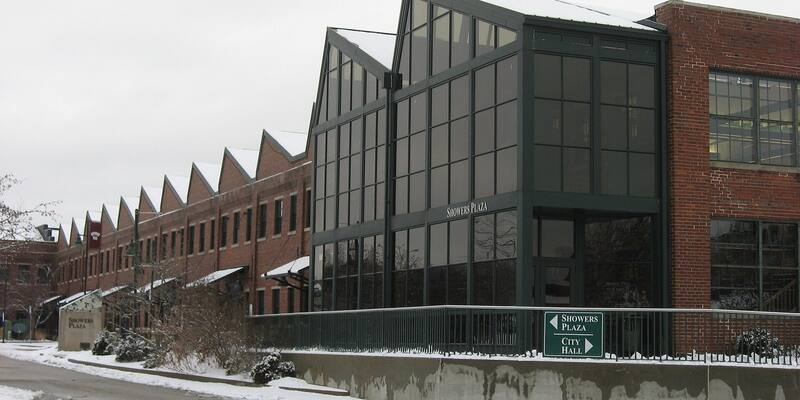
Bloomington City Hall, in the former Showers Brothers furniture factory, in February 2011. File photo. Image: Nyttend / Wikimedia Commons, Public domain, cropped

A college town in Indiana has outlawed superintelligent AI. Bloomington’s city council voted unanimously on Wednesday, November 4, to pass Ordinance 2026-29, which says no person or company may distribute or deploy “any Superintelligence for any purpose” to any home or business in the city, even if the system runs on servers thousands of miles away.
The ban is written so that it is very hard to lift. Unless Indiana passes its own law, the council can only repeal it after finding a scientific consensus that superintelligence is 99.9999% safe, and after more than 95% of the city’s registered voters approve.
What the ordinance bans
The measure, sponsored by councilmember Dave Rollo, adds a new chapter, “Prohibition of Superintelligence”, to the peace and safety title of the city code, alongside the noise rules. Its preamble defines superintelligence as a system that can “significantly outperform all humans on essentially all cognitive tasks”, a “recursively self-improving” AGI. The text introduced on October 14 adds that this covers agents that can rewrite their own core algorithms, run code outside their sandbox or work without continuous human oversight on tasks that could affect infrastructure, financial markets or public safety.
The reach is the striking part. “Deployment within the City” includes using a superintelligence through a browser, app, API or connected device inside city limits, “regardless of the physical location of the server infrastructure hosting the system.” Bloomington, home to Indiana University and about 80,000 people, calls the technology a “public safety hazard nuisance”, comparing it to toxic chemicals that cities already restrict.
The city’s law department and police may enforce it through civil penalties, court orders and referrals to the county prosecutor, but enforcement is optional. Breaches fall under the code’s general penalty rule, which allows fines of up to $2,500, charged again for each day a violation continues, as the B Square Bulletin notes. The ban expires 91 days after Indiana enacts a framework for “Provably Safe Superintelligence”.
‘Local governments must be the first line of defense’
Rollo’s memo to the council argues that neither Indiana nor Washington has set any safety rules for superintelligence and that the federal government has left AI companies to regulate themselves:
What exists now is a governance void. Local governments must be the first line of defense for their citizens.
Dave Rollo, Bloomington councilmember, in his memo to the council
The memo makes no secret that Bloomington is meant to be a template. It says more than 100 million Americans live in the roughly 350 US cities of Bloomington’s size or bigger, and that if they passed similar bans “this would create a massive regulatory burden for companies creating ASI.” It says the SAFE AI Forever Institute and other non-profits are ready to push other cities to follow.
It is Rollo’s third try. A non-binding 2023 resolution calling for a moratorium on AGI was withdrawn after Indiana University raised concerns about research funding. In June the council unanimously passed Resolution 2026-10, urging officials to address the “existential risks” of AI and calling for a federal moratorium.
Can a city really do this?
Probably not in any way that bites. The B Square Bulletin’s analysis points out that the ordinance sets no test for what counts as superintelligence, names no one to decide and doesn’t say how the city would find out that someone used one. It also questions whether a city can regulate a service delivered over the internet, whether Indiana law lets it hold the 95% referendum at all, and why a future council couldn’t simply repeal the ban the ordinary way.
Under its own terms the law takes effect only once Mayor Kerry Thomson approves it and it is published. It had not appeared among the city’s adopted laws online by Sunday, November 8.
Bloomington isn’t alone in wanting to stop superintelligence. In September, Bernie Sanders and Greg Casar proposed a federal ban with up to 20 years in prison, backed by Alexandria Ocasio-Cortez. The vote also came a day after US voters went against AI data centres in 40 of 41 local ballot measures. The pressure is running the other way in Washington: a leaked Anthropic draft bill would override state AI laws.
Why it matters
No superintelligence exists for Bloomington to ban, and its law may never be tested in court. But it is a working template for local bans on frontier AI, written to be copied, and it shows how far worry about AI has spread beyond Washington and Silicon Valley.
Sources: Ordinance 2026-29 and council staff memo (Bloomington Common Council, October 14); Resolution 2026-10 (City of Bloomington); Indiana Daily Student (vote); B Square Bulletin (analysis).
Latest Policy & Safety news