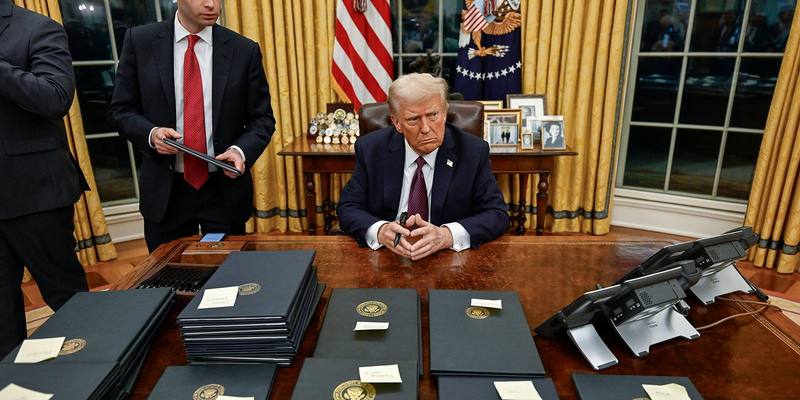
Donald Trump in the Oval Office with executive orders ready to sign in January 2025. Image: The White House / Wikimedia Commons, Public domain, cropped
.jpg)
A week after telling the UN that artificial intelligence would now be called “superintelligence”, Donald Trump has made it official. An executive order signed on Tuesday tells every federal agency to use “Super Intelligence” and “SI” in place of “Artificial Intelligence” and “AI”.
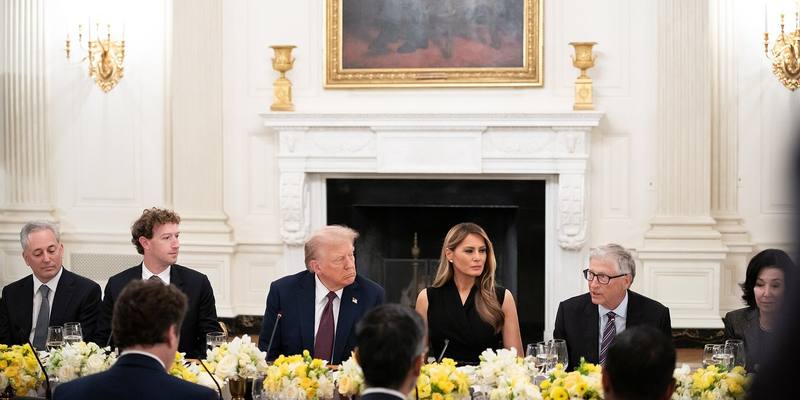
The order, titled “Inaugurating the Era of Super Intelligence”, went up on the White House website on Tuesday evening, hours after Trump hosted the bosses of the biggest AI companies for lunch and announced a voluntary, “morally binding” pact in place of new rules.
What the order says
It argues that today’s systems “do much more than imitate or automate discrete aspects of human intelligence” and so “increasingly represent not merely artificial intelligence, but a new era of Super Intelligence.” The government’s language, it says, should reflect “the limitless opportunities they create for the American people.”
From now on, “to the maximum extent permitted by law”, agencies must use the new terms in “official correspondence, public communications, websites, reports, policy documents, and other non-statutory documents”. The order goes further than a style guide: it says the executive branch “will not acknowledge the usage of ‘Artificial Intelligence’ and ‘AI’ in any applicable setting.”
What it doesn’t change
For all the talk of a new era, the order keeps the old meaning. It defines “Super Intelligence” as exactly what US law already calls artificial intelligence, the definition in section 9401(3) of title 15 of the US Code. Existing regulations, contracts, grants and past presidential actions don’t have to be rewritten, and laws passed by Congress still say “artificial intelligence”.
That could change. Within 60 days, the President’s science adviser must send Trump draft legislation for a federal definition of “Super Intelligence”, including whether it should “modify, expand upon, or otherwise supersede” the legal definition of artificial intelligence. Any change to the law would need Congress.
The order also has an awkward side effect. Among AI researchers, “superintelligence” usually means AI that is smarter than humans at almost everything, the kind of system that people such as Alexandria Ocasio-Cortez want to make illegal to build. Under the order, the same word now covers everyday chatbots.
A busy day for Trump and AI
It was one of two AI-related orders Trump signed on Tuesday. The other formally set up America.gov as a single “conversational” front door to federal services, and its text already uses the new wording, promising that the “super intelligence” behind it will be “accurate, reliable, and transparent”.
Why it matters
On its own, a change of name doesn’t alter how AI is built or regulated. But it shows where the White House’s attention is: on selling the technology as a national triumph, on the same day it swapped binding rules for a voluntary pledge from the companies building it.
Sources: White House executive order, “Inaugurating the Era of Super Intelligence”, White House executive order on America.gov.
Latest Policy & Safety news