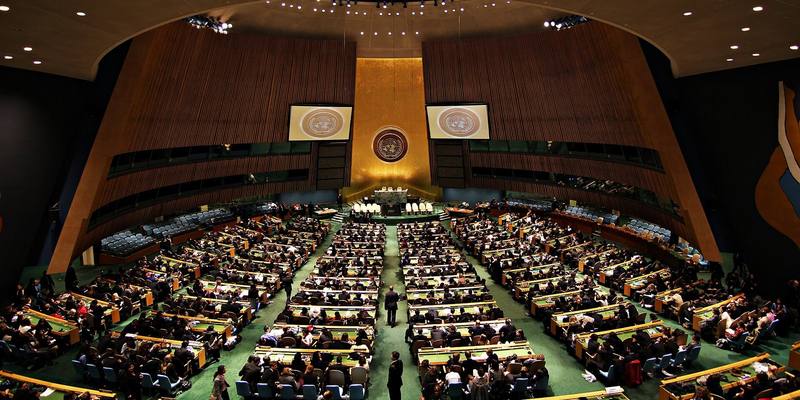
Delegates in the UN General Assembly Hall in New York, photographed in 2011. Image: Basil D Soufi / Wikimedia Commons, CC BY-SA 3.0, cropped
.jpg)
Artificial intelligence has gone from a footnote to one of the biggest topics at the United Nations. Closing this year’s General Assembly debate on Monday, Assembly President Khalilur Rahman said 128 delegations raised AI from the podium, up from just five four years ago, and more than spoke about climate change or human rights.
And many of them, particularly from Africa, Asia and Latin America, had the same message: they don’t want the rules for AI written entirely in Washington, Beijing and a handful of tech company boardrooms.
“Who designs it? Who benefits?”
Rahman said leaders saw enormous potential in the technology, but kept returning to the same questions: who designs it, who benefits, and who carries the risks. His conclusion, according to the UN’s own summary, was that AI governance must stay human-centred and inclusive, and must avoid a new divide in which a handful of countries and companies control the technologies shaping everyone’s future.
He singled out one line from the week’s speeches:
No machine possesses democratic legitimacy. No algorithm inherits constitutional responsibility.
Quoted by Khalilur Rahman, President of the UN General Assembly
Across the six days, 194 speakers took the floor, including 113 heads of state and government.
“Mere users of technologies designed elsewhere”
The Democratic Republic of the Congo’s foreign minister, Thérèse Kayikwamba Wagner, put the developing world’s case most bluntly. Speaking at last week’s Security Council session on AI, the same one where OpenAI’s Sam Altman and Anthropic’s Dario Amodei urged governments to work together, she said, as reported by Reuters:
Developing countries cannot be reduced to the role of mere users of technologies designed elsewhere, nor should be the mere recipients of standards and norms that they did not adequately participate in shaping.
Thérèse Kayikwamba Wagner, Foreign Minister, Democratic Republic of the Congo
Belize’s prime minister, John Briceño, made a similar point. Well governed, he said, AI could widen access to knowledge and improve public services, but “poorly governed, it can deepen inequality, expose critical systems, displace workers and leave developing countries dependent on technologies and rules designed elsewhere.”
Guterres: “the story of power”
UN Secretary-General António Guterres set the tone when he opened the debate on September 22, in his last address to the Assembly before he steps down at the end of the year. He tied AI to the climate crisis, saying the technology “moved at a speed that has blindsided even those who created it.” In his speech, he called them “chapters of the same story. The story of power. Who has it. Who is denied it.”
That framing puts much of the world at odds with Washington. The same day, President Trump told the Assembly that the people warning AI “is going to kill us all” were the same people who had been wrong about climate change, and rejected any global effort to control the technology. A week later, he got AI’s biggest bosses to sign a voluntary pact to police themselves, with no new rules.
What happens next
The debate is over, but the Assembly’s session isn’t. From October 1, its six main committees, whose work ranges from disarmament to economic affairs, take over the detailed negotiations. The Assembly will also appoint Guterres’s successor, who takes office on January 1, 2027.
Why it matters
The number tells the story: in four years, AI has gone from something five countries mentioned to something two-thirds of the world’s governments felt they had to address. The countries least able to build frontier AI are now the loudest in asking for a seat at the table, and with the US backing self-regulation and rejecting global rules, the gap between them is getting wider, not narrower.
Sources: UN News: The Takeaway Day 6 (primary), UN Secretary-General’s address to the General Debate, Reuters, via The Spokesman-Review (Wagner and Briceño)
Latest Policy & Safety news