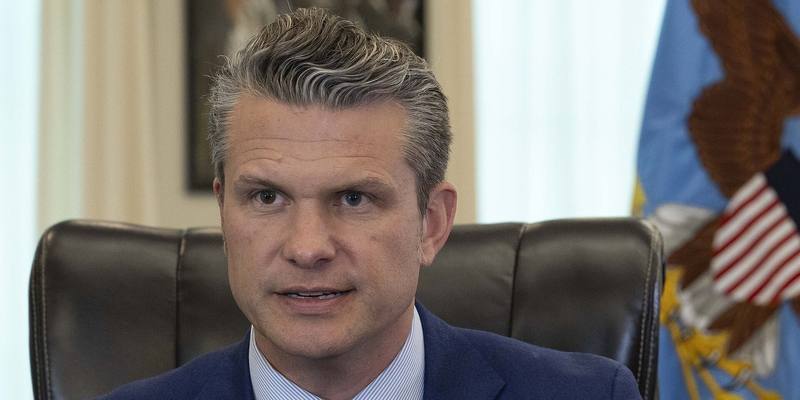
Pete Hegseth in his office at the Pentagon, April 2025. Image: Senior Airman Madelyn Keech, U.S. Air Force / Wikimedia Commons, Public domain, cropped

The US Department of Defense says it “has ceased the use of Anthropic products”, a department official told the BBC on Monday, more than seven months after defence secretary Pete Hegseth branded the Claude maker a national security supply chain risk.
Hegseth ordered the phase-out on February 27 and gave the department until late August to finish it. The statement doesn’t explain why it took longer, and several people familiar with the matter told the BBC that Claude was still in use as recently as last week.
Still in use last week
According to the BBC’s sources, who include former defence officials and contractors who have worked on Pentagon AI, Claude was used “throughout the whole period of the controversy” for research, analysis and intelligence gathering, and in military operations against Iran. One said that included Anthropic’s most powerful Mythos models.
Much of that work ran through Maven Smart System, the Palantir-run platform the Pentagon uses to organise intelligence. Analysts use Maven to pull together satellite images and drone footage, and the sources said that data was fed into Claude and other AI models for tasks including identifying potential military targets and drafting one-page briefs for commanders. The Pentagon’s statement came after the BBC asked about that continued use.
Lauren Kahn, a former US defence official now at Georgetown’s Center for Security and Emerging Technology, said the delay shows how hard it is to rip out an AI model once it is built into military systems:
The fact that it took the Pentagon until now to remove all use of Claude from across the system is indicative that these things are not just plug and play.
Lauren Kahn, Center for Security and Emerging Technology
A former senior defence official told the BBC there had been “concern with moving beyond Anthropic to OpenAI” and other tools when Hegseth first ordered the switch. The Pentagon has since signed deals with Google, xAI and OpenAI, and two people said OpenAI’s tools have been more widely adopted in some parts of the military in recent months.
How the fight started
Anthropic was the first advanced AI company whose tools were cleared for classified government work. The relationship broke down early this year when the Pentagon wanted to use Claude for “all lawful purposes” and Anthropic refused to drop two limits: no fully autonomous weapons and no mass surveillance of Americans. Hegseth then designated it a supply chain risk, a label usually reserved for companies tied to hostile foreign governments.
Anthropic called the move “unprecedented and unlawful” and sued. The courts have split since: a federal judge in San Francisco struck down one of the two designations in August, while a Washington appeals court ruled 2-1 last month that the Pentagon could keep the other. Anthropic declined to comment on the Pentagon’s statement.
A thaw at the White House
The Pentagon’s clean break comes as Anthropic’s relationship with the rest of the administration appears to be warming. Donald Trump hosted chief executive Dario Amodei at the White House last week and praised him as “great” and “fantastic”, and Amodei said afterwards that “if we work with the president, we can win safely”.
The military, meanwhile, is pushing deeper into AI without Anthropic, including through a new command for autonomous warfare that Elon Musk is helping to plan.
Why it matters
It is the clearest sign yet that the Pentagon is carrying through its blacklisting of Anthropic, even as the White House makes peace with the company. It also suggests Claude was doing real work inside US military systems for weeks after the deadline, and that replacing a model wired into tools like Maven is slower and harder than an order from the top implies.
Sources: BBC.
Latest Anthropic news