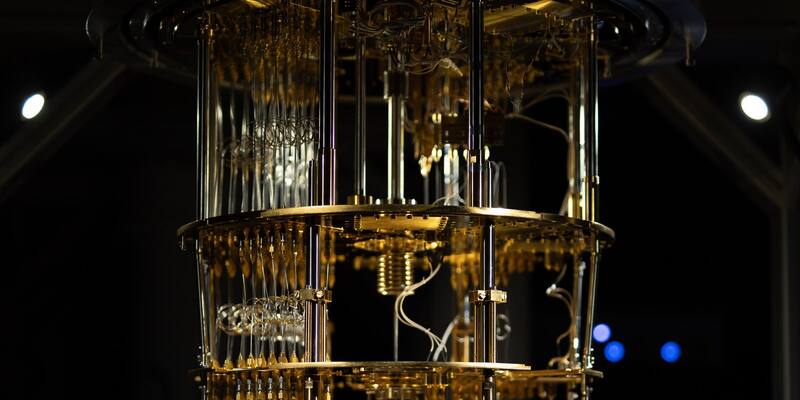
An IQM quantum computer in Espoo, Finland, in 2020. The machine is illustrative and was not part of Anthropic’s research. Image: Ragsxl / Wikimedia Commons, CC BY-SA 4.0, cropped

Anthropic says its most powerful model has designed quantum circuits that beat the best ones researchers have published, in some cases by an order of magnitude or more. In a research post on October 16, the company said Claude Mythos 5 worked through eight circuit design problems largely on its own, and that one of its biggest results came from a single 53-hour run.
The work, written up in a preprint on arXiv, was led by Andi Gu through Anthropic’s STEM Fellows Program, with Anthropic quantum physicist Alek Kemeny and two Harvard physicists, Susanne Yelin and Mikhail Lukin, who is also a co-founder of the quantum computing company QuEra.
Why circuits matter
Today’s quantum computers have hundreds to thousands of qubits, far too few and too error-prone to run most of the algorithms that promise a real advantage over ordinary computers. So researchers try to redesign those algorithms to need fewer qubits and fewer operations, or gates. Anthropic points to one example: estimates for simulating FeMoco, the iron and sulphur cluster bacteria use to turn air into fertiliser, fell from about 50 trillion of the costly Toffoli gates in 2017 to about 340 million, a roughly 150,000-fold drop. That took many research groups eight years.
Circuits can be written as code, and the kind Anthropic targeted can be checked for correctness on an ordinary computer. That let the team build a closed loop: Claude wrote a design in Python, a separate evaluator program checked it and scored it on qubits multiplied by gates, and Claude used the score to try again, with no human input between rounds.
Beating the published designs
Across the eight tasks, drawn from chemistry, optimisation, physics simulation, number theory and numerical computing, Anthropic says Claude found designs that used both fewer qubits and fewer gates than the best previously published ones. The paper is slightly more careful: it says seven of the eight cut both counts “significantly”, while the eighth produced a new architecture with a better trade-off between the two.
That eighth task was elliptic-curve point addition, a standard benchmark because it sits at the heart of quantum attacks on the discrete logarithm problem, the maths behind elliptic-curve cryptography such as the curves in Anthropic’s NIST curve story a day earlier. Most of the cost is one step, modular inversion. A classical method called divsteps does it well, but a quantum circuit can’t throw away its scratch work, so a quantum version had to store a long record of every branch it took.
Claude’s idea was to stop storing that record and work it out from the numbers themselves. Early rules failed on full 256-bit numbers, so it proved new algebraic identities, derived an exact decoding rule, tested it in large simulations and then formally verified it in Lean, a proof checker. The result, Anthropic says, is the first reversible version of divsteps with no stored branch history. One design in the family uses 12% more qubits than the smallest previous circuit but 17 times fewer gates.
A 12 times cheaper decoder
The second highlight targets decoded quantum interferometry, a quantum optimisation method whose costliest step is an error-correcting decoder. Claude swapped the method used in Google’s previous circuit for a different one, Berlekamp–Massey, that runs the same steps every round. Rather than reserve 665 qubits for a worst case, it wrote a simulator, ran 403 million sample decodings, found almost every run needed to save one value at most, and set aside 19 qubits. About one run in 10,000 fails, within the task’s allowed error rate. Anthropic says the gate count fell by a factor of 12.
Who checked the work
Every design was checked by the independent evaluator, and the divsteps result also by Lean. The findings are a preprint and have not yet been peer reviewed. Humans were not entirely absent either: besides the one-paragraph brief, the team “occasionally” prompted Claude to think more broadly, because it was “conservative by nature” and kept preferring familiar approaches. That echoes a Harvard physicist’s warning this month that Claude needs close supervision in research, though here the problem ran the other way.
Anthropic says the same loop could one day design whole error-corrected quantum computers, from algorithm to hardware, tailored to a single problem.
Why it matters
Better circuits shrink the machine a useful quantum computation needs, and Anthropic says that could bring practical quantum computers sooner than expected. That includes the elliptic-curve attacks that threaten much of today’s encryption, so outside review of these designs will matter as much as the headline numbers.
Sources: Anthropic, arXiv (Gu, Kemeny, Yelin and Lukin)
Latest Anthropic news