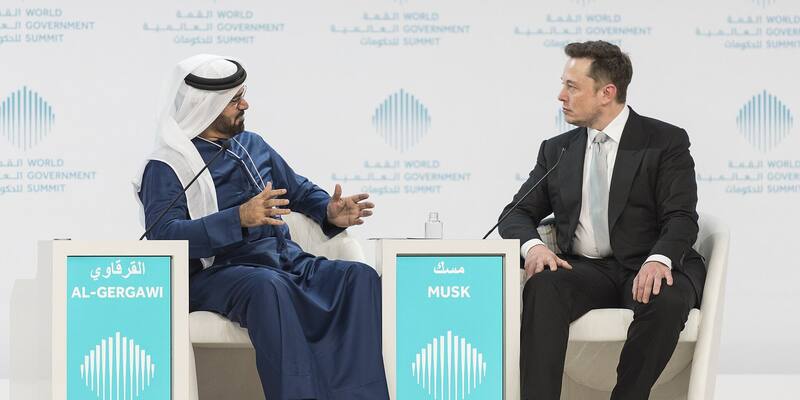
Elon Musk (right) with UAE minister Mohammad Al Gergawi at the World Government Summit in Dubai in February 2017, the session where he said a universal basic income would be needed. Image: JoohnSmith41 / Wikimedia Commons, CC BY-SA 4.0, cropped

In February 2017, on stage at the World Government Summit in Dubai, Elon Musk predicted “there will be fewer and fewer jobs that a robot cannot do better” and said “we will have to have some kind of universal basic income”. Then he turned to what he saw as the harder problem: “A lot of people they derive their meaning from their employment.” If you’re not needed, he asked, “what’s the meaning? Do you feel useless?”
Nine years on, the money half of that idea has moved from talk to pledges. Musk, OpenAI and Anthropic have all put forward ways to hand people a share of what AI earns. The other half, who people are once the job has gone, has barely moved at all. And the research says that is the half that matters most.
The cheques are starting to be written
Musk now goes further than a basic income. “Universal HIGH INCOME via checks issued by the Federal government is the best way to deal with unemployment caused by AI,” he posted on X in April, arguing that AI and robots will produce goods and services “far in excess of the increase in the money supply, so there will not be inflation”. At the White House on September 29, after the “morally binding” accord lunch, he said “by far the most likely outcome is an age of abundance”. On October 19 he pledged one of his SpaceX shares to every child in America next year, “the first of many”, which Donald Trump said would go into the government’s new Trump Accounts. With about 73 million under-18s, that is worth about $10 billion at recent prices, though under Treasury rules families generally can’t sell the shares for years.
OpenAI’s April policy paper, Industrial Policy for the Intelligence Age, proposes a Public Wealth Fund giving every citizen “a stake in AI-driven economic growth”, with returns “distributed directly to citizens”. It doesn’t say who would pay to seed it, though the Financial Times reported in July that Sam Altman had floated giving 5% of OpenAI to such a fund. Anthropic has gone furthest, committing 5% of its shares to a fund that might make “direct distributions to specific populations”, with AI’s effect on jobs its stated focus.
The urgency is real. Employers have cited AI in 120,136 US job cuts so far this year, about 21% of all announced cuts and the leading reason in 2026, according to Challenger, Gray & Christmas. Anthropic’s own staff data shows junior hires falling from 27% to 9% of its technical hiring as its AI agents took on the work, and on October 22 Bill Gates told people to brace for 20 years of turmoil.
What happens when people are simply given money
We already know a fair amount about this, because it has been tested. The biggest US trial, run by OpenResearch with funding from Altman, gave 1,000 low-income people in Texas and Illinois $1,000 a month for three years from November 2020, and 2,000 others $50 a month for comparison. The results, written up by economists including Eva Vivalt and Elizabeth Rhodes, were modest. Recipients worked one to two hours less a week, and their income, not counting the payments, fell by about $1,900 a year. The extra time went mostly on leisure. There was no measurable improvement in the quality of the jobs people held, and no significant rise in degrees. Recipients felt better in the first year, then their wellbeing slipped back to the same level as the comparison group.
Finland’s national trial in 2017 and 2018 paid 2,000 unemployed people €560 (about $650) a month with no strings. The final results found almost no effect on employment, about six extra days of work on average, but recipients reported less mental strain, depression and loneliness. In Sweden, a study of lottery winners found their earnings fell only modestly after a win, even with large sums in the bank.
The pattern is consistent. Money takes away fear and buys some time, and most people keep working anyway. What money doesn’t seem to buy is a lasting sense that life is going well.
What a job gives you besides a payslip
The best explanation is almost a century old. In the 1930s the social psychologist Marie Jahoda and her colleagues studied Marienthal, an Austrian village whose only big employer, a textile mill, had closed. Jahoda later argued that a job does five things besides pay: it gives you a structure to the day, contact with people outside your family, a sense of being useful to others, a status, and something to do.
A 2023 meta-analysis led by Karsten Paul at the University of Erlangen-Nuremberg tested that idea across many studies, and it held up. Employed people scored higher on all five, and each one independently predicted better mental health. The striking finding is about retired people, who already live on income they don’t work for. They were almost as short of those five things as the unemployed, even though they weren’t short of money. Students, with courses, classmates and goals, looked much more like workers.
That is the real problem with a world where AI pays everyone. A pension or a cheque fixes the income. It doesn’t give anyone a reason to get up, people to see, or the feeling that someone is relying on them.
Not everyone ties who they are to work. In a Pew Research survey, 39% of US employees said their job was extremely or very important to their overall identity. But that rose to 53% for people with a postgraduate degree and 47% for those on higher incomes: the white-collar, well-educated workers that Gates and Anthropic’s own figures suggest AI reaches first.
“Break the link between the generation of economic value and self-worth”
The people building the technology do see the problem. In his January essay The Adolescence of Technology, Anthropic’s chief executive, Dario Amodei, called AI “a general labor substitute for humans”. On purpose, he was hopeful:
I think human purpose does not depend on being the best in the world at something, and humans can find purpose even over very long periods of time through stories and projects that they love. We simply need to break the link between the generation of economic value and self-worth and meaning.
Dario Amodei, chief executive, Anthropic
He added: “that is a transition society has to make, and there is always the risk we don’t handle it well.”
Musk got to the same question at the VivaTech conference in Paris in May 2024, when he said that “in a benign scenario, probably none of us will have a job”:
If a computer and the robots can do everything better than you, then… does your life have meaning?
Elon Musk, at VivaTech 2024
His best guess at an answer was that “maybe we are what give the AI meaning”. Gates has floated keeping some work, such as childcare, food preparation, art and sport, “human-reserved” even where AI could do it better. OpenAI’s paper proposes trial four-day weeks “with no loss in pay” and a family benefit that “recognizes caregiving as economically valuable work”.
The economist John Maynard Keynes saw this coming. In his 1930 essay Economic Possibilities for our Grandchildren, he predicted that once the struggle to make a living was solved, man would face “his real, his permanent problem”:
how to use his freedom from pressing economic cares, how to occupy the leisure, which science and compound interest will have won for him, to live wisely and agreeably and well.
John Maynard Keynes, 1930
So who are you without your job?
The evidence points to an answer, and it isn’t “whatever you like”. Outside paid work, the people who fare best are the ones who still have a role, like students. Retirees have the income but, on average, much less of the rest. The cash trials show the same thing from the other side: given money and time, people mostly spent the time on leisure, not on retraining or reinventing themselves.
So the question from the tech leaders’ own warnings isn’t really “what will you do all day?” It is “who will need you?” A shorter working week, paid and respected caring roles, jobs kept for people on purpose, and clubs, unions and community groups that give people structure and status all answer that. A monthly payment, however high, doesn’t.
None of the pledges made so far pays for any of that. Musk’s share is locked away for years. OpenAI’s fund has no money in it yet. Anthropic hasn’t said who will decide how its fund is spent.
Frequently asked questions
What is universal high income?
It is Elon Musk’s name for government payments big enough to live comfortably on, rather than a basic income that covers only essentials. He says AI and robots will produce so much that the payments won’t cause inflation, but he hasn’t published a detailed plan, and many economists doubt the sums add up.
Will AI companies pay everyone a basic income?
Not yet. No country pays a universal income funded by AI. Musk has pledged one SpaceX share to every US child in 2027, OpenAI has proposed a Public Wealth Fund that would pay returns to citizens, and Anthropic has committed 5% of its shares to a fund that may make direct payments. None is up and running.
Do people stop working if they are given free money?
Mostly not. In the largest US trial, people given $1,000 a month for three years worked one to two hours less a week. Finland’s trial and studies of Swedish lottery winners found similarly small effects on work.
What will people do if AI takes all the jobs?
Nobody knows. Research on unemployment and retirement suggests people need more than income: structure to the day, contact with others, a sense of being useful, status and something to do. Proposals so far include shorter working weeks, paid caring roles and keeping some jobs for humans.
Why do people get their identity from work?
Jobs do more than pay. The psychologist Marie Jahoda argued they also give time structure, social contact, a shared purpose, status and activity, and later studies found people who lose them, including many retirees, report worse mental health. In a Pew survey, 39% of US employees said their job was very or extremely important to who they are.
MadRobot’s take
AI’s leaders talk about the cheque because it’s the part they can write, and it makes the technology sound generous. Every trial so far says the cheque is the easy part. Musk named the hard part himself in 2017, and nine years later nobody building these systems has a serious plan for it. Before telling a generation that work will be optional, they should show how people will still be needed, not just paid.
Sources: World Government Summit; Fox Business (Musk’s April X post); Axios and CNBC (SpaceX share pledge); OpenAI, Industrial Policy for the Intelligence Age; TechCrunch (Financial Times report); Challenger, Gray & Christmas, September 2026 report; Vivalt et al., NBER Working Paper 32719; Finnish Ministry of Social Affairs and Health; Cesarini et al., American Economic Review; Paul et al., Frontiers in Psychology; Pew Research Center; Dario Amodei, The Adolescence of Technology; Gizmodo (VivaTech remarks); Keynes, Economic Possibilities for our Grandchildren.
Latest Business news