

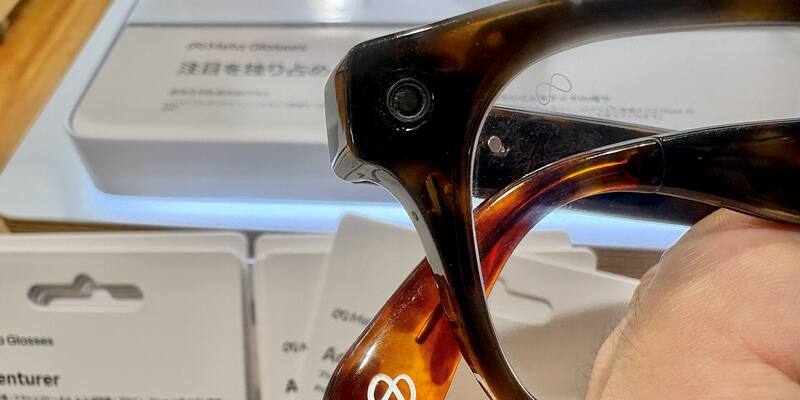
The camera in the corner of a pair of Meta glasses, at an electronics shop in Nagoya, Japan, in October 2026. Illustrative. Image: Kyu3a / Wikimedia Commons, CC BY-SA 4.0, cropped

Dutch consumer and privacy groups want a judge to pull Meta’s Ray-Ban and Oakley smart glasses from sale in the Netherlands, calling them a hidden camera. Their cases, set out in a 44-page court summons and a consumer group lawsuit, were heard together at the Amsterdam District Court on Thursday.
What the groups want
Offlimits, the Dutch centre against online sexual abuse, and The Firewall, a privacy and democracy foundation, filed a joint summons on October 23 against four Meta companies and Ray-Ban owner Luxottica. The Consumentenbond, the country’s biggest consumer association, brought its own case alongside.
The Offlimits and Firewall summons asks the judge to:
- Stop sales: ban Meta and Luxottica from offering glasses in the Netherlands that can record people without their consent, “whether or not a small white light on the front of the glasses flashes”.
- Change glasses already sold: make recording impossible without the consent of the people filmed, across every Meta, Ray-Ban and Oakley model.
- Stop AI training: bar Meta from using footage of people who live in the Netherlands to train AI models, from processing it without a legal basis under the GDPR, and from sending it outside Europe without proper protection.
Each breach would cost €100,000 (about $110,000) a day. As a fallback, the groups suggest an exception for blind and partially sighted people who use the glasses to hear what is in front of them, on a version that cannot record.
The Consumentenbond wants Meta to bring the glasses and their default settings in line with privacy law within two weeks of a ruling, and stop what it calls unlawful processing for AI. If Meta says that cannot be done, it wants a sales ban, with a medical exception.
The light that doesn’t always flash
The summons says the recording light is hard to see and easy to cover with tape. It also says no light flashes at all when a wearer asks Meta AI about what the camera is seeing, for example to read out text or identify a shop. It also cites Swedish press reports that workers at Sama, a Meta subcontractor in Kenya, reviewed clips from the glasses of people undressing and using the toilet.
Robbert Hoving, Offlimits’ director, said when the case was filed:
Most people have no idea they’ve been filmed with the Meta glasses. Yet victims are already reporting to our helpline when it has happened to them. These first reports are only the tip of the iceberg.
Robbert Hoving, director, Offlimits
‘Each invasion of privacy is worse than the last’
In court, Offlimits lawyer Karlijn Han said the glasses were being used for “creep shots” and that covert recordings were “undoubtedly” being made in changing rooms, hospitals, playgrounds and on beaches, Reuters reported. “Each invasion of privacy is worse than the last,” she said.
Meta’s lawyer, Bastiaan Kemp, asked the court to throw the case out. He said the demands would hurt legitimate users and amount to a product recall, and that the recording light makes filming obvious. He denied that Meta processes recordings made in Europe, or uses them to train AI, in breach of EU law:
Providers of products cannot be held responsible for every instance of deliberate misuse.
Bastiaan Kemp, lawyer for Meta
EssilorLuxottica’s lawyer said it has no access to footage and a ban would be disproportionate when rivals sell similar glasses. Meta also argued that politicians or regulators, not a judge, should decide on a ban, and that Offlimits had received only a few misuse reports in more than a year of sales, Dutch news site TPO reported. Meta and EssilorLuxottica sold more than 7 million smart glasses in 2025, around 80% of the global market.
Pressure is building across Europe
The judge is due to rule by December 24, and any order would apply only in the Netherlands. Offlimits has won there before: in March, the same court ordered Grok and X to stop the chatbot’s undressing feature for people living in the Netherlands, the summons notes.
Dutch retailers Hans Anders and Wehkamp stopped selling the glasses in October, and the Dutch privacy regulator has advised people not to buy AI camera glasses. Germany’s national consumer federation announced its own legal action against Meta and Ray-Ban on Tuesday, according to Reuters. Norway has gone further still, with a government plan to ban AI glasses from parks, schools and gyms, while Google is pitching its new Gemini glasses as hiding strangers’ faces from the AI.
Why it matters
This goes beyond a regulator’s warning: it is a court bid to stop Meta selling its AI glasses in a European country. If the judge sides with the groups, Meta must change how the glasses record and how it uses footage for AI, or leave Dutch shops, and groups elsewhere in Europe would have a ruling to point to.
Sources: Offlimits and The Firewall court summons (Amsterdam District Court); Offlimits; Consumentenbond; Reuters; TPO.
Latest Meta news