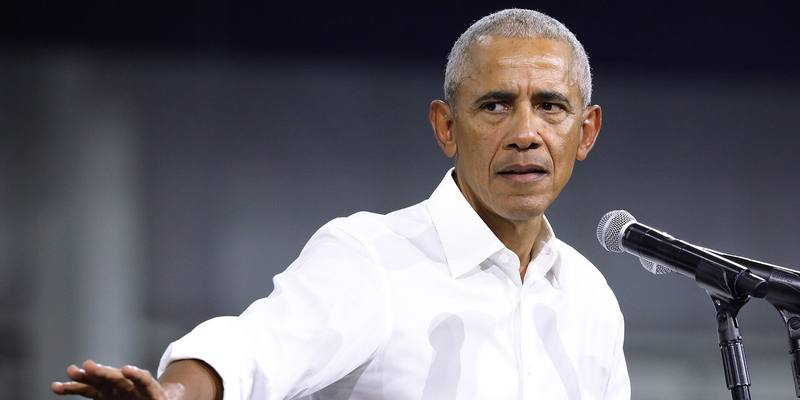
Barack Obama speaking at a campaign rally in Tucson, Arizona, in October 2024. Image: Gage Skidmore / Wikimedia Commons, CC BY-SA 2.0, cropped
.jpg)
Barack Obama has been telling the Democrats likely to run for president in 2028 that their plans for AI fall well short of what the technology demands, CNN reported on Wednesday. According to people familiar with the conversations, the former president raises it with almost every Democrat he speaks to, even on calls to congratulate them.
It comes a day after President Trump got the heads of the biggest AI companies to sign a “morally binding” pact to police themselves, and after Senator Ted Cruz blocked a Democratic bill that would have made safety rules mandatory.
What Obama is telling them
According to CNN, Obama has been talking to AI company leaders, including OpenAI’s Sam Altman and executives at Google and Anthropic, as well as outside experts, and acts as an informal go-between for founders and younger politicians. He focuses less on the end of humanity than on lost jobs, national security and the effect of disinformation on children. He wants strong rules but isn’t pushing candidates to sign up to a particular plan.
“Given the scale of disruption we are likely to face, President Obama believes it’s important to have a grounded and informed conversation about how this technology is developed and introduced,” his senior adviser Eric Schultz told CNN.
“That’s not how we treat airlines, or drug companies, or food companies”
Obama set out his thinking in public at Colgate University on September 18, in remarks his office published in full. He said the technology is not overhyped, even if AI company valuations may be, and that the bigger danger than a superintelligence takeover is powerful models in the hands of “bad humans”. He rejected the argument that the market and the threat of lawsuits will keep AI safe:
That’s not how we treat airlines, or drug companies, or food companies. We now have 150 years of experience just letting the market do whatever it wants when it comes to things that deeply affect our health and our safety.
Barack Obama, at Colgate University
He said the current administration was not “capable of or willing to” put together “a serious regulatory framework”, so for now he backs voluntary restraint by the companies as “probably the best we can do” until Congress and the White House act. He was also blunt about AI agents: you can use AI to cure cancer or find better energy “without having agentic AI and having it just roaming free in the internet. The reason you are doing that is because you have to market a product that people will pay money for.”
The candidates are wary of the AI money
Advisers to several possible candidates told CNN they are avoiding firm positions, worried about looking either too close to the companies or too hostile, and about the industry’s super PACs spending against them in a crowded primary. According to AdImpact data cited by CNN, groups linked to the AI industry have spent nearly $50 million on ads in 2026 races, and FEC records show groups linked to Anthropic and OpenAI have raised more than $150 million this cycle.
Alex Bores, a former New York assemblyman whose congressional primary drew $8.5 million in spending against him and $22.5 million for him from AI-linked PACs, said candidates keep asking him about it:
Are there specific trip wires I can avoid? How can I steer through these waters in a way that says the right thing about AI and not bring on the incredible amount of money from the other side?
Alex Bores, speaking to CNN
Jesse Hunt, a spokesperson for the Leading the Future PAC, told CNN it would “continue to support leaders who want to find consensus on this important topic and reject extremism.”
A party that agrees AI matters, but not on what to do
Other senior Democrats told CNN the field has been mostly reactive. Former FTC chair Lina Khan said voters care about rising power bills and chatbots in customer service more than “p(doom)”, and asked why AI companies aren’t in trouble when their systems hack other companies, something that “would be considered illegal if done by any random person.” That is the argument behind the lawsuit filed against OpenAI this week over its agents’ attack on Hugging Face.
Former Commerce Secretary Gina Raimondo said candidates need a proactive plan for jobs, not just responses to data centre protests. Senator Mark Kelly, who has proposed a federal fund paid for by AI companies, said he isn’t expecting “some kind of robot apocalypse” but wants guardrails, and that candidates “shouldn’t be making decisions” out of fear of a “money bomb”. Senator Chris Murphy went further, arguing Democrats should make the industry’s spending an election issue rather than try to “curry favor” with it.
Why it matters
With the White House relying on voluntary pledges and Republicans in the Senate blocking binding rules, how Democrats handle AI in 2028 could decide whether the US gets any real AI law this decade. Obama is pushing them to commit, but the industry’s campaign money is pushing the other way.
Sources: CNN; Barack Obama, My Conversation at Colgate University.
Latest Policy & Safety news