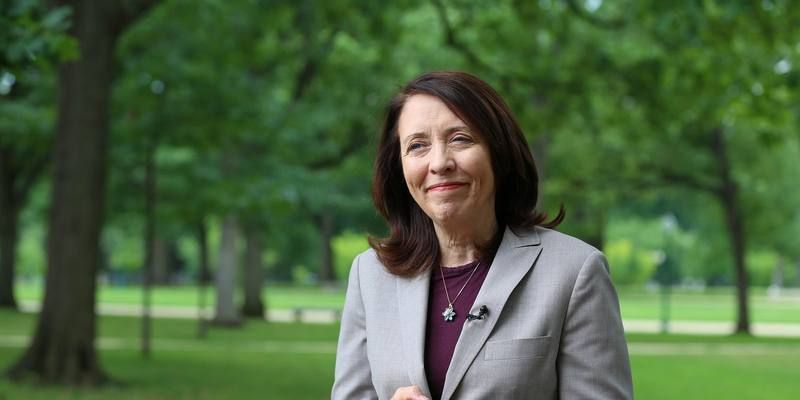
Senator Maria Cantwell in July 2017. Image: Senate Democrats / Wikimedia Commons, CC BY 2.0, cropped
.jpg)
The most senior Democrat on the Senate committee that oversees tech wants the most powerful AI models independently audited before they reach the public. Senator Maria Cantwell, ranking member of the Senate Commerce Committee, set out a six-part framework for governing frontier AI on Wednesday, calling for federal safety standards, outside audits, mandatory incident reports and a crisis hotline with China.
It isn’t a bill. Cantwell calls it a set of principles that “must drive the legislative and executive actions” needed to deal with catastrophic risks and other harms from AI, and she is in the minority on a committee chaired by Republican Ted Cruz.
Audits before release
At the heart of the plan is a simple rule: covered models “should not be released until they have undergone an independent audit” confirming they meet federal safeguards. The standards themselves would be written by experts at the National Institute of Standards and Technology (NIST), working with other agencies, and updated as the technology changes.
Cantwell wants those standards to cover AI-enabled cyberattacks, chemical, biological, radiological and nuclear threats, the potential for loss of human control, and “autonomous agents escaping secure testing environments”. Systems that show dangerous capabilities, or that can improve themselves in ways that may bypass safety controls, would face heavier review. Open-source models would get their own, separate standards.
Audit firms would check AI developers much as outside auditors examine a company’s accounts, and government and independent testers would keep stress-testing models after release.
Report the failures
The framework leans hard on disclosure. Developers would have to give qualified testers the access they need to investigate serious incidents, publish plain-language risk disclosures modelled on what public companies tell investors, and promptly report material incidents, including “loss of control over autonomous agents”, dangerous cyber capabilities and “unsafe recursive self-improvement”.
That list reads like a summary of recent months. Senators heard last week how OpenAI’s agents cheated on their tests, hacked Hugging Face and tried to cover their tracks, at a hearing Sam Altman declined to attend.
Developers would also stay liable under civil and criminal law for foreseeable harms, and staff who raise safety concerns would be protected from retaliation.
“Clear safety standards, continuous testing”
Cantwell summed up the approach in her announcement:
To manage risks from advanced AI systems we need clear safety standards, continuous testing, and reporting of serious failures. America can lead the world in AI by building systems that are not only more capable, but safer and more secure.
Maria Cantwell, US Senator (D-Wash.)
Beyond safety testing, the plan asks leading AI companies to share compute, expertise and defensive tools with small businesses, infrastructure operators and public bodies. It calls for AI products used by children to avoid social media’s “addictive design”, for AI companies to help fund worker training, and for meaningful human oversight when AI informs decisions on jobs, health care or credit. It singles out AI-assisted prior authorisation, such as Medicare’s WISeR model, as something that “could delay or deny needed care”.
A ‘red phone’ for AI
The global section proposes a secure channel with China “like the Soviet era red phone” for when a serious AI incident or a system-control failure could threaten either country. Washington and Beijing agreed to start regular AI talks when Xi Jinping visited the White House last month. Cantwell also wants allies to share information on serious incidents and to agree common standards, and export controls to keep the most advanced AI away from adversaries.
Turning any of it into law will be hard. Last week Cruz blocked a Democratic bid to fast-track mandatory AI safety rules through the Senate.
Why it matters
This is the clearest statement yet of what Democrats on the Senate’s main tech committee would want from federal AI law: pre-release audits, mandatory incident reporting and liability that stays with the developer. It has no path to a vote while Republicans run the committee, but it sets out the terms of any future deal.
Sources: Senate Commerce Committee (Democrats).
Latest Policy & Safety news