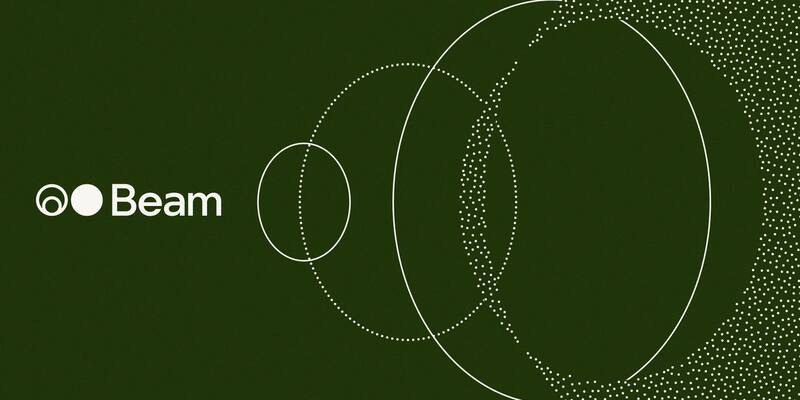
Reflection’s launch artwork for Beam, its first open-weight model (illustrative). Image: Reflection AI
Reflection AI, the Nvidia-backed start-up founded by former Google DeepMind researchers, has released the weights of Beam, a 501 billion-parameter model built for coding and long-running AI agents, free for anyone to download, run and change under an Apache 2.0 licence.
The company first unveiled Beam on October 5 but held the model back for final red-teaming. As of Friday the weights are on Hugging Face, alongside a model card with final benchmarks and a safety technical report. Reflection pitches it as a Western answer to the Chinese open models from Moonshot AI, Zhipu and Alibaba that many developers now build on.
What Beam is
Beam is a mixture-of-experts model: of its 501 billion parameters, only about 23 billion are active for each token, which keeps it cheaper to run than its size suggests. It reads and writes text only, works mainly in English, handles up to 1 million tokens of context and has a knowledge cutoff of June 30, 2026.
Reflection says it pretrained Beam on 23.8 trillion tokens, then ran more than 100 million reinforcement-learning attempts on 10,500 Nvidia GB300 chips over four weeks, which it calls one of the largest such runs by any open lab. The weights come in three precisions (BF16, FP8 and NVFP4). Reflection told VentureBeat the 8-bit and 4-bit versions fit on a single eight-GPU server, while the full version needs tens of GPUs. This is not a laptop model.
How it stacks up
On Reflection’s own model card, Beam scores 81.6% on SWE-bench Verified, a test of fixing real GitHub issues, 80.1% on Terminal-Bench 2.1 and 90.6% on the GPQA Diamond science test. Its October 5 comparison put it level with Zhipu’s GLM-5.2 on most tests and admitted that Moonshot’s Kimi K3 stays ahead on raw ability, for example 88.3% to 80.1% on Terminal-Bench. Reflection’s pitch is efficiency: it says Beam reaches similar answers to GLM-5.2 with three to four times less computing at inference. All of these figures come from Reflection and haven’t been independently checked.
The licence is unusually loose. The model card says Reflection does not prohibit distillation, using Beam’s outputs to train other models, fine-tuning or merging. Beam scored an 88.9% refusal rate on harmful requests in Reflection’s own safety tests, a level of disclosure many Chinese labs skip at launch.
“This is not to say that Chinese models are bad”
Co-founder and chief technology officer Ioannis Antonoglou framed the release as a matter of who American companies depend on, without knocking the rivals. He told VentureBeat:
This is not to say that Chinese models are bad.
Ioannis Antonoglou, co-founder and CTO, Reflection AI
He said Beam will “win on merit rather than on anything else”, but warned that wide use of Chinese models could leave “core pieces of the U.S. economy” dependent on Chinese technology. He also called Nvidia “a close partner and investor in the company” and dismissed reports that Nvidia might buy Reflection as “baseless rumors”.
The release lands the same day China proposed export controls on large AI models, and ten days after Mistral promised its own 1 trillion-parameter open model. Microsoft also said on Friday that its in-house MAI Base 2 beats every open rival it tested.
Where you can use it
Beyond the raw weights, Beam is live at launch on Amazon Web Services, Google Cloud, Microsoft Azure, Cloudflare, Databricks, Together AI, Fireworks AI, Nvidia NIM, Ollama, LM Studio and OpenRouter, among more than 20 platforms, with Dell and HPE offering it for on-premises and air-gapped systems. Reflection’s own API is free during a public beta at platform.reflection.ai. OpenRouter lists Beam at $0.25 per million input tokens and $1 per million output tokens; other providers set their own prices.
Reflection has also open-sourced Mirror, the terminal coding agent it trained Beam alongside, and says Beam works with harnesses such as OpenCode, Nous Research’s Hermes and Pi.
Why it matters
US firms that want a strong open model they can host themselves have mostly had to pick a Chinese one. Beam gives them a large, permissively licensed American alternative, though by Reflection’s own numbers it still trails the best of China’s open models on raw ability.
Sources: Reflection: Beam is now available; Beam model card; Reflection: Introducing Beam; Beam weights on Hugging Face; VentureBeat interview with Ioannis Antonoglou; OpenRouter.
Latest More Labs news