
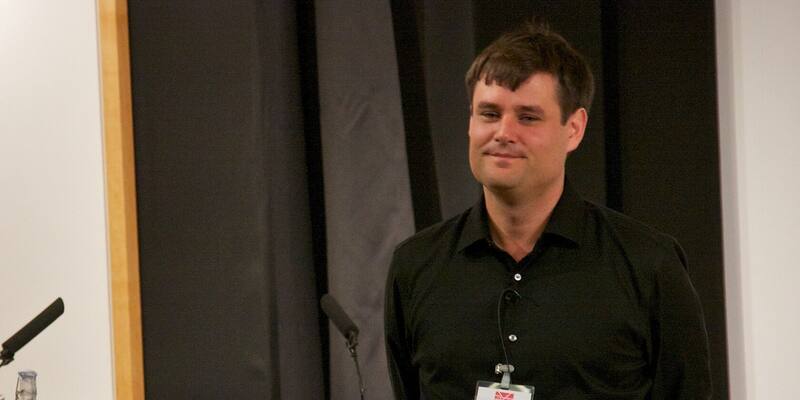
Michael Nielsen speaking at the Science Online London conference in September 2011, while he was writing Neural Networks and Deep Learning. Cropped. Image: Mike Peel (www.mikepeel.net) / Wikimedia Commons, CC BY-SA 4.0, cropped

Michael Nielsen, whose free online book Neural Networks and Deep Learning taught a generation of engineers how modern AI works, has taken it down. In its place is a signed essay saying the “extraordinarily reckless behaviour” of the frontier AI labs means they “are knowingly endangering all of humanity”, and that he no longer wants to help train people for that work.
What happened to the book
Nielsen is a quantum computing pioneer who co-wrote Quantum Computation and Quantum Information, the field’s standard textbook. He wrote the deep learning book between 2011 and 2015 and put it online free, and it became one of the most recommended first stops for anyone learning how neural networks are trained. He announced its removal on X on Friday, and the post passed 1,000 likes within three hours:
I took down my old book on neural nets: neuralnetworksanddeeplearning.com
— Michael Nielsen (@michael_nielsen) November 27, 2026
The book’s address now shows only his essay, dated November 2026. He writes that when he wrote the book he expected systems like these “to be many decades away, but to bring remarkable benefits for humanity”. Now, he says, they “genuinely will bring, indeed, already are bringing, many wonders”, but also “pose a significant risk of catastrophe”. His reason for pulling it is short:
I don’t wish to help (even in a very small way) train people to contribute to this work, and so I’ve taken the book down.
Michael Nielsen, author of Neural Networks and Deep Learning
Why he says he got the timing wrong
In a footnote, Nielsen says his technical bets from 2015 held up, but he “badly misunderstood” how much money would pour in. He expected hundreds of millions, perhaps billions, of dollars by the mid-2020s; instead “hundreds of billions and likely trillions of dollars will soon become available”. He puts his error at “a factor of perhaps 1,000”, which he says has brought human-level and superhuman AI perhaps 15 to 20 years forward.
He also argues that the usual fear, rogue machines slipping out of control, is only part of the problem. The bigger risk, he writes, is AI suddenly unlocking cheap, destructive technologies faster than society can build defences, like all of the 20th century’s dangers, from the atomic bomb to the ozone hole, arriving in 1901. That is why he calls technical “alignment” work at the labs “mostly market-supplied safety”, which makes AI more palatable to buyers and governments and so “speeds development”.
‘Safety theatre’: his case against Anthropic and OpenAI
Most of the essay takes on the argument that it is better for safety-minded people to build AI than to leave it to others. Nielsen says no frontier lab “would come remotely close” to proving it lowers the risk. He cites Anthropic dropping its 2023 Responsible Scaling Policy pledge to pause if safety couldn’t be guaranteed, a retreat critics also raised in the MisAnthropic Statement before its IPO, and says “any promises about the future from Anthropic should be treated as safety theatre, and not trusted”. “Similar criticisms can be made of OpenAI,” he adds.
He quotes Anthropic’s own alignment lead, Evan Hubinger, who put the chance of AI killing all humans at more than 10% within a decade, and the Saturday Night Live sketch in which a fake Dario Amodei urges lawmakers to stop him. His verdict on the real one:
The real Amodei comes across as somebody in the business of selling matches who also believes he should be the fire chief.
Michael Nielsen
He also quotes an October thread by Jason Clinton, Anthropic’s deputy chief information security officer, replying to a critic during major cyber incidents: “yes. it was always going to be this way. we tried to warn the world.” And he notes that Anthropic’s own models have breached outside organisations during testing: three incidents disclosed in July and a fourth in September. In a separate test, an Anthropic model sent Philadelphia police a fake murder tip.
‘Don’t go to work for a frontier lab’
Nielsen grants that AI’s overall impact “to date” has been net positive and that slowing down has a real cost. But he calls joining a frontier lab “one of the worst life choices a person can make” and ends with a direct plea: “don’t go to work for a frontier lab. If you work on AI, work on slowing it down.” He adds: “I very much hope I’m wrong about all of this.”
He joins a string of insiders taking a public stand, from the Google DeepMind engineer who quit because AI was moving too fast to the DeepMind researchers who left over military work. Anthropic and OpenAI haven’t commented on the essay.
Why it matters
Nielsen isn’t a lab employee resigning; he is one of the people who taught the field its basics, and he has withdrawn that teaching as a protest. His argument, that safety work at the labs mostly speeds up the race, goes further than most critics, and it is aimed squarely at the engineers the labs most want to hire.
Sources: Michael Nielsen, Neural Networks and Deep Learning (book site, now his November 2026 essay), Michael Nielsen on X.
Latest Anthropic news